I mumbled something about how it was easy to calculate e to any power using that series (you just substitute the power for x). “Oh yeah?” they said, … - Richard Feynman
""
I mumbled something about how it was easy to calculate e to any power using that series (you just substitute the power for x). “Oh yeah?” they said, “Well, then, what’s e to the 3.3?” said some joker — I think it was Tukey. I say, “That’s easy. It’s 27.11.” Tukey knows it isn’t so easy to compute all that in your head. “Hey! How’d you do that?” Another guy says, “You know Feynman, he’s just faking it. It’s not really right.” They go to get a table, and while they’re doing that, I put on a few more figures: “27.1126,” I say. They find it in the table. “It’s right! But how’d you do it!” “I just summed the series.” “Nobody can sum the series that fast. You must just happen to know that one. How about e to the 3?” “Look,” I say. “It’s hard work! Only one a day!” “Hah! It’s a fake!” they say, happily. “All right,” I say, “It’s 20.085.
Richard Phillips Feynman (May 11, 1918 – February 15, 1988) was an American theoretical physicist. He is known for the work he did in the path integral formulation of quantum mechanics, the theory of quantum electrodynamics, the physics of the superfluidity of supercooled liquid helium, and in particle physics, for which he proposed the parton model. For his contributions to the development of quantum electrodynamics, Feynman received the Nobel Prize in Physics in 1965 jointly with Julian Schwinger and Shin'ichirō Tomonaga. Feynman developed a widely used pictorial representation scheme for the mathematical expressions describing the behavior of subatomic particles, which later became known as Feynman diagrams. During his lifetime, Feynman became one of the best-known scientists in the world.
Biography information from
Wikiquote·
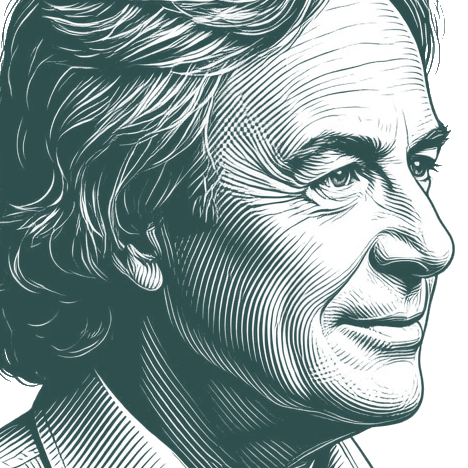
Portrait adapted from
Wikimedia Commons, Copyright Tamiko Thiel 1984 (CC BY-SA)
Also Known As
Pen Names:
Ofey
Native Name:
Richard Phillips Feynman
Alternative Names:
Feynman
•
Dick Feynman
•
Richard P. Feynman
I’m not responsible for what other people think I am able to do; I don’t have to be good because they think I’m going to be good.
So I have just one wish for you—the good luck to be somewhere where you are free to maintain the kind of integrity I have described, and where you do not feel forced by a need to maintain your position in the organization, or financial support, or so on, to lose your integrity. May you have that freedom.
We are at the very beginning of time for the human race. It is not unreasonable that we grapple with problems. But there are tens of thousands of years in the future. Our responsibility is to do what we can, learn what we can, improve the solutions, and pass them on. It is our responsibility to leave the people of the future a free hand. In the impetuous youth of humanity, we can make grave errors that can stunt our growth for a long time. This we will do if we say we have the answers now, so young and ignorant as we are. If we suppress all discussion, all criticism, proclaiming “This is the answer, my friends; man is saved!” we will doom humanity for a long time to the chains of authority, confined to the limits of our present imagination. It has been done so many times before. It is our responsibility as scientists, knowing the great progress which comes from a satisfactory philosophy of ignorance, the great progress which is the fruit of freedom of thought, to proclaim the value of this freedom; to teach how doubt is not to be feared but welcomed and discussed; and to demand this freedom as our duty to all coming generations.