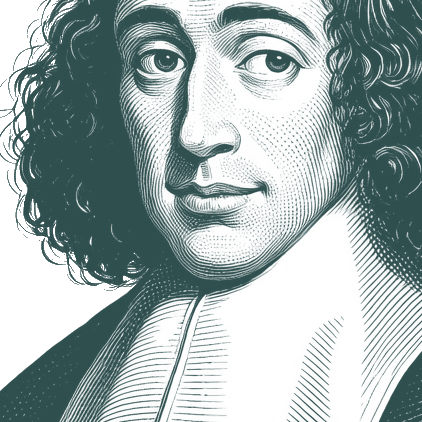
Offer with me reverently a tribute to the manes of the holy, rejected Spinoza. The high World-Spirit pervaded him; the Infinite was his beginning and… - Benedictus de Spinoza
""
Offer with me reverently a tribute to the manes of the holy, rejected Spinoza. The high World-Spirit pervaded him; the Infinite was his beginning and his end; the Universe was his only and his everlasting love. In holy innocence and in deep humility he beheld himself mirrored in the eternal world, and perceived how he also was its most worthy mirror. He was full of religion, full of the Holy Spirit. Wherefore, he stands there alone and unequalled; master in his art, yet without disciples and without citizenship, sublime above the profane tribe.
Benedictus de Spinoza (24 November 1632 – 21 February 1677) was a social and metaphysical philosopher known for the elaborate development of his monist philosophy, which has become known as Spinozism. Controversy regarding his ideas led to his excommunication from the Jewish community of his native Amsterdam. He was named Baruch ("blessed" in Hebrew) Spinoza by his synagogue elders and known as Bento de Spinoza or Bento d'Espiñoza, but afterwards used the name Benedictus ("blessed" in Latin) de Spinoza.
Native Name:
בָּרוּךְ שְׂפִּינוֹזָה
•
Benedito de Espinosa
Alternative Names:
Benedict de Spinoza
•
Baruch de Espinosa
•
Barukh Shpinozah
•
Benoît de Spinoza
•
Sbīnūzā
•
Ispīnūzā
•
Barukh Spinoza
•
Bento de Espinosa
•
Baruch d' Espinoza
•
Shpinozah
•
Baruch de Spinoza
•
Spinoza
•
Benoit de Spinoza
•
Benedictus De Spinoza
•
Benedictus Spinoza
•
Baruch Spinoza
•
Baruch Benedictus de Spinoza
لقد أُوحيَت كلُّ المقاييس إلى سُليمان بوسائل على مُستوى فَهْمِه وطبقًا لآرائه؛ ذلك لأنه، نظرًا إلى أننا غير مُلزَمين بالاعتقاد بأنَّ سليمان كان رياضيًّا، فمن حقِّنا أن نؤكِّد أنه كان يجهَلُ نِسبة مُحيط الدائرة إلى قُطرها، وكان يظنُّ مع جمهرة العُمَّال أنها نسبة ٣ إلى ١، فإذا قيل إنَّنا لم نفهم نصَّ سِفر الملوك (٧: ٢٣) فإني لا أعلم، في الحق، ماذا يُمكننا أن نفهم من الكتاب؛ ذلك لأنَّ ما ورَد في هذا الموضع كان مُجرَّد وصفٍ للبناء، وعلى نحوٍ تاريخي مَحْض. أمَّا إذا اعتقَدَ أحدٌ أنه يستطيع افتراضَ قصْدٍ آخر للكِتاب لم يُصرَّح به لسبب نجهله، فإنَّ هذا أمرٌ لا يترتَّب عليه أقلُّ من أن نقلِبَ الكتاب بأسره رأسًا على عقب
I now want, much more briefly, to take another path across my essays in order to look at another group of theses developed there on the question of "knowledge". I cannot hide the fact that in this matter I depended heavily on Spinoza. I said a moment ago that Marx was close to Hegel in his critique of the idea of a theory of knowledge. But this Hegelian critique is already present in Spinoza. What does Spinoza in fact mean when he writes, in a famous phrase, "Habemus enim ideam veram..."? That we have a true idea? No: the weight of the phrase lies on the "enim". It is in fact because and only because we have a true idea that we can produce others, according to its norm. And it is in fact because and only because we have a true idea that we can know that it is true, because it is "index sui". Where does this true idea come from? That is quite a different question. But it is a fact that we do have it (habemus), and whatever it may be that produces this result, it governs everything that can be said about it and derived from it. Thus Spinoza in advance makes every theory of knowledge, which reasons about the justification of knowledge, dependent on the fact of the knowledge which we already possess. And so every question of the Origin, Subject and Justification of knowledge, which lie at the root of all theories of knowledge, is rejected. But that does not prevent Spinoza from talking about knowledge: not in order to understand its Origin, Subject and Justification, but in order to determine the process and its moments, the famous "three levels", which moreover appear very strange when you look at them close up, because the first is properly the lived world, and the last is specially suited to grasping the "singular essence" -- or what Hegel would in his language call the "universal concrete" -- of the Jewish people, which is heretically treated in the Theologico-Political Treatise. I am sorry if some people consider, apparently out of theoretical opportunism, that I thus fall into a heresy, but I would say that Marx -- not only the Marx of the 1857 Introduction, which in fact opposes Hegel through Spinoza, but the Marx of Capital, together with Lenin -- is in fact on close terms with Spinoza's positions.
...But I was indeed on Spinoza's "line" by insisting with Marx and Hegel on the distinction between the "real concrete," therefore, the universal singular (all the "cases" that constitute the world from the beginning of knowledge of the first kind), and the concrete-in-thought that constitutes knowledge of the third kind.