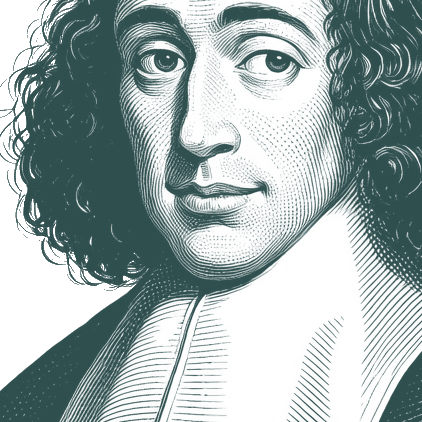
...Spinoza hit the nail on the head with his paradoxical proposition: God is an extended, that is, material being. He found, at least for his time, t… - Benedictus de Spinoza
""
...Spinoza hit the nail on the head with his paradoxical proposition: God is an extended, that is, material being. He found, at least for his time, the true philosophical expression for the materialistic tendency of the modern era; he legitimated and sanctioned it: God himself is a materialist. Spinoza's philosophy was religion; he himself was an amazing man. Unlike so many others, Spinoza's materialism did not stand in contradiction to the notion of a non-material and anti-materialistic God who also quite consistently imposes on man the duty to give himself up only to anti-materialistic, heavenly tendencies and concerns, for God is nothing other than the archetypal and ideal image of man; what God is and how he is, is what man ought to be or wants to be, or at least hopes to be in the future. But only where theory does not belie practice, and practice theory, is there character, truth, and religion. Spinoza is the Moses of modern free-thinkers and materialists.
Benedictus de Spinoza (24 November 1632 – 21 February 1677) was a social and metaphysical philosopher known for the elaborate development of his monist philosophy, which has become known as Spinozism. Controversy regarding his ideas led to his excommunication from the Jewish community of his native Amsterdam. He was named Baruch ("blessed" in Hebrew) Spinoza by his synagogue elders and known as Bento de Spinoza or Bento d'Espiñoza, but afterwards used the name Benedictus ("blessed" in Latin) de Spinoza.
Native Name:
בָּרוּךְ שְׂפִּינוֹזָה
•
Benedito de Espinosa
Alternative Names:
Benedict de Spinoza
•
Baruch de Espinosa
•
Barukh Shpinozah
•
Benoît de Spinoza
•
Sbīnūzā
•
Ispīnūzā
•
Barukh Spinoza
•
Bento de Espinosa
•
Baruch d' Espinoza
•
Shpinozah
•
Baruch de Spinoza
•
Spinoza
•
Benoit de Spinoza
•
Benedictus De Spinoza
•
Benedictus Spinoza
•
Baruch Spinoza
•
Baruch Benedictus de Spinoza
SOCIEDAD (civitas, respublica, multitudo) Surge de la composición — mediante pacto — de las potencias individuales, en aras de la común utilidad y del apetecido beneficio para todos (TP 2 y 3), y se generaliza como que nada hay más útil que el hombre para el hombre,
Spinoza's thought is completely idealistic when it is presented as negative thought, when it develops the bourgeois utopia, living it in the extreme, abstract consequences of its spiritual idyll; it is, in contrast, completely materialistic as soon as it is reassembled in a constructive way, inverting the impossibility of an ideal world in the materialistic tension of its components and embracing these in a practical project, in a violent dynamism of worldly liberation. "Benedictus maledictus": never has a philosopher been more rightly hated by his times, a bourgeois and capitalist epoch.
It will be said that, although God’s law is inscribed in our hearts, Scripture is nevertheless the Word of God, and it is no more permissible to say of Scripture that it is mutilated and contaminated than to say this of God’s Word. In reply, I have to say that such objectors are carrying their piety too far, and are turning religion into superstition; indeed, instead of God’s Word they are beginning to worship likenesses and images, that is, paper and ink.