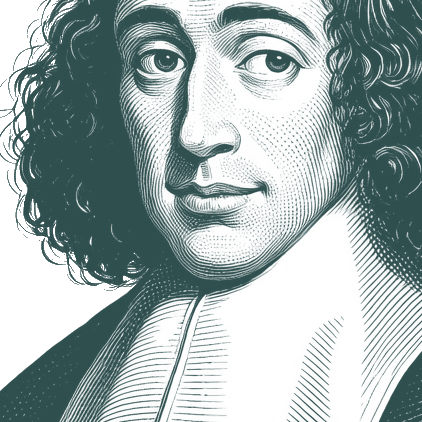
Happiness is not the reward of virtue, but is virtue itself; nor do we delight in happiness because we restrain from our lusts; but on the contrary, … - Benedictus de Spinoza
""
Happiness is not the reward of virtue, but is virtue itself; nor do we delight in happiness because we restrain from our lusts; but on the contrary, because we delight in it, therefore we are able to restrain them.
Benedictus de Spinoza (24 November 1632 – 21 February 1677) was a social and metaphysical philosopher known for the elaborate development of his monist philosophy, which has become known as Spinozism. Controversy regarding his ideas led to his excommunication from the Jewish community of his native Amsterdam. He was named Baruch ("blessed" in Hebrew) Spinoza by his synagogue elders and known as Bento de Spinoza or Bento d'Espiñoza, but afterwards used the name Benedictus ("blessed" in Latin) de Spinoza.
Native Name:
בָּרוּךְ שְׂפִּינוֹזָה
•
Benedito de Espinosa
Alternative Names:
Benedict de Spinoza
•
Baruch de Espinosa
•
Barukh Shpinozah
•
Benoît de Spinoza
•
Sbīnūzā
•
Ispīnūzā
•
Barukh Spinoza
•
Bento de Espinosa
•
Baruch d' Espinoza
•
Shpinozah
•
Baruch de Spinoza
•
Spinoza
•
Benoit de Spinoza
•
Benedictus De Spinoza
•
Benedictus Spinoza
•
Baruch Spinoza
•
Baruch Benedictus de Spinoza
Even in the case of philosophers who give systematic form to their work, Spinoza for instance, the true inner structure of the system is quite unlike the form in which it was consciously presented by him.
All laws which can be broken without any injury to another, are counted but a laughing-stock, and are so far from bridling the desires and lusts of men, that on the contrary they stimulate them.
Try QuoteGPT
Chat naturally about what you need. Each answer links back to real quotes with citations.
Only in relation to our imagination can things be called beautiful or ugly, well-ordered or confused