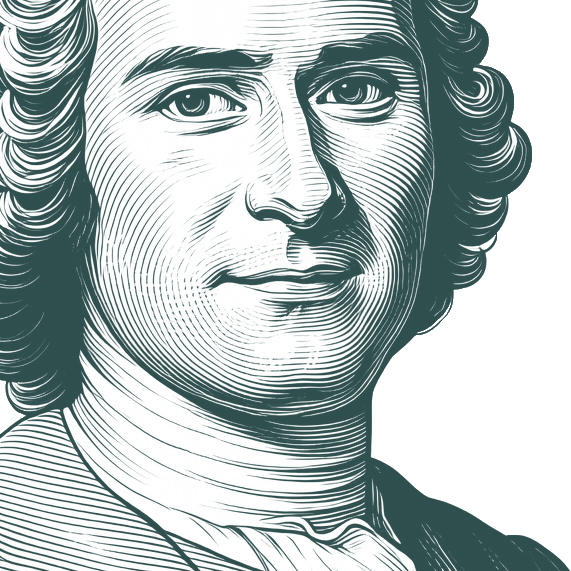
" The spectacle of nature, by growing quite familiar to him, becomes at last equally indifferent. It is constantly the same order, constantly the sam… - Jean-Jacques Rousseau
" The spectacle of nature, by growing quite familiar to him, becomes at last equally indifferent. It is constantly the same order, constantly the same revolutions; he has not sense enough to feel surprise at the sight of the greatest wonders; and it is not in his mind we must look for that philosophy, which man must have to know how to observe once, what he has every day seen." Jean Jacques Rousseau, On the Inequality among Mankind, Ch. 1, 20.
Jean-Jacques Rousseau (June 28, 1712 – July 2, 1778) was a major French-speaking Genevan philosopher of Enlightenment whose political ideas influenced the French Revolution, the development of socialist theory, and the growth of nationalism.
Biography information from
Wikiquote·
Portrait adapted from
Wikimedia Commons, Maurice Quentin de La Tour (Public domain / CC0)
Also Known As
Alternative Names:
Citizen of Geneva
•
Jean Jacques Rousseau
•
J. J. Rousseau
•
Rousseau
•
J.J. Rousseau
•
JJ Rousseau
Everything is good as it leaves the hands of the Author of things; everything degenerates in the hands of man. He forces one soil to nourish the products of another, one tree to bear the fruit of another. He mixes and confuses the climates, the elements, the seasons. He mutilates his dog, his horse, his slave. He turns everything upside down; he disfigures everything; he loves deformity, monsters. He wants nothing as nature made it, not even man; for him, man must be trained like a school horse; man must be fashioned in keeping with his fancy like a tree in his garden
La ambición de los poderosos aprovechó estas circunstancias para perpetuar sus cargos en sus familias; el pueblo, habituado ya a la dependencia, al reposo y a las comodidades de la vida, y lejos así mismo de estar en situación de poder romper sus cadenas, consintió en el aumento de su servidumbre como medio de asegurar su tranquilidad; y así es como los jefes, que llegaron a ser hereditarios, se acostumbraron a mirar su magistratura como un caudal de familia, a considerarse ellos mismos propietarios del Estado, del cual no eran, ciertamente, más que funcionarios; a llamar esclavos a sus conciudadanos; a contarlos, como a rebaños, entre el número de las cosas de su propiedad, y a llamarse a sí mismos iguales a los dioses y reyes de los reyes.
Si seguimos el progreso de la desigualdad en estas diferentes evoluciones, hallaremos que su primera causa fue la constitución de la ley y del derecho de propiedad; la institución de la magistratura, la segunda; y la tercera y última, el cambio de poder legítimo en poder arbitrario.
Hayır. Çünkü öğrencime verdiğim özgürlük onu karşı karşıya bıraktığım kimi önemsiz rahatsızlıkları rahat rahat giderir. Karda mosmor kesilmiş, çok üşümüş, parmaklarını ancak oynatabilir durumda oynayan yumurcaklar görüyorum. Gidip ısınmak ellerinde, ama hiç aldırış ettikleri yok; buna zorlansalar, zorlanmanın sıkıntılarını soğuğun sıkıntılarından yüz kez daha çok hissederlerdi. Öyleyse neden yakınıyorsunuz? Çocuğunuzu seve seve katlanmak istediği rahatsızlıklarla karşı karşıya bırakarak mutsuz mu kılacağım? Onu şimdi özgür bırakarak ona iyilik yapıyorum; katlanması gereken kötülüklere karşı donatarak ona gelecek için iyilik yapıyorum. Benim öğrencim ya da sizin öğrenciniz olmayı seçmek elinde olsaydı, sanıyor musunuz ki bir an duraksardı?