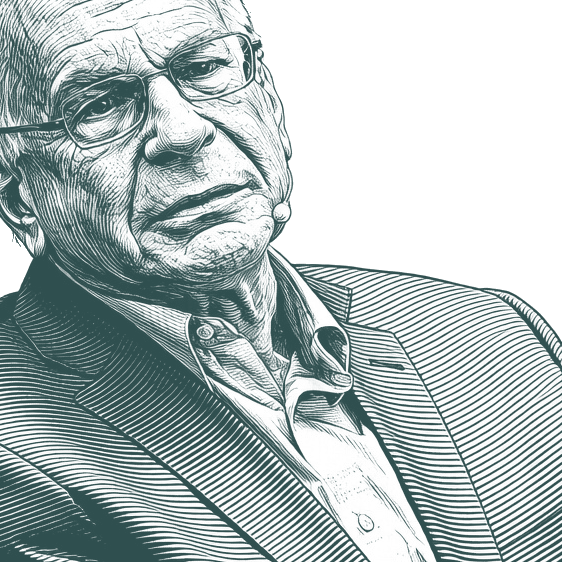
The often-used phrase “pay attention” is apt: you dispose of a limited budget of attention that you can allocate to activities, and if you try to you… - Daniel Kahneman
""
The often-used phrase “pay attention” is apt: you dispose of a limited budget of attention that you can allocate to activities, and if you try to you try to go beyond your budget, you will fail.
Daniel Kahneman (March 5, 1934 – March 27, 2024) was an Israeli-American psychologist. He shared the 2002 Nobel Memorial Prize in Economic Sciences with Vernon L. Smith. Kahneman is notable for his work on the psychology of judgment and decision-making, behavioral economics and hedonic psychology. Latterly, he was professor emeritus of psychology and public affairs at Princeton University's Woodrow Wilson School.
People tend to assess the relative importance of issues by the ease with which they are retrieved from memory — and this is largely determined by the extent of coverage in the media. Frequently mentioned topics populate the mind even as others slip away from awareness.
Most of us view the world as more benign than it really is, our own attributes as more favorable than they truly are, and the goals we adopt as more achievable than they are likely to be. We also tend to exaggerate our ability to forecast the future, which fosters overconfidence. In terms of its consequences for decisions, the optimistic bias may well be the most significant cognitive bias. Because optimistic bias is both a blessing and a risk, you should be both happy and wary if you are temperamentally optimistic.
Go Premium
Support Quotewise while enjoying an ad-free experience and premium features.
We all have a need for the reassuring message that actions have appropriate consequences, and that success will reward wisdom and courage. Many business books are tailor-made to satisfy this need.