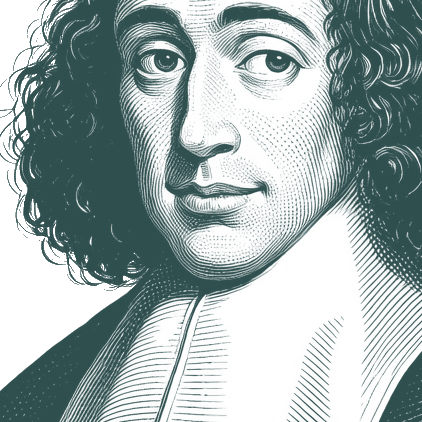
Spinoza's true politics is his metaphysics. Against the potentialities of this metaphysics, the polemic of bourgeois thought and all the mystificator… - Benedictus de Spinoza

" "

Spinoza's true politics is his metaphysics. Against the potentialities of this metaphysics, the polemic of bourgeois thought and all the mystificatory attempts that go under the emblem of "Spinozism" discharge their weapons. But Spinoza's metaphysics is articulated in his political discourse, and some of its potentialities are developed specifically in this field. Here we must try to identify them.

English
Collect this quote

About Benedictus de Spinoza

Benedictus de Spinoza (24 November 1632 – 21 February 1677) was a social and metaphysical philosopher known for the elaborate development of his monist philosophy, which has become known as Spinozism. Controversy regarding his ideas led to his excommunication from the Jewish community of his native Amsterdam. He was named Baruch ("blessed" in Hebrew) Spinoza by his synagogue elders and known as Bento de Spinoza or Bento d'Espiñoza, but afterwards used the name Benedictus ("blessed" in Latin) de Spinoza.

Biography information from Wikiquote

Also Known As

Native Name: בָּרוּךְ שְׂפִּינוֹזָה Benedito de Espinosa
Alternative Names: Benedict de Spinoza Baruch de Espinosa Barukh Shpinozah Benoît de Spinoza Sbīnūzā Ispīnūzā Barukh Spinoza Bento de Espinosa Baruch d' Espinoza Shpinozah Baruch de Spinoza Spinoza Benoit de Spinoza Benedictus De Spinoza Benedictus Spinoza Baruch Spinoza Baruch Benedictus de Spinoza
Go Premium

Support Quotewise while enjoying an ad-free experience and premium features.

View Plans

Related quotes. More quotes will automatically load as you scroll down, or you can use the load more buttons.

Additional quotes by Benedictus de Spinoza

For many years I did not dare look into a Latin author or at anything which evoked an image of Italy. If this happened by chance, I suffered agonies. Herder often used to say mockingly that I had learned all my Latin from Spinoza, for that was the only Latin book he had ever seen me reading. He did not realize how carefully I had to guard myself against the classics, and that it was sheer anxiety which drove me to take refuge in the abstractions of Spinoza. [Original in German: Schon einige Jahre her durft' ich keinen lateinischen Autor ansehen, nichts betrachten, was mir ein Bild Italiens erneute. Geschah es zufällig, so erduldete ich die entsetzlichsten Schmerzen. Herder spottete oft über mich, daß ich all mein Latein aus dem Spinoza lerne, denn er hatte bemerkt, daß dies das einzige lateinische Buch war, das ich las; er wußte aber nicht, wie sehr ich mich vor den Alten hüten mußte, wie ich mich in jene abstrusen Allgemeinheiten nur ängstlich flüchtete.]

Nothing is more absurd than ownership claimed for ideas. Hegel did, to be sure, use many of Schelling's ideas for his philosophy, but Mr. Schelling would never have known what to do with these ideas anyway. He always just philosophized, but was never able to produce a philosophy. And besides, one could certainly maintain that Mr. Schelling borrowed more from Spinoza than Hegel borrowed from Schelling. If Spinoza is some day liberated from his rigid, antiquated Cartesian, mathematical form and made accessible to a large public, we shall perhaps see that he, more than any other, might complain about the theft of ideas. All our present‑day philosophers, possibly without knowing it, look through glasses that Baruch Spinoza ground.

Limited Time Offer

Premium members can get their quote collection automatically imported into their Quotewise collections.

...No other thinker was considered to have systematized ‘atheism’ so as to turn it into a working philosophy to the same extent or as effectively as Spinoza. If there were, and had long been, many, philosophical ‘atheists’ publicly condemned as such, stretching back, via Vanini, to Epicurus and Lucretius, “je crois qu’il [i.e. Spinoza] est le premier,” writes Bayle in his Dictionnaire, “qui ait réduit en système l’athéisme, et qui en ait fait un corps de doctrine lié et tissu selon les manières des geomètres…”, a pronouncement that itself became immensely influential through the rest of the Enlightenment. As the Cambridge don, Brampton Gurdon (d.1741), son of a Suffolk gentleman and member of Parliament, expressed this point (following Bayle), in 1723, “Spinoza is the only person among the modern Atheists, that has pretended to give us a regular scheme of Atheism, and therefore I cannot act unfairly in making him the representative of their party, and in proving the weakness and absurdities of the atheistick scheme, by shewing the faults of his.” Criticism of the existing order of things using ‘atheistic’ ideas as a tool to demolish accepted thinking long remained the exclusive speciality of a forbidden ‘underground’ philosophy associated with Spinoza’s name rather than any other.

Loading...