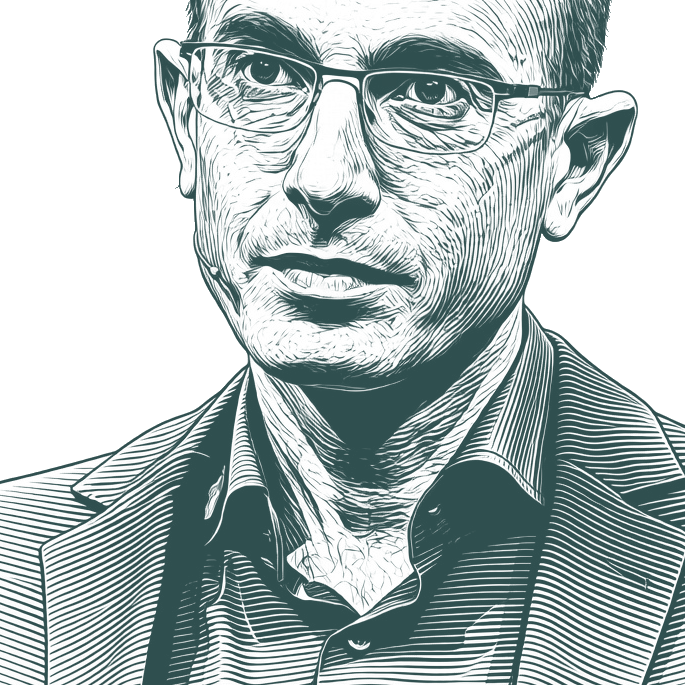
There is some evidence that the size of the average Sapiens brain has actually decreased since the age of foraging.5 Survival in that era required su… - Yuval Noah Harari
""
There is some evidence that the size of the average Sapiens brain has actually decreased since the age of foraging.5 Survival in that era required superb mental abilities from everyone. When agriculture and industry came along people could increasingly rely on the skills of others for survival, and new ‘niches for imbeciles’ were opened up. You could survive and pass your unremarkable genes to the next generation by working as a water carrier or an assembly-line worker.
English
Collect this quote
About
Yuval Noah Harari
Yuval Noah Harari (Hebrew: יובל נח הררי; born 24 February 1976) is an Israeli professor of history at the Hebrew University of Jerusalem and the author of Sapiens: A Brief History of Humankind.
As Nietzsche put it, if you have a why to live, you can bear almost any how. A meaningful life can be extremely satisfying even in the midst of hardship, whereas a meaningless life is a terrible ordeal no matter how comfortable it is. Though
Centuries ago human knowledge increased slowly, so politics and economics changed at a leisurely pace too. Today our knowledge is increasing at breakneck speed, and theoretically we should understand the world better and better. But the very opposite is happening. Our new-found knowledge leads to faster economic, social and political changes; in an attempt to understand what is happening, we accelerate the accumulation of knowledge, which leads only to faster and greater upheavals. Consequently we are less and less able to make sense of the present or forecast the future. In 1016 it was relatively easy to predict how Europe would look in 1050. Sure, dynasties might fall, unknown raiders might invade, and natural disasters might strike; yet it was clear that in 1050 Europe would still be ruled by kings and priests, that it would be an agricultural society, that most of its inhabitants would be peasants, and that it would continue to suffer greatly from famines, plagues and wars. In contrast, in 2016 we have no idea how Europe will look in 2050. We cannot say what kind of political system it will have, how its job market will be structured, or even what kind of bodies its inhabitants will possess.
According to the Buddha, then, life has no meaning, and people don’t need to create any meaning. They just need to realise that there is no meaning, and thus be liberated from the suffering caused by our attachments and our identification with empty phenomena.