Horror and doubt distract
His troubled thoughts and from the bottom stir
The Hell within him, for within him Hell
He brings and round about him, nor … - John Milton
""
Horror and doubt distract His troubled thoughts and from the bottom stir The Hell within him, for within him Hell He brings and round about him, nor from Hell One step no more than from himself can fly By change of place.
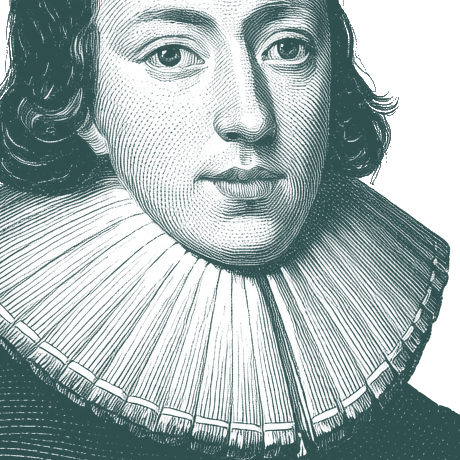
John Milton (9 December 1608 – 8 November 1674) was an English poet, polemicist, man of letters, and a civil servant for the Commonwealth of England under Oliver Cromwell. He wrote at a time of religious flux and political upheaval, and is most famous for his epic poem Paradise Lost (1667), written in blank verse.
Sweet is the breath of morn, her rising sweet, With charm of earliest birds; pleasant the sun, When first on this delightful land he spreads His orient beams, on herb, tree, fruit and flower, Glistening with dew; fragrant the fertile earth After soft showers, and sweet the coming on of grateful Evening mild; the silent Night, With this her solumn bird and hisfair Moon, And these the gems of Heaven, their starry train; But neither breath of morn nor rising sun On this delightful land, nor herb, fruit, flower Glistening with dew, nor fragrance after shower, Nor grateful Evening mild, nor silent Night, With this her solumn bird, nor walk by Moon, Or glittering starlight, without thee is sweet
How soon hath Time, the subtle thief of youth, Stol'n on his wing my three-and-twentieth year!
Unlimited Quote Collections
Organize your favorite quotes without limits. Create themed collections for every occasion with Premium.
We boast our light; but if we look not wisely on the run itself, it smites us into darkness. Who can discern those planets that are oft combust, and those starts of brightest magnitude that rise and set with the sun, until the opposite motion of their orbs bring them to such a place in the firmament where they may be seen evening or morning? The light which we have gained was given us, not to be ever staring on, but by it to discover onward things more remote from our knowledge.