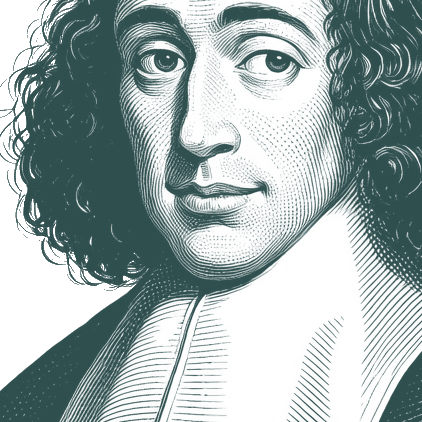
I also believe that Spinoza, like Nietzsche and Schopenhauer, on whose lives and philosophy I have based two earlier novels, wrote much that is highl… - Benedictus de Spinoza
""
I also believe that Spinoza, like Nietzsche and Schopenhauer, on whose lives and philosophy I have based two earlier novels, wrote much that is highly relevant to my field of psychiatry and psychotherapy—for example, that ideas, thoughts, and feelings are caused by previous experiences, that passions may be studied dispassionately, that understanding leads to transcendence—and I wished to celebrate his contributions through a novel of ideas.
Benedictus de Spinoza (24 November 1632 – 21 February 1677) was a social and metaphysical philosopher known for the elaborate development of his monist philosophy, which has become known as Spinozism. Controversy regarding his ideas led to his excommunication from the Jewish community of his native Amsterdam. He was named Baruch ("blessed" in Hebrew) Spinoza by his synagogue elders and known as Bento de Spinoza or Bento d'Espiñoza, but afterwards used the name Benedictus ("blessed" in Latin) de Spinoza.
Native Name:
בָּרוּךְ שְׂפִּינוֹזָה
•
Benedito de Espinosa
Alternative Names:
Benedict de Spinoza
•
Baruch de Espinosa
•
Barukh Shpinozah
•
Benoît de Spinoza
•
Sbīnūzā
•
Ispīnūzā
•
Barukh Spinoza
•
Bento de Espinosa
•
Baruch d' Espinoza
•
Shpinozah
•
Baruch de Spinoza
•
Spinoza
•
Benoit de Spinoza
•
Benedictus De Spinoza
•
Benedictus Spinoza
•
Baruch Spinoza
•
Baruch Benedictus de Spinoza
Through the seventeenth and eighteenth centuries, Bruno's ideas were widely imparted, borrowed, sounded ; almost never, though, with the name Giordano Bruno attached to them. Kepler once chided Galileo for omitting his debt to Bruno ; yet, we can discern Kepler's own indifference … Later generations would evoke Bruno's writings to the phrase, without quoting or acknowledging him. Recent scholarship on Spinoza, for example, cites Bruno's powerful exertion on his thought about infinity and on his style. Never does Spinoza cite Bruno by name.
The philosopher Spinoza likened our existence to that of a cell in the bloodstream: the lone cell would be unaware of the fact that it is merely a part of a greater whole.
Enhance Your Quote Experience
Enjoy ad-free browsing, unlimited collections, and advanced search features with Premium.
The philosophy of a purely theoretical thinker, who contemplates all things from the point of view of things in themselves, belongs in the same class as the attempt to apply abstract thought to the entire field of consciousness without meeting any byways or stops. Look at Baruch Spinoza, that true hero of thought, who studied in his own person the way in which the emotions and passions, as expressions of his internal mechanism, transform themselves for him into objects of geometrical analysis! In the meantime, until the heroism of Baruch Spinoza shall become the matter-of-fact virtue of everyday life in the higher developed humanity of the future, and until myths, poetry, metaphysics and religion shall no longer overshadow the field of consciousness, let us be content that up to now, and for the present, philosophy in its differentiated and its improved sense has served, and serves, as a critical instrument and helps science to keep its formal methods and logical processes clear; that it helps us in our lives to reduce the obstacles, which the fantastic projections of the emotions, passions, fears and hopes pile in the way of free thought; that it helps and serves, as Spinoza himself would say, to vanquish imaginationem et ignorantiam.