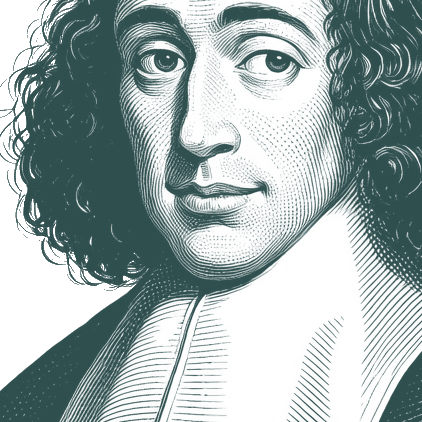
[Jérome Skalski's question: Wasn't Spinoza also a thinker of radical democracy? Philosophically, was Althusserian Marxism also a return to Spinoza?] … - Benedictus de Spinoza
""
[Jérome Skalski's question: Wasn't Spinoza also a thinker of radical democracy? Philosophically, was Althusserian Marxism also a return to Spinoza?] Althusser admired the Spinoza of the Theological-Political Treatise, but that was not the aspect that interested him the most. You are absolutely right to say that Spinoza's thought is a radically democratic thought. This is a dimension that has come to the forefront for a while now, and which has been appropriated by a broad variety of philosophers some of whom effectively come from a Marxist background. However, this was not the aspect or dimension that interested Althusser. Not because he was hostile towards it, but because he fundamentally thought that radical democracy was a transition, an intermediary stage towards the dictatorship of the proletariat. From this point of view, he was a very orthodox Marxist. The dimension that he emphasized in Spinoza concerned the theory of ideology. With Spinoza, there is the first great materialist critique of ideology. Althusser defended a paradoxical thesis. I understand that it forcefully shocked many Marxists at the time but, on the other hand, it was very attractive to certain people among us. This idea was that the concept of ideology was the fundamental aspect of Marx's theoretical revolution: not only the critique of bourgeois ideology, but the critique of ideology in general. To Althusser, this also appeared to be an important point within the debates internal to Communism at the time, in that it was dominated by the ideological complex he called humanism and economism. He thought that the Marxist tradition was weak on the question of ideology and that Marx, even if he possessed the genius to invent the concept, had had a very bad analysis of it. In Spinoza, he found the elements for a materialist theory of ideology that was neither Feuerbachian or Hegelian, and was not attached to a philosophy of history or to the concept of an alienation of man or a human essence. All of this paired very well with what was called Althusser’s scientism, such as it was expressed in the idea of the epistemological break and led to his proximity with structuralism. Althusser quickly criticized these positions in his Elements of Self-Criticism.
English
Collect this quote
About
Benedictus de Spinoza
Benedictus de Spinoza (24 November 1632 – 21 February 1677) was a social and metaphysical philosopher known for the elaborate development of his monist philosophy, which has become known as Spinozism. Controversy regarding his ideas led to his excommunication from the Jewish community of his native Amsterdam. He was named Baruch ("blessed" in Hebrew) Spinoza by his synagogue elders and known as Bento de Spinoza or Bento d'Espiñoza, but afterwards used the name Benedictus ("blessed" in Latin) de Spinoza.
Native Name:
בָּרוּךְ שְׂפִּינוֹזָה
•
Benedito de Espinosa
Alternative Names:
Benedict de Spinoza
•
Baruch de Espinosa
•
Barukh Shpinozah
•
Benoît de Spinoza
•
Sbīnūzā
•
Ispīnūzā
•
Barukh Spinoza
•
Bento de Espinosa
•
Baruch d' Espinoza
•
Shpinozah
•
Baruch de Spinoza
•
Spinoza
•
Benoit de Spinoza
•
Benedictus De Spinoza
•
Benedictus Spinoza
•
Baruch Spinoza
•
Baruch Benedictus de Spinoza
There is no place in Spinoza's system for a sense of mystery in the face of nature. Such an attitude is to be dispelled by the intelligibility of things. Religious wonder is bred by ignorance, he believes. Spinoza contrasts the person who "is eager, like an educated man, to understand natural things" with the person who "wonders at them, like a fool". For Spinoza, anyone who would approach nature with the kind of worshipful awe usually demanded by the religious attitude represents the latter. By definition, and in substance, pantheism is not atheism. And Spinoza is an atheist.
Spinoza would not tolerate restrictions, imposed by any political or religious system or by any moral attitude. He struggled for the ideal of free thought. Hardly any other philosopher made so many enemies. He was labelled ‘a troublemaking Jew’, banned from the synagogue and from the academic establishment. Even his pupils would acknowledge him in private. And when Karl Ludwig asked the impoverished lonely philosopher to lecture at the University of Heidelberg, he turned him down. Spinoza could not guarantee that his thinking would not threaten ‘widely accepted religious concepts’. The philosopher in him preferred the quiet retiring life to a bourgeois career.
Try QuoteGPT
Chat naturally about what you need. Each answer links back to real quotes with citations.
...The rise, triumph, and victory of Spinozism in Europe are reminiscent of the power of ancient Buddhism because both are religiosity rather than philosophy. Spinozism is religion even when it operates with bizarre formulas. Its starting-point is a dead God, who is reminiscent of Buddha's Brahma. It is man's metaphysical fear and not the idea of a living God which is the driving force in religiosity. True religiosity is not an understanding of how God is correlated to man and to the world but the feeling of man's insignificance in the cosmos, giving birth to a state of meekness, humbleness, compassion, and pity. Only when man is crushed and overwhelmed by the thought of his insignificance in this vast universe does he become truly religious. These feelings are as present in Spinozism as they are in Buddhism.