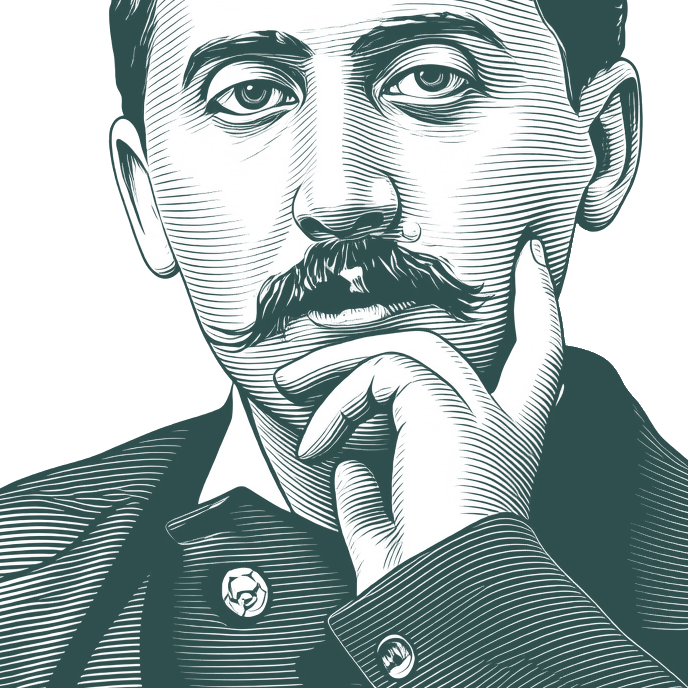
Valentin Louis Georges Eugène Marcel Proust (10 July 1871 – 18 November 1922) was a French novelist, essayist and critic.
Biography information from
Wikiquote·
Portrait adapted from
Wikimedia Commons, Otto Wegener (Public domain / CC0)
Also Known As
Alternative Names:
Valentin Louis Georges Eugène Marcel Proust
•
Proust
•
Valentin Louis Georges Eugéne Marcel Proust
•
Valentin-Louis-Georges-Eugéne-Marcel Proust
•
Valentin Louis Georges Eugene Marcel Proust
•
Valentin-Louis-Georges-Eugene-Marcel Proust
•
Bernard d'Algouvres
•
Valentin-Louis-Georges-Eugène-Marcel Proust
Compared with that of a great artist, the friendliness of a great nobleman, however charming it may be, seems like play-acting, like simulation. Saint-Loup sought to please; Elstir loved to give, to give himself. Everything he possessed, ideas, works, and the rest which he counted for far less, he would have given gladly to anyone who understood him. But, for lack of congenial company, he lived in an unsociable isolation which fashionable people call pose and ill-breeding, the authorities a recalcitrant spirit, his neighbours madness, his family selfishness and pride.
This compulsion to an activity without respite, without variety, without result was so cruel that one day, noticing a swelling over his stomach, he felt an actual joy in the idea that he had, perhaps, a tumor that would prove fatal, that he need not concern himself with anything further, since it was this malady that was going to govern his life, to make a plaything of him, until the not-distant end. If indeed, at his period, it often happened that, though without admitting it even to himself, he longed for death, it was in order to escape not so much from the keenness of his sufferings as from the monotony of his struggle.
Limited Time Offer
Premium members can get their quote collection automatically imported into their Quotewise collections.
We believe that we can change the things around us in accordance with our desires — we believe it because otherwise we can see no favourable outcome. We do not think of the outcome which generally comes to pass and is also favourable: we do not succeed in changing things in accordance with our desires, but gradually our desires change. The situation that we hoped to change because it was intolerable becomes unimportant to us. We have failed to surmount the obstacle, as we were absolutely determined to do, but life has taken us round it, led us beyond it, and then if we turn round to gaze into the distance of the past, we can barely see it, so imperceptible has it become.