For each reflection you make an arrow. This arrow... for the reflection from front surface, and this arrow... from the back surface... and... you tie… - Richard Feynman
""
For each reflection you make an arrow. This arrow... for the reflection from front surface, and this arrow... from the back surface... and... you tie the arrows together this way... [Y]ou put the tail of the other one on the head of that one... and you put these two arrows together by this rule, and you look at <nowiki>[</nowiki>the vector sum,] how far off you've come from the end... You count the number of beans you put in the barrel, I mean you make these pictures. ...[T]hen you ask, "How big is this circle [whose radius is the vector sum of the front and back arrows] in area?" And that area represents the probability... If the circle area is big, then you get a high probability, if... small, you get a small probability.
English
Collect this quote
About
Richard Feynman
Richard Phillips Feynman (May 11, 1918 – February 15, 1988) was an American theoretical physicist. He is known for the work he did in the path integral formulation of quantum mechanics, the theory of quantum electrodynamics, the physics of the superfluidity of supercooled liquid helium, and in particle physics, for which he proposed the parton model. For his contributions to the development of quantum electrodynamics, Feynman received the Nobel Prize in Physics in 1965 jointly with Julian Schwinger and Shin'ichirō Tomonaga. Feynman developed a widely used pictorial representation scheme for the mathematical expressions describing the behavior of subatomic particles, which later became known as Feynman diagrams. During his lifetime, Feynman became one of the best-known scientists in the world.
Biography information from
Wikiquote·
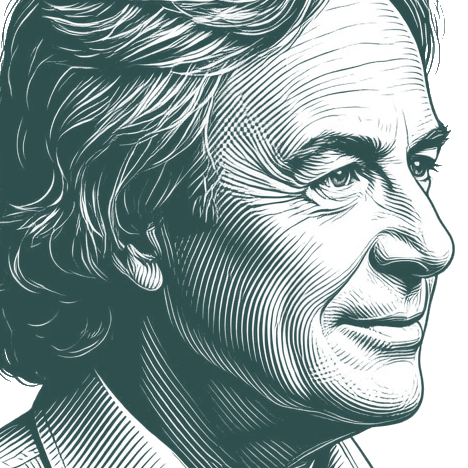
Portrait adapted from
Wikimedia Commons, Copyright Tamiko Thiel 1984 (CC BY-SA)
Also Known As
Pen Names:
Ofey
Native Name:
Richard Phillips Feynman
Alternative Names:
Feynman
•
Dick Feynman
•
Richard P. Feynman
The imagination of nature is far, far greater than the imagination of man.
What I got out of that story was something still very new to me: I understood at last what art is really for, at least in certain respects. It gives somebody, individually, pleasure. You can make something that somebody likes so much that they’re depressed, or they’re happy, on account of that damn thing you made! In science, it’s sort of general and large: You don’t know the individuals who have appreciated it directly. I understood that to sell a drawing is not to make money, but to be sure that it’s in the home of someone who really wants it; someone who would feel bad if they didn’t have it. This was interesting.
People are always asking for the latest developments in the unification of this theory with that theory, and they don't give us a chance to tell them anything about what we know pretty well. They always want to know the things we don't know.