Nay, if we may openly speak the truth, and as becomes one man to another, neither Pagan nor Mahometan, nor Jew, ought to be excluded from the civil r… - John Locke
""
Nay, if we may openly speak the truth, and as becomes one man to another, neither Pagan nor Mahometan, nor Jew, ought to be excluded from the civil rights of the commonwealth because of his religion.
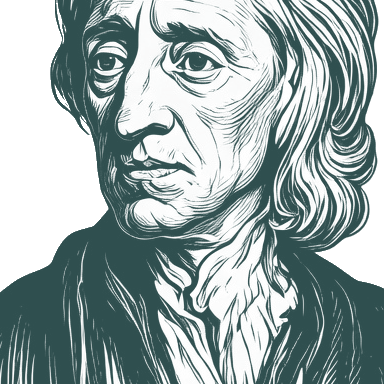
John Locke (29 August 1632 – 28 October 1704) was an influential English philosopher and social contract theorist. He developed an alternative to the Hobbesian state of nature and asserted a government could be good only if it received the consent of the governed and protected the natural rights of life, liberty, and estate. If such a consent was not achieved, Locke argued in favour of a right of rebellion, which he referred to as an "appeal to heaven".
Biography information from
Wikiquote·
Portrait adapted from
Wikimedia Commons, Godfrey Kneller (Public domain / CC0)
For, since it would be utterly in vain to suppose a rule set to the free actions of men, without annexing to it some enforcement of good and evil to determine his will, we must, wherever we suppose a law, suppose also some reward or punishment annexed to that law. It would be in vain for one intelligent being to set a rule to the actions of another, if he had it not in his power to reward the compliance with, and punish deviation from his rule, by some good and evil, that is not the natural product and consequence of the action itself. For that, being a natural convenience or inconvenience, would operate of itself, without a law. This, if I mistake not, is the true nature of all law, properly so called.
There is nobody in the commonwealth of learning who does not profess himself a lover of truth: and there is not a rational creature that would not take it amiss to be thought otherwise of. And yet, for all this, one may truly say, that there are very few lovers of truth, for truth’s sake, even amongst those who persuade themselves that they are so. How a man may know whether he be so in earnest, is worth inquiry: and I think there is one unerring mark of it, viz. The not entertaining any proposition with greater assurance than the proofs it is built upon will warrant. Whoever goes beyond this measure of assent, it is plain, receives not the truth in the love of it; loves not truth for truth’s sake, but for some other bye-end.
PREMIUM FEATURE
Advanced Search Filters
Filter search results by source, date, and more with our premium search tools.