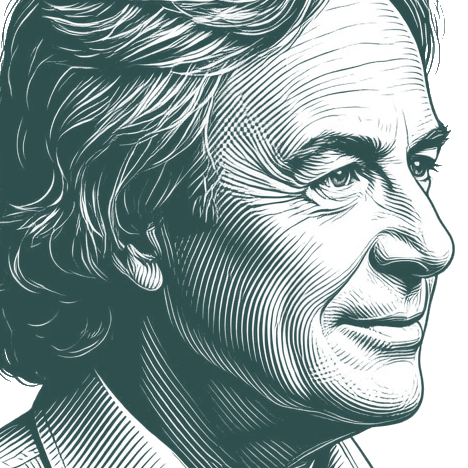
After reading the salary, I've decided that I must refuse. The reason I have to refuse a salary like that is I would be able to do what I've always w… - Richard Feynman
""
After reading the salary, I've decided that I must refuse. The reason I have to refuse a salary like that is I would be able to do what I've always wanted to do- -get a wonderful mistress, put her up in an apartment, buy her nice things.. . With the salary you have offered, I could actually do that, and I know what would happen to me. I'd worry about her, what she's doing; I'd get into arguments when I come home, and so on. All this bother would make me uncomfortable and unhappy. I wouldn't be able to do physics well, and it would be a big mess! What I've always wanted to do would be bad for me, so I've decided that I can't accept your offer.
Richard Phillips Feynman (May 11, 1918 – February 15, 1988) was an American theoretical physicist. He is known for the work he did in the path integral formulation of quantum mechanics, the theory of quantum electrodynamics, the physics of the superfluidity of supercooled liquid helium, and in particle physics, for which he proposed the parton model. For his contributions to the development of quantum electrodynamics, Feynman received the Nobel Prize in Physics in 1965 jointly with Julian Schwinger and Shin'ichirō Tomonaga. Feynman developed a widely used pictorial representation scheme for the mathematical expressions describing the behavior of subatomic particles, which later became known as Feynman diagrams. During his lifetime, Feynman became one of the best-known scientists in the world.
Biography information from
Wikiquote·
Portrait adapted from
Wikimedia Commons, Copyright Tamiko Thiel 1984 (CC BY-SA)
Also Known As
Pen Names:
Ofey
Native Name:
Richard Phillips Feynman
Alternative Names:
Feynman
•
Dick Feynman
•
Richard P. Feynman
Now we have a problem. We can deduce, often, from one part of physics like the law of gravitation, a principle which turns out to be much more valid than the derivation. This doesn't happen in mathematics, that the theorems come out in places where they're not supposed to be!
"For example, there was a book that started out with four pictures: first there was a wind-up toy; then there was an automobile; then there was a boy riding a bicycle; then there was something else. And underneath each picture, it said "What makes it go?" I thought, I know what it is: They're going to talk about mechanics, how the springs work inside the toy; about chemistry, how the engine of an automobile works; and biology, about how the muscles work.
It was the kind of thing my father would have talked about: "What makes it go? Everything goes because the sun is shining." And then we would have fun discussing it: "No, the toy goes becaues the spring is wound up, I would say. "How did the spring get would up" he would ask. "I wound it up" "And how did you get moving?" "From eating" "And food grows only because the sun is shining. So it's because the sun is shining that all these things are moving" That would get the concept across that motion is simply the transformation of the sun's power.
I turned the page. The answer was, for the wind-up toy, "Energy makes it go." And for the boy on the bicycle, "Energy makes it go." For everything "Energy makes it go."
Now that doesn't mean anything. Suppose it's "Wakalixes." That's the general principle: "Wakalixes makes it go." There is no knowledge coming in. The child doesn't learn anything; it's just a word
What the should have done is to look at the wind-up toy, see that there are springs inside, learn about springs, learn about wheels, and never mind "energy". Later on, when the children know something about how the toy actually works, they can discuss the more general principles of energy.
It is also not even true that "energy makes it go", because if it stops, you could say, "energy makes it stop" just as well. What they're talking about is concentrated energy being transformed into more dilute forms, which is a very subtle aspect of energy. Energy is neither increased nor decreased in these examples; it's just
"Once in Hawaii I was taken to see a Buddhist temple. In the temple a man said, "I am going to tell you something that you will never forget." And then he said, "To every man is given the key to the gates of heaven. The same key opens the gates of hell.