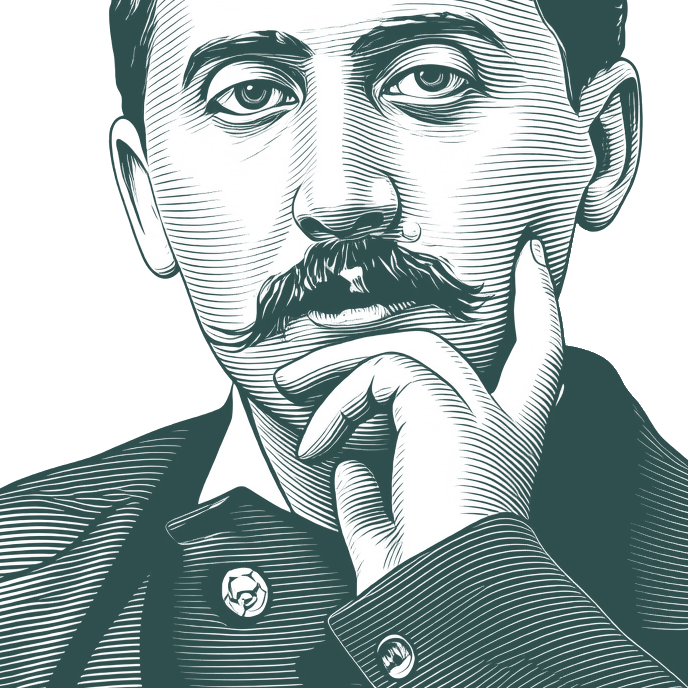
You cannot be surprised at anything men do, they're such brutes. - Marcel Proust
""
You cannot be surprised at anything men do, they're such brutes.
English
Collect this quote
About
Marcel Proust
Valentin Louis Georges Eugène Marcel Proust (10 July 1871 – 18 November 1922) was a French novelist, essayist and critic.
Biography information from
Wikiquote·
Portrait adapted from
Wikimedia Commons, Otto Wegener (Public domain / CC0)
Also Known As
Alternative Names:
Valentin Louis Georges Eugène Marcel Proust
•
Proust
•
Valentin Louis Georges Eugéne Marcel Proust
•
Valentin-Louis-Georges-Eugéne-Marcel Proust
•
Valentin Louis Georges Eugene Marcel Proust
•
Valentin-Louis-Georges-Eugene-Marcel Proust
•
Bernard d'Algouvres
•
Valentin-Louis-Georges-Eugène-Marcel Proust
The differences which exist between every one of our real impressions — differences which explain why a uniform depiction of life cannot bear much resemblance to the reality — derive probably from the following cause: the slightest word that we have said, the most insignificant action that we have performed at anyone epoch of our life was surrounded by, and colored by the reflection of things which logically had no connection with it and which later have been separated from it by our intellect which could make nothing of it for its own rational purposes, things, however, in the midst of which — here the pink reflection of the evening upon the flower-covered wall of a country restaurant, a feeling of hunger, the desire for women, the pleasure of luxury; here the blue volutes of the morning sea and, enveloped in them, phrases of music half emerging like the shoulders of water-nymphs — the simplest act or gesture remains immured as within a thousand vessels, each one of them filled with things of a color, a scent, a temperature that are absolutely different one from another, vessels, moreover, which being disposed over the whole range of our years, during which we have never ceased to change if only in our dreams and our thoughts, are situated at the most various moral altitudes and give us the sensation of extraordinarily diverse atmospheres.
The novelist’s happy discovery was to think of substituting for those opaque sections, impenetrable by the human spirit, their equivalent in immaterial sections, things, that is, which the spirit can assimilate to itself. After which it matters not that the actions, the feelings of this new order of creatures appear to us in the guise of truth, since we have made them our own, since it is in ourselves that they are happening, that they are holding in thrall, while we turn over, feverishly, the pages of the book, our quickened breath and staring eyes. And once the novelist has brought us to that state, in which, as in all purely mental states, every emotion is multiplied ten-fold, into which his book comes to disturb us as might a dream, but a dream more lucid, and of a more lasting impression than those which come to us in sleep; why, then, for the space of an hour he sets free within us all the joys and sorrows in the world, a few of which, only, we should have to spend years of our actual life in getting to know, and the keenest, the most intense of which would never have been revealed to us because the slow course of their development stops our perception of them.
Enhance Your Quote Experience
Enjoy ad-free browsing, unlimited collections, and advanced search features with Premium.
Peut-être n’eût-elle pas pensé que le mal fût un état si rare, si extraordinaire, si dépaysant, où il était si reposant d’émigrer, si elle avait su discerner en elle, comme en tout le monde, cette indifférence aux souffrances qu’on cause et qui, quelques autres noms qu’on lui donne, est la forme terrible et permanente de la cruauté.