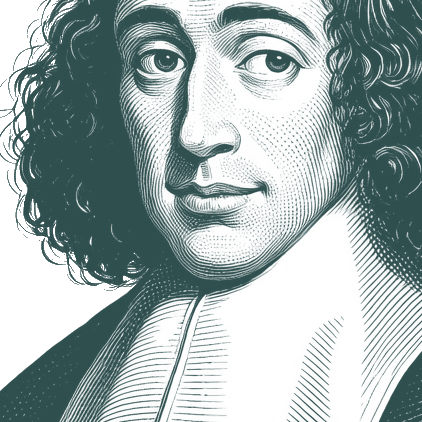
[Spinoza] — the philosopher whom I trust most,... [Original in German: Der Philosoph, dem ich zumeist vertraue,...] - Benedictus de Spinoza
""
[Spinoza] — the philosopher whom I trust most,... [Original in German: Der Philosoph, dem ich zumeist vertraue,...]
German
Collect this quote
About
Benedictus de Spinoza
Benedictus de Spinoza (24 November 1632 – 21 February 1677) was a social and metaphysical philosopher known for the elaborate development of his monist philosophy, which has become known as Spinozism. Controversy regarding his ideas led to his excommunication from the Jewish community of his native Amsterdam. He was named Baruch ("blessed" in Hebrew) Spinoza by his synagogue elders and known as Bento de Spinoza or Bento d'Espiñoza, but afterwards used the name Benedictus ("blessed" in Latin) de Spinoza.
Native Name:
בָּרוּךְ שְׂפִּינוֹזָה
•
Benedito de Espinosa
Alternative Names:
Benedict de Spinoza
•
Baruch de Espinosa
•
Barukh Shpinozah
•
Benoît de Spinoza
•
Sbīnūzā
•
Ispīnūzā
•
Barukh Spinoza
•
Bento de Espinosa
•
Baruch d' Espinoza
•
Shpinozah
•
Baruch de Spinoza
•
Spinoza
•
Benoit de Spinoza
•
Benedictus De Spinoza
•
Benedictus Spinoza
•
Baruch Spinoza
•
Baruch Benedictus de Spinoza
أوحي إلى نوح، بطريقةٍ على مستوى فَهْمه، بأنَّ الله سيُهلِك الجنس البشري. الواقع أنَّ نوحًا كان يَعتقِد أنَّ العالم كله، باستثناء فلسطين، لم يكُن مسكونًا، ولم يجهل الأنبياء مِثل هذه الأشياء فحسْب، بل جَهِلوا أيضًا أشياء أخرى كثيرةً أكثر أهمية، ولا يَنقُص جهلهم هذا من تقواهم شيئًا لأنهم لم يقولوا شيئًا خاصًّا يتعلَّق بصفات الله، بل كانت آراؤهم عنه هي بِعَينها الآراء المُتداولة، وكان الوحي الذي هبط عليهم مُتناسبًا مع آرائهم
How then could such a figure, seemingly the least ‘historical’ of philosophers, provide thinkers concerned with transformation, novelty, the event, with the wherewithal to advance radical projects of thought? Why is Spinoza repeatedly be invoked in the most urgent of political and ideological polemics? How could a philosophy turned toward the eternity of being (an ontology) link up with the attempt to understand the collective construction of a common political space and the sometimes catastrophic incursion of worldly events?
However, his contemporary, Leibnitz, the father of the German enlightenment, who created an optimistic world-picture, always remained only a philosopher for philosophers. Even Immanuel Kant, although always famous, was never popular. In his own fatherland he was all but forgotten for most of the nineteenth century until revived by Hermann Cohen and his school. Spinoza, however, was never exhumed because he was never buried. Kant, because of his exclusive intellectuality, has influenced only his students, while Spinoza, because of his emotional appeal, has ruled even those who have never heard his name.