How, then, does one become an activist?
The easy answer would be to say that we do not become activists; we simply forget that we are. We are all bo… - Noam Chomsky
""
How, then, does one become an activist?
The easy answer would be to say that we do not become activists; we simply forget that we are. We are all born with compassion, generosity, and love for others inside us. We are all moved by injustice and discrimination. We are all, inside, concerned human beings. We all want to give more than to receive. We all want to live in a world where solidarity and companionship are more important values than individualism and selfishness. We all want to share beautiful things; experience joy, laughter, love; and experiment, together.
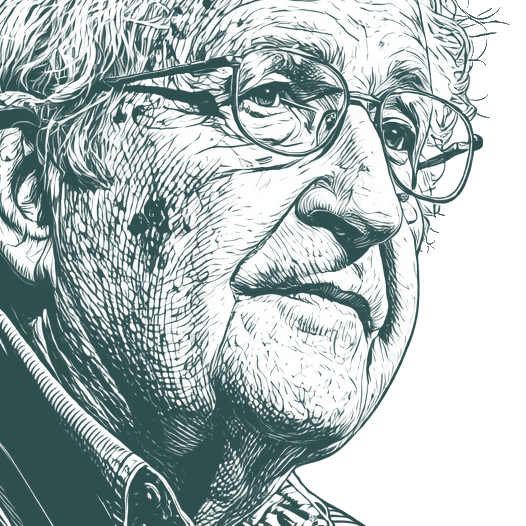
Avram Noam Chomsky (born 7 December 1928) is an American linguist, analytical philosopher, cognitive scientist, political analyst, human rights activist and anarcho-socialist.
Biography information from
Wikiquote·
Portrait adapted from
Wikimedia Commons, Augusto Starita / Ministerio de Cultura de la Nación (CC BY-SA)
Biden has pretty much picked up Trump’s foreign policy. He has eliminated some of the more gratuitously savage elements. Like in the case of Palestine, for example, Trump was not satisfied with just giving everything away to Israeli right-wing power—”do what you want”—and offering nothing to the Palestinians, just kicking them in the face. He even had to go beyond that to truly gratuitous savagery like cutting off the lifeline, the UNRWA lifeline, for Palestinians to be able to have at least minimal bare survival in the Israeli punching bag in Gaza. Even that, well, Biden removed those things. Other than that, pretty much followed the same policies.
When we talk about [Chinese] economic imperialism, exactly what are we referring to? We’re referring to investment in development programs throughout Eurasia, spanning to Africa, spanning even to Latin America.
Enhance Your Quote Experience
Enjoy ad-free browsing, unlimited collections, and advanced search features with Premium.
In September the government announced the national security strategy. That is not completely without precedent, but it is quite new as a formulation of state policy. What is stated is that we are tearing the entire system of the international law to shreds, the end of UN charter, and that we are going to carry out an aggressive war - which we will call "preventive" - and at any time we choose, and that we will rule the world by force. In addition, we will assure that there is never any challenge to our domination because we are so overwhelmingly powerful in military force that we will simply crush any potential challenge. That caused shudders around the world, including the foreign policy elite at home which was appalled by this. It is not that things like that haven't been heard in the past. Of course they had, but it had never been formulated as an official national policy. I suspect you will have to go back to Hitler to find an analogy to that. Now, when you propose new norms in the international behavior and new policies you have to illustrate it, you have to get people to understand that you mean it. Also you have to have what a Harvard historian called an "exemplary war", a war of example, which shows that we really mean what we say. And we have to choose the right target. The target has to have several properties. First it has to be completely defenseless. No one would attack anybody who might be able to defend themselves, that would be not prudent. Iraq meets that perfectly... And secondly, it has to be important. So there will be no point invading Burundi, for example. It has to be a country worthwhile controlling, owning, and Iraq has that property too.