"She wrote me a letter (Joan,1941) asking,"How can I read it?,Its so hard." I told her to start at the beginning and read as far as you can get until… - Richard Feynman
"She wrote me a letter (Joan,1941) asking,"How can I read it?,Its so hard." I told her to start at the beginning and read as far as you can get until you're lost. Then start again at the beginning and keep working through until you can understand the whole book. And thats what she did"
Richard Phillips Feynman (May 11, 1918 – February 15, 1988) was an American theoretical physicist. He is known for the work he did in the path integral formulation of quantum mechanics, the theory of quantum electrodynamics, the physics of the superfluidity of supercooled liquid helium, and in particle physics, for which he proposed the parton model. For his contributions to the development of quantum electrodynamics, Feynman received the Nobel Prize in Physics in 1965 jointly with Julian Schwinger and Shin'ichirō Tomonaga. Feynman developed a widely used pictorial representation scheme for the mathematical expressions describing the behavior of subatomic particles, which later became known as Feynman diagrams. During his lifetime, Feynman became one of the best-known scientists in the world.
Biography information from
Wikiquote·
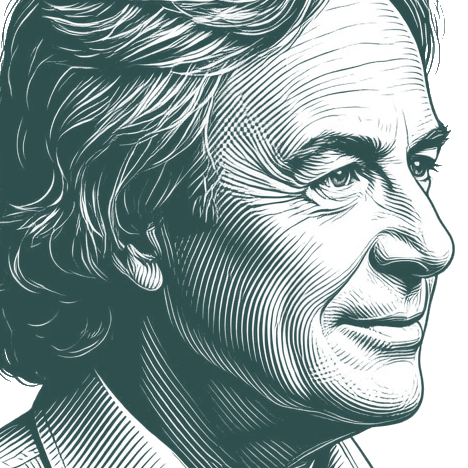
Portrait adapted from
Wikimedia Commons, Copyright Tamiko Thiel 1984 (CC BY-SA)
Also Known As
Pen Names:
Ofey
Native Name:
Richard Phillips Feynman
Alternative Names:
Feynman
•
Dick Feynman
•
Richard P. Feynman
The ultimate test of your knowledge is your capacity to convey it to another.
Anyway, Smith told me to sign some papers for the three ideas I was giving to the government to patent. Now, it’s some dopey legal thing, but when you give the patent to the government, the document you sign is not a legal document unless there’s some exchange, so the paper I signed said, “For the sum of one dollar, I, Richard P. Feynman, give this idea to the government…” I sign the paper. “Where’s my dollar?” “That’s just a formality,” he says. “We haven’t got any funds set up to give a dollar.” “You’ve got it all set up that I’m signing for the dollar,” I say. “I want my dollar!” “This is silly,” Smith protests. “No, it’s not,” I say. “It’s a legal document. You made me sign it, and I’m an honest man. If I sign something that says I got a dollar, I’ve gotta get a dollar. There’s no fooling around about it.” “All right, all right!” he says, exasperated. “I’ll give you a dollar, from my pocket!” “OK.” I take the dollar, and I realize what I’m going to do. I go down to the grocery store, and I buy a dollar’s worth — which was pretty good, then — of cookies and goodies, those chocolate goodies with marshmallow inside, a whole lot of stuff. I come back to the theoretical laboratory, and I give them out: “I got a prize, everybody! Have a cookie! I got a prize! A dollar for my patent! I got a dollar for my patent!” Everybody who had one of those patents — a lot of people had been sending them in — everybody comes down to Captain Smith: they want their dollar!
Words can be meaningless. If they are used in such a way that no sharp conclusions can be drawn.