Blinded as we all are with the "French" Spinoza in all his different guises, from Althusser through Deleuze to Negri, one should not forget other rea… - Benedictus de Spinoza
""
Blinded as we all are with the "French" Spinoza in all his different guises, from Althusser through Deleuze to Negri, one should not forget other readings of Spinoza which played a crucial role in theoretical orientations whose very mention gives shudder to "postmodern" Leftists. First, Spinoza was a crucial reference in the work of Georgi Plekhanov, the key theoretical figure of Russian Social Democracy, who, a century ago, was the first to evelate Marxism into an all-encompassing world-view (incidentally, he also coined the term "dialectical materialism) - against Hegel, he designated Marxism as "modern Spinozism"... Then, the reference to Spinoza is central for the work of Leo Strauss, the father figure of today's US neo-conservatives: for Strauss, Spinoza provides a model for the split between popular ideology appropriate for ordinary people and true knowledge that should remain accessible only to the few. Last but not least, Spinoza's anti-Cartesian teaching on the human soul is considered an authority among some most influential of today's cognitivists and brain scientists - Antonio Damasio even wrote a popular book Looking for Spinoza. It is thus as if every postmodern "French" figure of Spinoza is accompanied by an obscene disavowed double or precursor: Althusser's proto-Marxist Spinoza - "with Plekhanov"; Negri's anti-Empire Spinoza of the multitude - "with Leo Strauss"; Deleuze's Spinoza of affects - "with Damasio"...
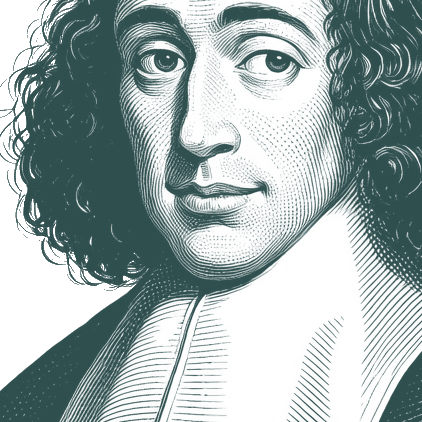
Benedictus de Spinoza (24 November 1632 – 21 February 1677) was a social and metaphysical philosopher known for the elaborate development of his monist philosophy, which has become known as Spinozism. Controversy regarding his ideas led to his excommunication from the Jewish community of his native Amsterdam. He was named Baruch ("blessed" in Hebrew) Spinoza by his synagogue elders and known as Bento de Spinoza or Bento d'Espiñoza, but afterwards used the name Benedictus ("blessed" in Latin) de Spinoza.
Native Name:
בָּרוּךְ שְׂפִּינוֹזָה
•
Benedito de Espinosa
Alternative Names:
Benedict de Spinoza
•
Baruch de Espinosa
•
Barukh Shpinozah
•
Benoît de Spinoza
•
Sbīnūzā
•
Ispīnūzā
•
Barukh Spinoza
•
Bento de Espinosa
•
Baruch d' Espinoza
•
Shpinozah
•
Baruch de Spinoza
•
Spinoza
•
Benoit de Spinoza
•
Benedictus De Spinoza
•
Benedictus Spinoza
•
Baruch Spinoza
•
Baruch Benedictus de Spinoza
Spinoza redefines the problem of Modern philosophy, which is the conquest of the world and the liberation of humanity, and destroys both its multiple antinomies and the continually resurgent separation (dualistic, transcendental, etc.) in the theory of knowledge and history, in the same way that criticism has always destroyed Zenonian sophism: moving forward, putting reality in motion. Spinoza's philosophy is born from the radicalization of the ontological paradox of being: in the recognition that the hypostasis, the only possible hypostasis, is that of the world and of the development of its necessity from physics to practice. It is a conception of the world that immediately produces, as if from its own basis, a completely modern conception of science and worldly knowledge, both technical and liberatory. It is a radically materialistic conception of being and of the world.
Emotion, which is suffering, ceases to be suffering as soon as we form a clear and precise picture of it.
Try QuoteGPT
Chat naturally about what you need. Each answer links back to real quotes with citations.
An immense role in the development of logic, and in preparing the ground for modern views on its subject matter, a role far from fully appreciated, was played by Spinoza. Like Leibniz, Spinoza rose high above the mechanistic limitations of the natural science of his time. Any tendency directly to universalise partial forms and methods of thinking only useful within the bounds of mechanistic, mathematical natural science was also foreign to him. Insofar as logic was preserved alongside the doctrine of substance, Spinoza treated it as an applied discipline by analogy with medicine, since its concern proved not to be the invention of artificial rules but the co-ordination of human intellect with the laws of thought understood as an ‘attribute’ of the natural whole, only as ‘modes of expression’ of the universal order and connection of things. He also tried to work out logical problems on the basis of this conception. Spinoza understood thought much more profoundly and, in essence, dialectically, which is why his figure presents special interest in the history of dialectics; he was probably the only one of the great thinkers of the pre-Marxian era who knew how to unite brilliant models of acutely dialectical thought with a consistently held materialist principle (rigorously applied throughout his system) of understanding thought and its relations to the external world lying in the space outside the human head. The influence of Spinoza's ideas on the subsequent development of dialectical thought can hardly be exaggerated. ‘It is therefore worthy of note that thought must begin by placing itself at the standpoint of Spinozism; to be a follower of Spinoza is the essential commencement of all Philosophy.’ [Lectures on the History of Philosophy, Hegel]