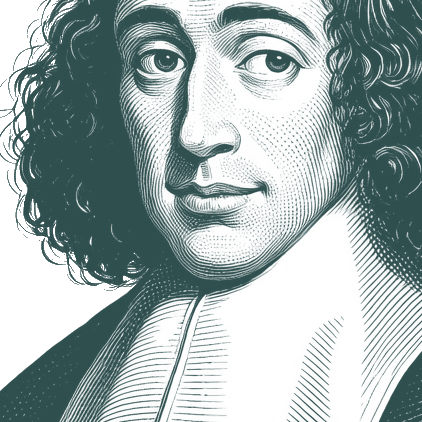
[Nietzsche and Spinoza: Enemy-Brothers] Amor fati—love of fate—is the defiant formula by which Nietzsche sums up his philosophical affirmation. The t… - Benedictus de Spinoza
""
[Nietzsche and Spinoza: Enemy-Brothers] Amor fati—love of fate—is the defiant formula by which Nietzsche sums up his philosophical affirmation. The term, never before used in philosophy, is clearly a polemical transformation of Spinoza's amor dei intellectualis, rejecting the primacy of the intellect and putting fatum (fate) in place of Spinoza's nature-God as the object of love. The pair amor dei and amor fati provides an apt verbal representation of the complex relationship between Nietzsche and Spinoza, the two enemy-brothers of modern philosophy. Perhaps no two philosophers are as akin as Spinoza and Nietzsche, yet no two are as opposed. If Spinoza initiated the modern philosophy of immanence and undergirds it throughout, then Nietzsche brings it to its most radical conclusion—and, as we shall see, turns this conclusion against Spinoza himself. Nietzsche explicitly recognizes his debt and kinship to Spinoza. Speaking of his "ancestors," Nietzsche at various times gives several lists, but he always mentions Spinoza and Goethe—and always as a pair. This is no accident, for Nietzsche sees Goethe as incorporating Spinoza and as anticipating his own "Dionysian" ideal.
Benedictus de Spinoza (24 November 1632 – 21 February 1677) was a social and metaphysical philosopher known for the elaborate development of his monist philosophy, which has become known as Spinozism. Controversy regarding his ideas led to his excommunication from the Jewish community of his native Amsterdam. He was named Baruch ("blessed" in Hebrew) Spinoza by his synagogue elders and known as Bento de Spinoza or Bento d'Espiñoza, but afterwards used the name Benedictus ("blessed" in Latin) de Spinoza.
Native Name:
בָּרוּךְ שְׂפִּינוֹזָה
•
Benedito de Espinosa
Alternative Names:
Benedict de Spinoza
•
Baruch de Espinosa
•
Barukh Shpinozah
•
Benoît de Spinoza
•
Sbīnūzā
•
Ispīnūzā
•
Barukh Spinoza
•
Bento de Espinosa
•
Baruch d' Espinoza
•
Shpinozah
•
Baruch de Spinoza
•
Spinoza
•
Benoit de Spinoza
•
Benedictus De Spinoza
•
Benedictus Spinoza
•
Baruch Spinoza
•
Baruch Benedictus de Spinoza
One explanation for Spinoza's status as unknown celebrity is the scandal he caused in his own time. As we shall see (in Chapter Six), his words were deemed heretical and banned for decades and with rare exceptions were quoted only as part of the assault on his work. The attacks paralyzed most attempts by Spinoza admirers to discuss his ideas publicly. The natural continuity of intellectual acknowledgment that follows a thinker's work was thus interrupted, even as some of his ideas were used uncredited. This state of affairs, however, hardly explains why Spinoza continued to gain fame but remained unknown once the likes of Goethe and Wordsworth began to champion him. Perhaps a better explanation is that Spinoza is not easy to know.
...[T]he once-accepted assumption that Spinoza was considered a “dead dog” in Kant's day [i.e. before the break of the Pantheismusstreit] is no longer tenable. [...] Suffice it here to recall the well-known fact that Spinoza is the subject of the single longest entry in Bayle's Dictionnaire (1702). It is true that Bayle attempts to refute Spinoza (though some have doubted the sincerity of his intentions) but unlikely that so much space would be dedicated to refuting a neglected philosopher—unlikely, indeed, that Spinoza's relevance would wane once this high-profile entry had been published about him. J. Zedler's Grosses Universal Lexikon (1731–54) gives a similar impression, devoting to Spinoza a five-page discussion. Descartes, by comparison, is discussed in one page. Hume, Locke, Hobbes, and Plato are equally dealt with in one page (or less) each. D. Diderot and J. d'Alembert's Encyclopédie (1751–72) similarly dedicates to Spinoza five times more space than to most relevant thinkers in the history of philosophy. While speaking of Spinoza's metaphysics in extremely hostile terms, the Encyclopédie gives a reliable account of the Ethics definitions and axioms and discusses at length its most important demonstrations, especially E1p1–11. The Dictionnaire, the Lexikon, and the Encyclopédie were the main transmitters of Enlightenment thought. The attention they devoted to Spinoza ensured him a place at the heart of Enlightenment debate. It would be impossible for any educated reader to avoid contact with Spinoza's ideas. It would be easy for every metaphysician to get a grasp on the system of the Ethics. And it would be tempting, for every philosophically inclined thinker, to read Spinoza for themselves.
Enhance Your Quote Experience
Enjoy ad-free browsing, unlimited collections, and advanced search features with Premium.
It is unquestionably the peacefulness and calm of the Spinozist system which particularly produces the idea of its depth, and which, with hidden but irresistible charm, has attracted so many minds. The Spinozist system will also always remain in a certain sense a model. A system of freedom — but with just as great contours, with the same simplicity, as a perfect counter-image (Gegenbild) of the Spinozist system — this would really be the highest system. This is why Spinozism, despite the many attacks on it, and the many supposed refutations, has never really become something truly past, never been really overcome up to now, and no one can hope to progress to the true and the complete in philosophy who has not at least once in his life lost himself in the abyss of Spinozism. Nobody who wishes to arrive at his own firm conviction should leave unread the main work of Spinoza, his Ethics (for he presented his system under this title), and I should like to urge everyone who is seriously concerned with his education not only to study assiduously on his own, which no teacher can replace, but to be most conscientious and careful in the choice of what he reads.