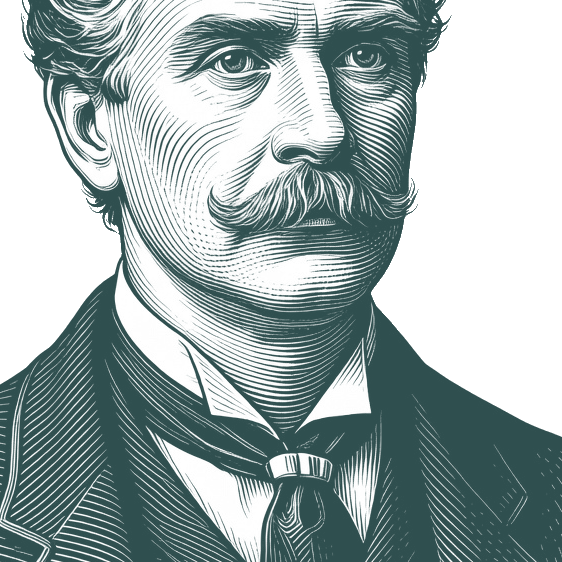
Destiny: A tyrant's authority for crime and a fool's excuse for failure. - Ambrose Bierce
""
Destiny: A tyrant's authority for crime and a fool's excuse for failure.
English
Collect this quote
About
Ambrose Bierce
Ambrose Gwinnett Bierce (June 24, 1842 – date of death uncertain; probably late 1912 or early 1914) was an American satirist, critic, short story writer, editor and journalist. He is perhaps most famous for his serialized mock lexicon, The Devil's Dictionary, in which, over the years, he scathed American culture and accepted wisdom by pointing out alternate, more practical definitions for common words.
Biography information from
Wikiquote·
Portrait adapted from
Wikimedia Commons, John Herbert Evelyn Partington (Public domain / CC0)
There are sounds that we cannot hear. At either end of the scale are notes that stir no chord of that imperfect instrument, the human ear. They are too high or too grave. I have observed a flock of blackbirds occupying an entire tree-top—the tops of several trees—and all in full song. Suddenly—in a moment—at absolutely the same instant all spring into the air and fly away. How? They could not all see one another—whole tree-tops intervened. At no point could a leader have been visible to all. There must have been a signal of warning or command, high and shrill above the din, but by me unheard. I have observed, too, the same simultaneous flight when all were silent, among not only blackbirds, but other birds— quail, for example, widely separated by bushes —even on opposite sides of a hill. It is known to seamen that a school of whales basking or sporting on the surface of the ocean, miles apart, with the convexity of the earth between, will sometimes dive at the same instant—all gone out of sight in a moment. The signal has been sounded—too grave for the ear of the sailor at the masthead and his comrades on the deck—who nevertheless feel its vibrations in the ship as the stones of a cathedral are stirred by the bass of the organ. As with sounds, so with colors. At each end of the solar spectrum the chemist can detect the presence of what are known as 'actinic' rays. They represent colors—integral colors in the composition of light—which we are unable to discern. The human eye is an imperfect instrument; its range is but a few octaves of the real “chromatic scale.” I am not mad; there are colors that we cannot see. And, God help me! the Damned Thing is of such a color!
ADAGE, n. Boned wisdom for weak teeth.
Abstainer, n. A weak person who yields to the temptation of denying himself a pleasure. A total abstainer is one who abstains from everything but abstention, and especially from inactivity in the affairs of others.