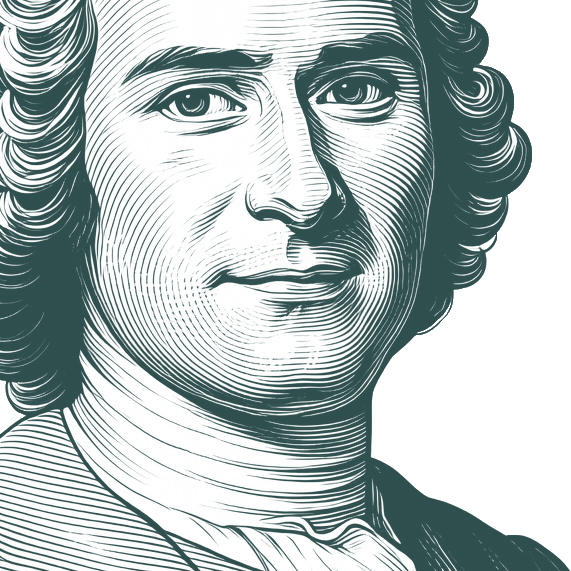
Being wealthy isn't just a question of having lots of money. It's a question of what we want. Wealth isn't an absolute, it's relative to desire. Ever… - Jean-Jacques Rousseau
""
Being wealthy isn't just a question of having lots of money. It's a question of what we want. Wealth isn't an absolute, it's relative to desire. Every time we seek something that we can't afford, we can be counted as poor, how much money we may actually have.
Jean-Jacques Rousseau (June 28, 1712 – July 2, 1778) was a major French-speaking Genevan philosopher of Enlightenment whose political ideas influenced the French Revolution, the development of socialist theory, and the growth of nationalism.
Biography information from
Wikiquote·
Portrait adapted from
Wikimedia Commons, Maurice Quentin de La Tour (Public domain / CC0)
Also Known As
Alternative Names:
Citizen of Geneva
•
Jean Jacques Rousseau
•
J. J. Rousseau
•
Rousseau
•
J.J. Rousseau
•
JJ Rousseau
so true it is that pleasure does not depend on extravagance, and that joy is as readily purchased by pence as pounds.
"Hold childhood in reverence, and do not be in any hurry to judge it for good or ill. Leave exceptional cases to show themselves, let their qualities be tested and confirmed, before special methods are adopted. Give nature time to work before you take over her business, lest you interfere with her dealings. You assert that you know the value of time and are afraid to waste it. You fail to perceive that it is a greater waste of time to use it ill than to do nothing, and that a child ill taught is further from virtue than a child who has learnt nothing at all. You are afraid to see him spending his early years doing nothing. What! is it nothing to be happy, nothing to run and jump all day? He will never be so busy again all his life long. Plato, in his Republic, which is considered so stern, teaches the children only through festivals, games, songs, and amusements. It seems as if he had accomplished his purpose when he had taught them to be happy; and Seneca, speaking of the Roman lads in olden days, says, "They were always on their feet, they were never taught anything which kept them sitting." Were they any the worse for it in manhood? Do not be afraid, therefore, of this so-called idleness. What would you think of a man who refused to sleep lest he should waste part of his life? You would say, "He is mad; he is not enjoying his life, he is robbing himself of part of it; to avoid sleep he is hastening his death." Remember that these two cases are alike, and that childhood is the sleep of reason.
The apparent ease with which children learn is their ruin. You fail to see that this very facility proves that they are not learning. Their shining, polished brain reflects, as in a mirror, the things you show them, but nothing sinks in. The child remembers the words and the ideas are reflected back; his hearers understand them, but to him they are meaningless.
Although memory and reason are wholly different faculties, the one does not really develop apart from the other.
Bir adam yetiştirmeye kalkışma cesaretini göstermeden önce, insanın kendisinin adam olmuş olması gerektiğini anımsayın; insanın göstermek istediği örneği kendinde bulması gerekir. Çocuk henüz bir şey bilmezken, bakışlarını çevresindeki şeyler arasında görmesi uygun olan şeylere çevirmeye hazırlamak için zaman vardır. Kendinizi herkes tarafından sayılır, sevilir kılın; herkesin sizin hoşunuza gitmeye çalışması için, kendinizi sevdirmekle işe başlayın. Eğer çocuğun çevresindeki şeylere hiç egemen değilseniz, ona da hiç egemen olamazsınız ve bu otorite, erdeme değer vermeye dayalı değilse, hiçbir zaman yeterli olmayacaktır. Kesenin ağzını adamakıllı açıp parayı avuç avuç saçmak bir işe yaramaz; paranın kimseyi sevdirdiğini hiç görmedim.