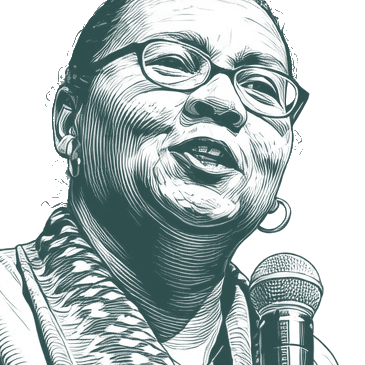
Individual heterosexual women came to the movement from relationships where men were cruel, unkind, violent, unfaithful. Many of these men were radic… - bell hooks
""
Individual heterosexual women came to the movement from relationships where men were cruel, unkind, violent, unfaithful. Many of these men were radical thinkers who participated in movements for social justice, speaking out on behalf of the workers, the poor, speaking out on behalf of racial justice. However when it came to the issue of gender they were as sexist as their conservative cohorts.
bell hooks (born Gloria Jean Watkins; September 25, 1952 – December 15, 2021), was an American university professor specializing in social criticism focused on groups distinguished by established differences in social power.
Biography information from
Wikiquote·
Portrait adapted from
Wikimedia Commons, Cmongirl (Public domain / CC0)
True resistance begins with people confronting pain... and wanting to do something to change it.
I think the truth is that finding ourselves brings more excitement and well-being than anything romance has to offer, and somewhere we know that.
It is a contradiction that white females have structured a women’s liberation movement that is racist and excludes many non-white women. However, the existence of that contradiction should not lead any woman to ignore feminist issues. Oftentimes I am asked by black women to explain why I would call myself a feminist and by using that term ally myself with a movement that is racist. I say, “The question we must ask again and again is how can racist women call themselves feminists.” It is obvious that many women have appropriated feminism to serve their own ends, especially those white women who have been at the forefront of the movement; but rather than resigning myself to this appropriation I choose to re-appropriate the term “feminism,” to focus on the fact that to be “feminist” in any authentic sense of the term is to want for all people, female and male, liberation from sexist role patterns, domination, and oppression.