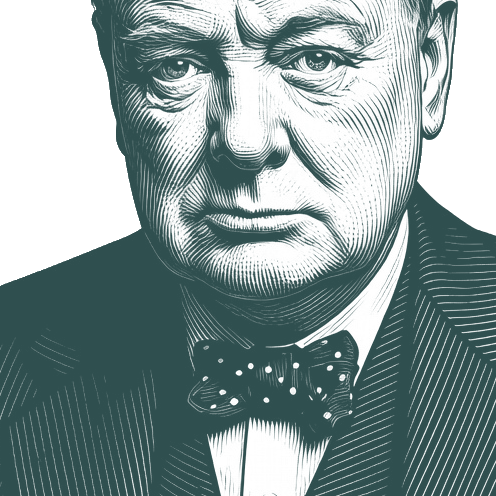
When I am abroad I always make it a rule never to criticize or attack the Government of my country. I make up for lost time when I am at home. - Winston Churchill
""
When I am abroad I always make it a rule never to criticize or attack the Government of my country. I make up for lost time when I am at home.
English
Collect this quote
About
Winston Churchill
Sir Winston Leonard Spencer Churchill KG OM CH TD FRS PC (November 30, 1874 – January 24, 1965) was a British statesman who served as Prime Minister of the United Kingdom from 1940 to 1945, during the Second World War, and again from 1951 to 1955. Churchill was a Sandhurst-educated soldier, a Nobel Prize-winning writer and historian, a prolific painter, and one of the longest-serving politicians in British history. Apart from two years between 1922 and 1924, he was a Member of Parliament (MP) from 1900 to 1964 and represented a total of five constituencies. Ideologically an economic liberal and imperialist, he was for most of his career a member of the Conservative Party, which he led from 1940 to 1955, though he was a member of the Liberal Party from 1904 to 1924.
Biography information from
Wikiquote·
Portrait adapted from
Wikimedia Commons, Yousuf Karsh (Public domain / CC0)
Also Known As
Birth Name:
Winston Leonard Spencer Churchill
Also Known As:The pug•The Old Lion
Alternative Names:
Winston Spencer Churchill
•
Charles Maurin
•
David Winter
•
The Honourable Sir Winston Spencer Churchill
•
Colonel Warden
•
Sir Winston Leonard Spencer Churchill
•
Sir Leonard Spencer
•
Sir Winston Churchill
•
Sir Winston Spencer Churchill
•
Mr Green
•
The Right Honourable Sir Winston Spencer Churchill
•
The Right Honourable Sir Winston Leonard Spencer Churchill
•
The Right Honourable Sir Winston Churchill
•
Churchill
•
Winston S. Churchill
•
Winston Leonard Spencer-Churchill
•
Sir Winston Leonard Spencer-Churchill
A man is about as big as the things that make him angry
I was very glad when Mr. Attlee described my speeches in the late war as expressing the will not only of Parliament but of the whole nation. I have never accepted what many people have kindly said—namely, that I inspired the nation. Their will was resolute and remorseless and it proved unconquerable. It fell to me to express it and if I found the right word you must remember that I have always earned my living by my pen, and by my tongue.
I cannot, of course, commit myself to any particular details. Reports are coming in in rapid succession. So far the Commanders who are engaged report that everything is proceeding according to plan. And what a plan! This vast operation is undoubtedly the most complicated and difficult that has ever taken place. It involves tides, wind, waves, visibility, both from the air and the sea standpoint, and the combined employment of land, air and sea forces in the highest degree of intimacy and in contact with conditions which could not and cannot be fully foreseen. There are already hopes that actual tactical surprise has been attained, and we hope to furnish the enemy with a succession of surprises during the course of the fighting. The battle that has now begun will grow constantly in scale and in intensity for many weeks to come, and I shall not attempt to speculate upon its course. This I may say, however. Complete unity prevails throughout the Allied Armies. There is a brotherhood in arms between us and our friends of the United States. There is complete confidence in the supreme commander, General Eisenhower, and his lieutenants, and also in the commander of the Expeditionary Force, General Montgomery. The ardour and spirit of the troops, as I saw myself, embarking in these last few days was splendid to witness. Nothing that equipment, science or forethought could do has been neglected, and the whole process of opening this great new front will be pursued with the utmost resolution both by the commanders and by the United States and British Governments whom they serve.