French mathematician, physicist, inventor, writer, and Christian philosopher (1623-1662)
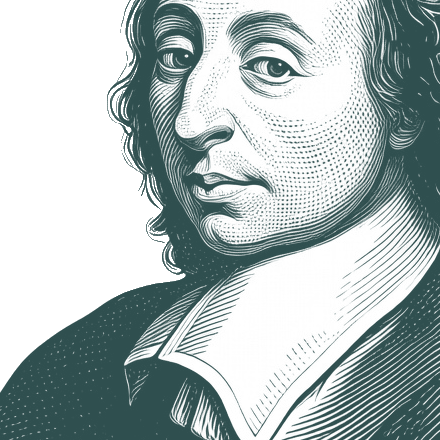
Blaise Pascal (19 June 1623 – 19 August 1662) was a French mathematician, logician, physicist and theologian.
Bio from: Wikiquote (CC BY-SA 4.0) · Portrait adapted from: Wikimedia Commons, unknown; a copy of the painting of François II Quesnel, which was made for Gérard Edelinck en 1691[réf. nécessaire]. (Public domain / CC0)
From Wikidata (CC0)

Christ prefigured by Joseph. Innocent, beloved of his father, sent by his father to see his brothers, is sold for twenty pieces of silver by his brothers. Through this he becomes their lord, their saviour, saviour of strangers and saviour of the world. None of this would have happened but for their plot to destroy him, the sale and their rejection of him. In prison, Joseph innocent between two criminals. Jesus on the cross between two thieves. He prophesies the salvation of one and the death of the other when to all appearance they are alike. Christ saves the elect and damns the reprobate for the same crime. Joseph only prophesies, Jesus acts. Joseph asks the man who will be saved to remember him when he comes in glory. And the man Jesus saves asks to be remembered when he comes into his kingdom.
We are so unhappy that we can only enjoy something which we should be annoyed to see go wrong, and that can and does constantly happen to thousands of things. Anyone who found the secret of rejoicing when things go well without being annoyed when they go badly would have found the point. It is perpetual motion.
Let no one say that I have said nothing new; the arrangement of the material is new. In playing tennis both players use the same ball, but one plays it better. I would just as soon be told that I have used old words. As if the same thoughts did not form a different argument by being differently arranged, just as the same words make different thoughts when arranged differently!
When we wish to correct with advantage, and to show another that he errs, we must notice from what side he views the matter, for on that side it is usually true, and admit that truth to him, but reveal to him the side on which it is false. He is satisfied with that, for he sees that he was not mistaken, and that he only failed to see all sides. Now, no one is offended at not seeing everything; but one does not like to be mistaken, and that perhaps arises from the fact that man naturally cannot see everything, and that naturally he cannot err in the side he looks at, since the perceptions of our senses are always true.
228. Objection of atheists: “But we have no light.” 229. This is what I see and what troubles me. I look on all sides, and I see only darkness everywhere. Nature presents to me nothing which is not matter of doubt and concern. If I saw nothing there which revealed a Divinity, I would come to a negative conclusion; if I saw everywhere the signs of a Creator, I would remain peacefully in faith. But, seeing too much to deny and too little to be sure, I am in a state to be pitied; wherefore I have a hundred times wished that if a God maintains nature, she should testify to Him unequivocally, and that, if the signs she gives are deceptive, she should suppress them altogether; that she should say everything or nothing, that I might see which cause I ought to follow. Whereas in my present state, ignorant of what I am or of what I ought to do, I know neither my condition nor my duty. My heart inclines wholly to know, where is the true good, in order to follow it; nothing would be too dear to me for eternity. I envy those whom I see living in the faith with such carelessness, and who make such a bad use of a gift of which it seems to me I would make such a different use. 230. It is incomprehensible that God should exist, and it is incomprehensible that He should not exist, that the soul should be joined to the body, and that we should have no soul; that the world should be created, and that it should not be created, &c.; that original sin should be, and that it should not be.
Canon 21. « Si quelqu’un dit que le juste ait le pouvoir de persévérer sans un secours spécial de Dieu, ou qu’il ne le puisse avec ce secours : qu’il soit anathème. » Canon 25. « Si quelqu’un dit que le juste pèche en toute bonne œuvre véniellement, ou, ce qui est plus insupportable, mortellement, et qu’il mérite la peine éternelle, mais qu’il n’est pas damné, par cette seule raison que Dieu ne lui impute pas ses œuvres à damnation : qu’il soit anathème. » Par où l’on voit, non-seulement que ces paroles, que « les commandemens ne sont pas impossibles aux justes, » sont restreintes à cette condition, quand ils sont secourus par la grâce ; mais qu’elles n’ont que la même force que celles-ci, que « les justes ne pèchent pas en toutes leurs actions ; » et enfin tant s’en faut que le pouvoir prochain soit étendu à tous les justes, qu’il est défendu de l’attribuer à ceux qui ne sont pas secourus de ce secours spécial, qui n’est pas commun à tous, comme il a été expliqué. Concluons donc que tous les Pères ne tiennent pas un autre langage. Saint Augustin et les Pères qui l’ont suivi, n’ont jamais parlé des commandemens, qu’en disant qu’ils ne sont pas impossibles à la charité, et qu’ils ne nous sont faits que pour nous faire sentir le besoin que nous avons de la charité, qui seule les accomplit. « Dieu, juste et bon, n’a pu commander des choses impossibles ; ce qui nous avertit de faire ce qui est facile, et de demander ce qui est difficile. » (Aug., De nat. et grat., cap. LXIX.) « Car toutes choses sont faciles à la charité. » (De perfect. justit., cap. x.) Et ailleurs : « Qui ne sait que ce qui se fait par amour n’est pas difficile? Ceux-là ressentent de la peine à accomplir les préceptes, qui s’efforcent de les observer par la crainte ; mais la parfaite charité chasse la crainte, et rend le joug du précepte doux ; et, bien loin d’accabler par son poids, elle soulève comme si elle nous donnoit des ailes. » Cette charité ne vient pas de notre libre arbitre (si la grâce de