American fiction writer and essayist (1962–2008)
David Foster Wallace (21 February 1962 – 12 September 2008) was an American novelist, essayist, and short story writer. His works include The Broom of the System (novel), Infinite Jest (novel), The Girl With Curious Hair (short story collection), Brief Interviews with Hideous Men (short story collection), A Supposedly Fun Thing I'll Never Do Again (essay collection), and the posthumously-published The Pale King (novel) and Both Flesh and Not (essay collection).
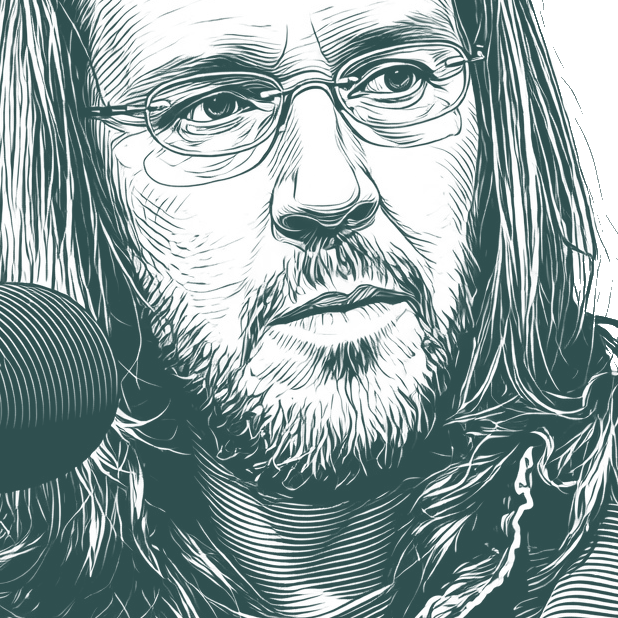
Bio from: Wikiquote (CC BY-SA 4.0) · Portrait adapted from: Wikimedia Commons, Steve Rhodes (CC BY)
From Wikidata (CC0)

Let me put it this way: You cannot live in the world without being in pain, spiritual and physical pain. We have developed mechanisms to deal with these pains, to overcome them somehow. Therapy, religion and spirituality, relationships, material success. All this can work, but also become a problem itself.
The pursuit of happiness has even been put into the American constitution a couple centuries ago. Today we're so rich, we own much more than we need, we have liberties unknown before, even though they are endangered in the current political climate in the US - and we forget how wonderful it nevertheless is, compared to most other political and economic systems. We have a saying that goes: Give a man enough rope and he hangs himself.
Advanced Search Filters
Filter search results by source, date, and more with our premium search tools.
To me, at least in retrospect, the really interesting question is why dullness proves to be such a powerful impediment to attention. Why we recoil from the dull. Maybe it’s because dullness is intrinsically painful; maybe that’s where phrases like ‘deadly dull’ or ‘excruciatingly dull’ come from. But there might be more to it. Maybe dullness is associated with psychic pain because something that’s dull or opaque fails to provide enough stimulation to distract people from some other, deeper type of pain that is always there, if only in an ambient, low-level way, and which most of us spend nearly all our time and energy trying to distract ourselves from feeling, or at least from feeling directly or with our full attention. Admittedly, the whole thing’s pretty confusing, and hard to talk about abstractly…but surely something must lie behind not just Muzak in dull or tedious places any more but now also actual TV in waiting rooms, supermarkets’ checkouts, airport gates, SUVs’ backseats. Walkman, iPods, BlackBerries, cell phones that attach to your head. This terror of silence with nothing diverting to do. I can’t think anyone really believes that today’s so-called ‘information society’ is just about information. Everyone knows it’s about something else, way down.
I think the world divides neatly into those who are excited by the managed induction of terror and those who are not. I do not find terror exciting. I find it terrifying. One of my basic goals is to subject my nervous system to as little total terror as possible. The cruel paradox of course is that this kind of makeup usually goes hand in hand with a delicate nervous system that's extremely easy to terrify.
The boy, who did everything well and with a natural unslumped grace the wraith himself had always lacked, and whom the wraith had been so terribly eager to see and hear and let him (the son) know he was seen and heard, the son had become a steadily more and more hidden boy, toward the wraith's life's end; and no one else in the wraith and the boy's nuclear family would see or acknowledge this, the fact that the graceful and marvelous boy was disappearing, right before their eyes. They looked but did not see his invisibility.
It took years after I’d graduated from Amherst to realize that people were actually far more complicated and interesting than books, that almost everyone else suffered the same secret fears and inadequacies as I, and that feeling alone and inferior was actually the great valent bond between us all. I wish I’d been smart enough to understand that when I was an adolescent.