The American Academy of Emergency Medicine confirms it: Each year, between one and two dozen adult US males are admitted to ERs after having castrated themselves. With kitchen tools, usually sometimes wire cutters. In answer to the obvious question, surviving patients most often report that their sexual urges had become a source of intolerable conflict and anxiety. The desire for perfect release and the real-world impossibility of perfect, whenever-you-want-it release had together produced a tension they could no longer stand.
American fiction writer and essayist (1962–2008)
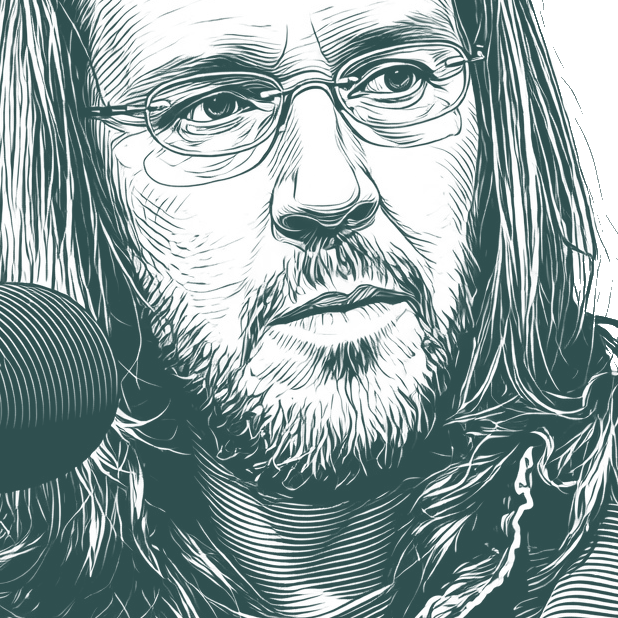
David Foster Wallace (21 February 1962 – 12 September 2008) was an American novelist, essayist, and short story writer. His works include The Broom of the System (novel), Infinite Jest (novel), The Girl With Curious Hair (short story collection), Brief Interviews with Hideous Men (short story collection), A Supposedly Fun Thing I'll Never Do Again (essay collection), and the posthumously-published The Pale King (novel) and Both Flesh and Not (essay collection).
Bio from: Wikiquote (CC BY-SA 4.0) · Portrait adapted from: Wikimedia Commons, Steve Rhodes (CC BY)
Alternative Names:
David Wallace
From Wikidata (CC0)

Showing quotes in randomized order to avoid selection bias. Click Popular for most popular quotes.
Todd, trust math. As in Matics, Math E. First-order predicate logic. Never fail you. Quantities and their relation. Rates of change. The vital statistics of God or equivalent. When all else fails. When the boulder's slid all the way back to the bottom. When the headless are blaming. When you do not know your way about. You can fall back and regroup around math. Whose truth is deductive truth. Independent of sense or emotionality. The syllogism. The identity. Modus Tollens. Transitivity. Heaven's theme song. The night light on life's dark wall, late at night. Heaven's recipe book. The hydrogen spiral. The methane, ammonia, H2O. Nucleic acids. A and G, T and C. The creeping inevibatility. Caius is mortal. Math is not mortal. What it is is: listen: it's true.
Try QuoteGPT
Chat naturally about what you need. Each answer links back to real quotes with citations.
In some respects all this variety is probably good, productive of difference and dialogue and so on. But it can also be confusing and stressful for the average citizen. Short of signing on to a particular mass ideology and patronizing only those partisan news sources that ratify what you want to believe, it is increasingly hard to determine which sources to pay attention to and how exactly to distinguish real information from spin.
If, by the virtue of charity or the circumstance of desperation, you ever chance to spend a little time around a Substance-recovery halfway facility like Enfield MA's state-funded Ennet House, you will acquire many exotic new facts…That certain persons simply will not like you no matter what you do. That sleeping can be a form of emotional escape and can with sustained effort be abused. That purposeful sleep-deprivation can also be an abusable escape. That you do not have to like a person in order to learn from him/her/it. That loneliness is not a function of solitude. That logical validity is not a guarantee of truth. That it takes effort to pay attention to any one stimulus for more than a few seconds. That boring activities become, perversely, much less boring if you concentrate intently on them. That if enough people in a silent room are drinking coffee it is possible to make out the sound of steam coming off the coffee. That sometimes human beings have to just sit in one place and, like, hurt. That you will become way less concerned with what other people think of you when you realize how seldom they do. That there is such a thing as raw, unalloyed, agendaless kindness. That it is possible to fall asleep during an anxiety attack. That concentrating intently on anything is very hard work. That 99% of compulsive thinkers' thinking is about themselves; that 99% of this self-directed thinking consists of imagining and then getting ready for things that are going to happen to them; and then, weirdly, that if they stop to think about it, that 100% of the things they spend 99% of their time and energy imagining and trying to prepare for all the contingencies and consequences of are never good. In short that 99% of the head's thinking activity consists of trying to scare the everliving shit out of itself. That it is possible to make rather tasty poached eggs in a microwave oven. That some people's moms never taught them to cover up or turn away when they sneeze. That the people to be the most frightened of are the people who are the most frightened. That it takes great personal courage to let yourself appear weak. That no single, individual moment is in and of itself unendurable. That other people can often see things about you that you yourself cannot see, even if those people are stupid. That having a lot of money does not immunize people from suffering or fear. That trying to dance sober is a whole different kettle of fish. That different people have radically different ideas of basic personal hygiene. That, perversely, it is often more fun to want something than to have it. That if you do something nice for somebody in secret, anonymously, without letting the person you did it for know it was you or anybody else know what it was you did or in any way or form trying to get credit for it, it's almost its own form of intoxicating buzz. That anonymous generosity, too, can be abused. That it is permissible to want. That everybody is identical in their unspoken belief that way deep down they are different from everyone else. That this isn't necessarily perverse. That there might not be angels, but there are people who might as well be angels.
If you spend enough time reading or writing, you find a voice, but you also find certain tastes. You find certain writers who when they write, it makes your own brain voice like a tuning fork, and you just resonate with them. And when that happens, reading those writers — not all of whom are modern . . . I mean, if you are willing to make allowances for the way English has changed, you can go way, way back with this — becomes a source of unbelievable joy. It’s like eating candy for the soul. So probably the smart thing to say is that lucky people develop a relationship with a certain kind of art that becomes spiritual, almost religious, and doesn’t mean, you know, church stuff, but it means you’re just never the same.
Is it possible really to love other people? If I’m lonely and in pain, everyone outside me is potential relief — I need them. But can you really love what you need so badly? Isn’t a big part of love caring more about what the other person needs? How am I supposed to subordinate my own overwhelming need to somebody else’s needs that I can’t even feel directly? And yet if I can’t do this, I’m damned to loneliness, which I definitely don’t want … so I’m back at trying to overcome my selfishness for self-interested reasons.
Maybe it’s not metaphysics. Maybe it’s existential. I’m talking about the individual US citizen’s deep fear, the same basic fear that you and I have and that everybody has except nobody ever talks about it except existentialists in convoluted French prose. Or Pascal. Our smallness, our insignificance and mortality, yours and mine, the thing that we all spend all our time not thinking about directly, that we are tiny and at the mercy of large forces and that time is always passing and that every day we’ve lost one more day that will never come back and our childhoods are over and our adolescence and the vigor of youth and soon our adulthood, that everything we see around us all the time is decaying and passing, it’s all passing away, and so are we, so am I, and given how fast the first forty-two years have shot by it’s not going to be long before I too pass away, whoever imagined that there was a more truthful way to put it than “die,” “pass away,” the very sound of it makes me feel the way I feel at dusk on a wintry Sunday — ’
‘And not only that, but everybody who knows me or even knows I exist will die, and then everybody who knows those people and might even conceivably have even heard of me will die, and so on, and the gravestones and monuments we spend money to have put in to make sure we’re remembered, these’ll last what — a hundred years? two hundred? — and they’ll crumble, and the grass and insects my decomposition will go to feed will die, and their offspring, or if I’m cremated the trees that are nourished by my windblown ash will die or get cut down and decay, and my urn will decay, and before maybe three or four generations it will be like I never existed, not only will I have passed away but it will be like I was never here, and people in 2104 or whatever will no more think of Stuart A. Nichols Jr. than you or I think of John T. Smith, 1790 to 1864, of Livingston, Virginia, or some such. That everything is on fire, slow fire, and we’re all less than a m
"To make someone an icon is to make him an abstraction, and abstractions are incapable of vital communication with living people.10
10 One has only to spend a term trying to teach college literature to realize that the quickest way to kill an author's vitality for potential readers is to present that author ahead of his time as "great" or "classic." Because then the author becomes for the students like medicine or vegetables, something the authorities have declared "good for them" that they "ought to like," at which point the students' nictitating membranes come down, and everyone just goes through the requisite motions of criticism and paper-writing without feeling one real or relevant thing. It's like removing all oxygen from the room before trying to start a fire."
The fraudulence paradox was that the more time and effort you put into trying to appear impressive or attractive to other people, the less impressive or attractive you felt inside — you were a fraud. And the more of a fraud you felt like, the harder you tried to convey an impressive or likable image of yourself so that other people wouldn't find out what a hollow, fraudulent person you really were.
Corporations are getting better and better at seducing us into thinking the way they think — of profits as the telos and responsibility as something to be enshrined in symbol and evaded in reality. Cleverness as opposed to wisdom. Wanting and having instead of thinking and making. We cannot stop it. I suspect what’ll happen is that there will be some sort of disaster — depression, hyperinflation — and then it’ll be showtime: We’ll either wake up and retake our freedom or we’ll fall apart utterly. Like Rome — conqueror of its own people.