By these atrocities, almost unparalleled in the black record of Turkish rule, the Armenian population was reduced in numbers by well over one million… If we succeeded in defeating this inhuman empire, one essential condition of the peace we should impose was the redemption of the Armenian valleys forever from the bloody misrule with which they had been stained by the infamies of the Turk.
Prime Minister of the United Kingdom from 1916 to 1922
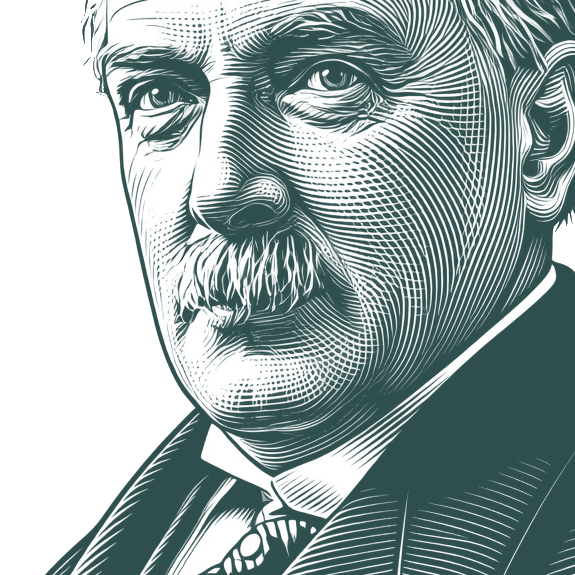
David Lloyd George (17 January 1863 – 26 March 1945) was a British politician, who served as Prime Minister of the United Kingdom from 1916 to 1922.
Bio from: Wikiquote (CC BY-SA 4.0) · Portrait adapted from: Wikimedia Commons, Harris & Ewing (Public domain / CC0)
Alternative Names:
David Lloyd George, 1st Earl Lloyd-George of Dwyfor
•
George David Lloyd
•
George Lloyd
•
Earl Lloyd-George
•
Lord Lloyd-George
From Wikidata (CC0)
Similar:
Ramsay MacDonald
66.7%
Winston Churchill
66.3%
Stanley Baldwin
65.8%
Clement Attlee
65.7%
H. H. Asquith
64.3%
Robert Gascoyne-Cecil, 3rd Marquess of Salisbury
63.6%
Margaret Thatcher
62.7%
William Ewart Gladstone
62.7%
Henry Temple, 3rd Viscount Palmerston
62.2%
Henry Campbell-Bannerman
62.2%
The Labour Party is being run by the extreme pacifist, Bolshevist group... What they really believed in was Bolshevism... I named one or two of them—Mr. Ramsay MacDonald, Mr. Snowden, Mr. Smillie, and others... [S]upposing they had had their way? (Cries of "Ah!") What would have happened? (A voice:—"We should have lost the war.") Belgium would have been overrun, France would have been overrun, Germany now would have had the whole Continent of Europe right under its cruel heel, the Channel ports would have been in the hands of the Germans...we should have been the slaves and the bondmen of Germany if we had listened to these men—and they are the real Labour Party at the present moment... I venture to say it would not be safe to entrust the destinies of a great Empire to their charge.
I have always said we will exact the last penny we can out of Germany up to the limit of her capacity, but I am not going to mislead the public on the question of the capacity until I know more about it, and I am not going to do it in order to win votes. It is not right; it is not fair; it is not straightforward; and it is not honest. If Germany has a greater capacity, she must pay to the very last penny.
Try QuoteGPT
Chat naturally about what you need. Each answer links back to real quotes with citations.
There is one point I had overlooked as to the question of the responsibility for the invasion of Belgium and the conduct of the war. The Government asked the Attorney-General to refer the question to some of the greatest jurists in this country. They have investigated it, and have come finally to the conclusion quite unanimously that in their judgment the Kaiser was guilty of an indictable offence for which he ought to be held responsible.
[W]hat about those people whom we received without question for years to our shores (Voices.—“Send them back”), who, after we did so and gave them equal rights with the sons and daughters of our own households, abused hospitality to betray the land that received them; to plot against its security, to spy upon it, and to supply information and weapons that enabled the Prussian War Lords to inflict, not punishment, but to inflict damage and injury, on the land which had received them. Never again! (Mr. Lloyd George here banged the table in front of him, and the audience cheered vociferously.)
I have already accepted the policy of Imperial preference...to the effect that a preference will be given on existing duties and on any duties which may subsequently be imposed. On this subject I think there is no difference of opinion between us. ... I am prepared to say that the key industries on which the life of the nation depends must be preserved. I am prepared to say also that, in order to keep up the present standard of production and develop it to the utmost extent possible, it is necessary that security should be give against the unfair competition to which our industries have been in the past subjected by the dumping of goods below the actual cost of production. ... I shall look at every problem simply from the point of view of what is the best method of securing the objects at which we are aiming without any regard to theoretical opinions about Free Trade or Tariff Reform.
Wilson is adopting a dangerous line. He wants to pose as the great arbiter of the war. His Fourteen Points are very dangerous. He speaks of the freedom of the seas. That would involve the abolition of the right of search and seizure, and the blockade. We shall not agree to that. Such a change would not suit this country. Wilson does not see that by laying down terms without consulting the Allies, he is making their position very difficult. He had no right to reply to the German Note without consultation, and I insisted upon a cablegram being sent to him. The position is very disturbing.
[T]he shielding of industries which have been demonstrated by the war to be essential to the very life of the nation. I remember when I was appointed Minister of Munitions I found there were industries essential to national defence which had been very largely captured by our enemies. ... [T]hese essential key industries shall be preserved after the war, not because we anticipate another war, but because we are less likely to have another war if they know that we are quite ready for any challenge on a just ground.