Prime Minister of the United Kingdom from 1916 to 1922
David Lloyd George (17 January 1863 – 26 March 1945) was a British politician, who served as Prime Minister of the United Kingdom from 1916 to 1922.
Bio from: Wikiquote (CC BY-SA 4.0) · Portrait adapted from: Wikimedia Commons, Harris & Ewing (Public domain / CC0)
From Wikidata (CC0)
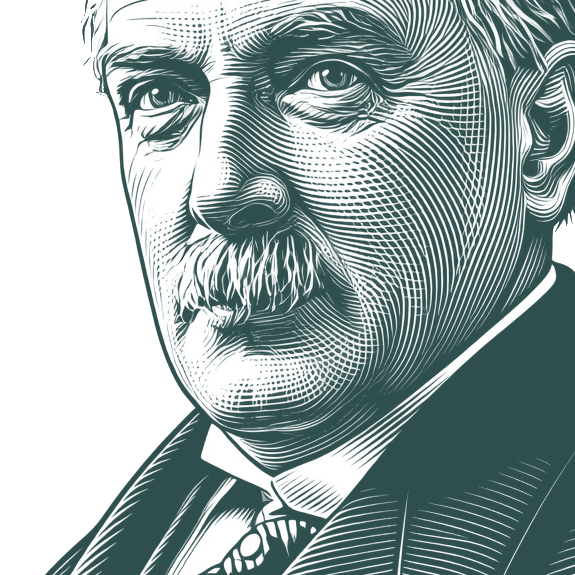

As we came away we ran into Lloyd George. Turning to me he said: "What are you going to do, my boy, when you grow up?" "I'm going into the Navy, sir," I replied. He frowned. "There are many greater storms in politics. If it's piracy you want, with broadsides, boarding parties, walking the plank and blood on the deck, this is the place." His words had gone home. That evening I confided to my father that what Lloyd George had said had decided my life. It would be politics for me.
There was no conspicuous officer in the Army who seemed to be better qualified for the Highest Command than Haig. That is to say, there was no outstanding General fit for so overwhelming a position as the command of a force five times as great as the largest army ever commanded by Napoleon, and many more times the size of any army led by Alexander, Hannibal or Caesar. I have no doubt these great men would have risen to the occasion, but such highly gifted men as the British Army possessed were consigned to the mud by orders of men superior in rank but inferior in capacity, who themselves kept at a safe distance from the slime which they had chosen as the terrain where their plans were to operate.
Independent thinking is not encouraged in a professional Army. It is a form of mutiny. Obedience is the supreme virtue. Theirs not to reason why. Orders are to be carried out and not canvassed. Criticism is insubordination. The object of discipline is to accustom men to respond to a command instantly, by instant action, without thought of effect or consequence. There were many intelligent officers and men who knew that the orders given them during the War were utterly stupid and must have been given by Staffs who had no understanding of the conditions. But orders were orders. And with their men they went to a doom they foresaw was inevitable. Such an instinctive obedience to the word of command is essential to the efficiency of a body of men who have to face terror, death or mutilation in the discharge of their terrible duties. But a long course of mental subservience and suppression cramps the development and suppleness of the intellect. It makes "an officer and a gentleman" but it is not conducive to the building up of an alert, adaptable and resourceful leader of men.
Generals were in every essential particular inadequately prepared for the contingencies which confronted them in this War. Had they been men of genius—which they were not—they could have adapted themselves more quickly and effectively to the new conditions of war. They were not equipped with that superiority in brains or experience over an amateur steeped in the incidents and needs of the War which would justify the attitude they struck and the note of assured pastmastership they adopted towards all criticism or suggestion from outside or below.
Advanced Search Filters
Filter search results by source, date, and more with our premium search tools.
The restoration of Belgium had become for us symbolic of the insistence on just dealings between nations and the suppressing of ruthless aggression by the strong against the weak. If aggression had been allowed to profit, to hold and keep its booty, it would have been an acknowledgment on the part of Britain either of hopeless defeat or utter dishonour.
Lenin was not concerned about democratic government. His main purpose was the social and economic emancipation of the worker under any form of government that would be most suited to achieve that end. The Bolsheviks were numerically a small party, drawn almost entirely from amongst the town workers, and their grip on power was not based on any principle of majority rule, gauged by the counting of heads, but on the right of the strongest, measured in terms of firm will, dear purpose and armed force. The peasants acquiesced with the patient docility of a people accustomed for generations to autocratic rule.
I was privileged, whilst this horrible battle was proceeding, to have a talk with one of Haig's most prominent military advisers, who afterwards owned that he had no idea of the conditions under which the battle was fought. I entreated him once more to reconsider the prospects of this venture in the light of what had actually happened. But he also was imbued with the relentlessness of his Chief. He treated me as a stupid civilian who knew nothing of war. When I alluded to the terrible casualties, he reminded me in Hotspur strain that you could not expect to make war without death and wounds. When I pointed to the wet season which had soaked the ground and made it unfit for the passage of tanks, artillery, or men, he said: Battles could not be stopped like tennis matches for a shower. Here again was Mars, but, I thought, Mars under an umbrella.