theoretical physicist and mathematician (1923–2020)
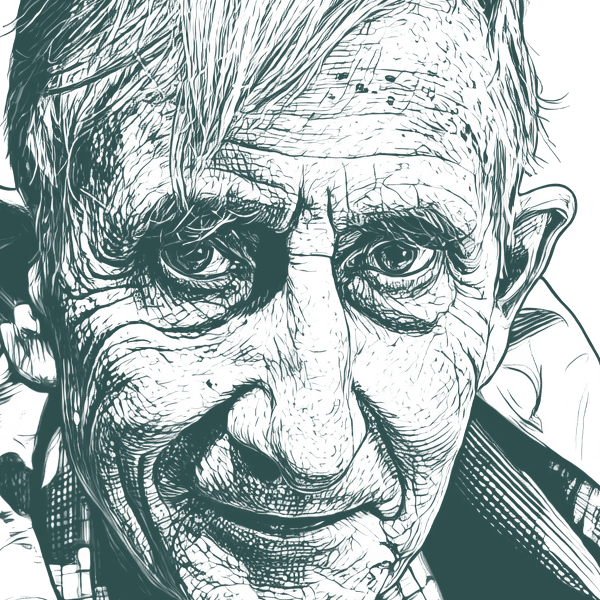
Freeman John Dyson (15 December 1923 – 28 February 2020) was an English-born American physicist, mathematician, and futurist, famous for his work in quantum mechanics, nuclear weapons design and policy, and the search for extraterrestrial intelligence. He was the winner of the Templeton Prize in the year 2000.
Bio from: Wikiquote (CC BY-SA 4.0) · Portrait adapted from: Wikimedia Commons, ioerror (CC BY-SA)
From Wikidata (CC0)
There is an enormous variety of things that we never dreamed of, like... black holes, s, quasars, all these unbelievably active goings-on in the universe... [I]n Aristotle's time the universe... was supposed to be quiescent, it was supposed to be perfect and peaceful, and nothing ever happened in the ; and that remained true... throughout all of the revolutions... It remained the general view of astronomers... through Copernicus, and Galileo, and Newton, and everybody else... until just the last 30 years, and now we know it's not like that at all. In fact the universe is full of violent events, and fantastic strong gravitational fields, and collapsed objects, and huge outpourings of energy. ...The things we understand least are the quasars... the most violent and... energetic objects in the universe, and they're totally... mysterious... and... they're rather frequent; and nobody ever dreamed that they existed... [E]ven after they were found it took a long time before people took them seriously. Nature's imagination is always richer than ours.
Enhance Your Quote Experience
Enjoy ad-free browsing, unlimited collections, and advanced search features with Premium.
In desperation I asked Fermi whether he was not impressed by the agreement between our calculated numbers and his measured numbers. He replied, "How many arbitrary parameters did you use for your calculations?" I thought for a moment about our cut-off procedures and said, "Four." He said, "I remember my friend Johnny von Neumann used to say, with four parameters I can fit an elephant, and with five I can make him wiggle his trunk." With that, the conversation was over.
Starting from Einstein's theory of general relativity, Oppenheimer and Snyder found solutions... that described what happens to a massive star when it has exhausted its supplies of nuclear energy. The star collapses gravitationally and disappears from the visible universe, leaving behind only an intense gravitational field to mark its presence. The star remains in a state of permanent free fall, collapsing endlessly inward into the gravitational pit without ever reaching the bottom. ... In my opinion, the black hole is incomparably the most exciting and the most important consequence of general relativity. But Einstein ... was actively hostile to the idea of black holes. ... Oddly enough, Oppenheimer too in later life was uninterested in black holes, although... they were his most important contribution to science. ... Oppenheimer in his later years believed that the only problem worthy of attention of a serious theoretical physicist was the discovery of fundamental equations of physics. Einstein certainly felt the same way.
Works in ChatGPT, Claude, or Any AI
Add semantic quote search to your AI assistant via MCP. One command setup.
My personal theology is described in the Gifford lectures that I gave at Aberdeen in Scotland in 1985, published under the title, Infinite In All Directions. Here is a brief summary of my thinking. The universe shows evidence of the operations of mind on three levels. The first level is elementary physical processes, as we see them when we study atoms in the laboratory. The second level is our direct human experience of our own consciousness. The third level is the universe as a whole. Atoms in the laboratory are weird stuff, behaving like active agents rather than inert substances. They make unpredictable choices between alternative possibilities according to the laws of quantum mechanics. It appears that mind, as manifested by the capacity to make choices, is to some extent inherent in every atom. The universe as a whole is also weird, with laws of nature that make it hospitable to the growth of mind. I do not make any clear distinction between mind and God. God is what mind becomes when it has passed beyond the scale of our comprehension. God may be either a world-soul or a collection of world-souls. So I am thinking that atoms and humans and God may have minds that differ in degree but not in kind. We stand, in a manner of speaking, midway between the unpredictability of atoms and the unpredictability of God. Atoms are small pieces of our mental apparatus, and we are small pieces of God's mental apparatus. Our minds may receive inputs equally from atoms and from God. This view of our place in the cosmos may not be true, but it is compatible with the active nature of atoms as revealed in the experiments of modern physics. I don't say that this personal theology is supported or proved by scientific evidence. I only say that it is consistent with scientific evidence.
The moral of Gandhi's life and death is that pacifism as a political program is much more difficult to sustain than pacifism as a personal ethic. Being himself a leader of extraordinary charisma and skill, Gandhi was able to organize a whole people around a program of pacifism. He proved that a pacifist resistance movement can be sustained for thirty years and can be strong enough to defeat an empire. The subsequent history of India proved that political pacifism was not strong enough to survive the death of its leader and to withstand the temptations of power.
Looking back upon this history, I disagree with Galison's conclusion. I do not see critical opalescence as a decisive factor in Einstein's victory. I see Poincare and Einstein equal in their grasp of contemporary technology, equal in their love of philosophical speculation, unequal only in their receptiveness to new ideas. Ideas were the decisive factor. Einstein made the big jump into the world of relativity because he was eager to throw out old ideas and bring in new ones. Poincare hesitated on the brink and never made the big jump. In this instance at least, Kuhn was right. The scientific revolution of 1905 was driven by ideas and not by tools.