No country is without popular heroes. America has at least one. Like young Lochinvar he "has come out of the West." He is in Chicago at present. His name is J. Howard Moore [...] He became a hero by a book. It happened this way. One day the Illinois Legislature passed a bill compelling teachers to instruct their pupils in morals, thirty minutes a week. Forthwith there was a panic. Ladies' hearts fluttered and men's lips dropped naughty words. Nobody in Illinois knew how to teach morals. Nobody? Just one. J. Howard Moore.
American zoologist and philosopher (1862–1916)
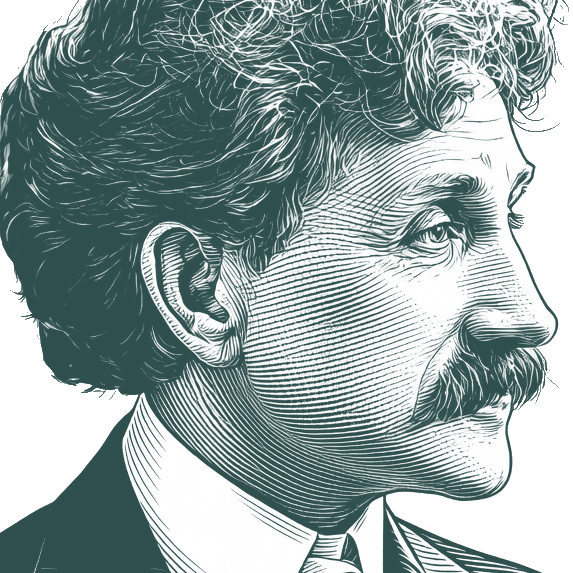
John Howard Moore (December 4, 1862 – June 17, 1916) was an American zoologist, philosopher, educator and social reformer. He advocated for the ethical consideration and treatment of animals and authored several articles, books, essays and pamphlets on topics including education, ethics, evolutionary biology, humanitarianism, utilitarianism and vegetarianism. He is best known for his work The Universal Kinship (1906), which advocated for a secular sentiocentric philosophy he called the doctrine of "Universal Kinship", based on the shared evolutionary kinship between all sentient beings.
Bio from: Wikiquote (CC BY-SA 4.0) · Portrait adapted from: Wikimedia Commons, Gibson, Sykes & Fowler (Public domain / CC0)
Alternative Names:
Prof. J. Howard Moore
•
Professor J. Howard Moore
•
John Howard Moore
•
J. H. Moore
•
Howard Moore
•
J. H. M.
From Wikidata (CC0)

Limited Time Offer
Premium members can get their quote collection automatically imported into their Quotewise collections.
I have a theory that we judge best of the reality of friendships in absence; and if this be true, I cannot have been mistaken as to the warmth of my feelings for Howard Moore, for I never saw him in person, though we corresponded regularly for years, and I have still a big packet of his letters which show him to have been no less lovable as a man than he was brilliant as a writer.
In The Universal Kinship, Howard Moore left to humanitarians a treasure which it will be their own fault if they do not value as it deserves. There is a tendency to forget that it is to modern evolutionary science that the ethic of humaneness owes its strongest corroboration. The physical basis of the humane philosophy rests on the biological fact that kinship is universal. Starting from this admitted truth, Moore showed, with much wealth of argument and epigram, that the supposed psychical gulf between human and non-human has no more existence, apart from the imagination of man. than the physical gulf which has now been bridged by science. The purpose of our movement was admirably stated by him: "to put science and humanitarianism in place of tradition and savagery." It was with that aim in view that our League of Humaneness had been formed.
Perhaps the most able of all vindications of humane principles is that contained in Mr. Howard Moore's The Universal Kinship, published by the League in 1906. It was through a notice which I wrote in the Humanitarian of an earlier book of his, Better-World Philosophy, that the League first came into association with him; and I remember with shame that when that "sociological synthesis," as its sub-title proclaimed it to be, first came into my hands, I nearly left it unread, suspecting it to be but the latest of the many wearisome ethical treatises that are a scourge to the reviewer, to whom the very word "sociology" or "synthesis" is a terror. But fortunately I read the book, and quickly discovered its merits; and from that time, till his death in 1916, Howard Moore was one of the truest and tenderest of our friends, himself prone to despondency and, as his books show, with a touch of pessimism, yet never failing in his support and encouragement of others and of all humanitarian effort. "What on earth would we Unusuals do, in this lonely dream of life," so he wrote in one of his letters, "if it were not for the sympathy and friendship of the Few?"
Indeed, all his works are replete with the sublimest thoughts and inspirations, and the least that we, as Comrades, can do as proof of our mission to spread "enlightenment is first, to acquaint ourselves with Professor Moore's books, and secondly, to pass the knowledge on to others. Thus his efforts shall not have been in vain.
John Howard Moore wrote and worked with feverish haste, and he believed that the blind and heartless world would listen to his words and mend its ways. But humanity went on trading and dickering, lying and cheating, marrying and dying, and never heard his voice. One day he opened his eyes and knew his work was in vain, and feeling the weight of the universal sorrow on his soul, he took his life. The coroner's jury determined that "he died from his own hand, while suffering under a temporary fit of insanity." I tell you he died from his own hand while suffering under a temporary fit of sanity [...] Poor, dead dreamer! You are not the first or last mortal to learn the truth. Other men have awakened from the mad and blissful dream of saving mankind from itself. I, too, have dreamed my dreams, had my illusions, and wakened from my sleep [...] Among all who are gathered here there is but one whom we can felicitate on this event, and that one is our friend who lies peaceful and all unconscious of the world. If any word of mine could call back his troubled soul, I should feel myself guiltier far than I would to cause a brother's death.
This man, our brother, never purposely killed a living thing until he put the pistol to his head. Poor dead dreamer, you are not the first or last mortal to learn the truth [...] I have dreamed my dreams, had my illusions and wakened from my sleep. Why do I not follow him? I do not end it all because the love of life and the shrinking fear of death in all living things stays my hand and my courage fails.
It is not too much to say that all that should be said, all that can be said, all that any one of us thinks he would like to say, is said in this book [The Universal Kinship] [...] nothing that I have ever yet read has so brought home to me the whole question of my relationship to and personal responsibility for the subhuman creation.
[The Universal Kinship] leaves me in a glow of enthusiasm and hope. It seems like the embodiment of years of almost despairing effort and pain of all of us who have felt these things. That which we have been thinking and feeling—some in one direction and some in another, some in fuller understanding and breadth, others in little flashes of insight here and there—all seems gathered together, expressed, and given form and color and life in your wonderful book.
I do not know of any book [The Universal Kinship] dealing with evolution that I have read with such keen interest. Mr. Moore has a broad grasp and shows masterly knowledge of the subject. And withal the interest never flags. The book reads like a novel. One is constantly keyed up and expectant. Mr. Moore is to be congratulated upon the magnificent way in which he has made alive the dull, heavy processes of the big books. And, then, there is his style. He uses splendid virile English and shows a fine appreciation of the values of words. He uses always the right word.
Everywhere we turn we find evidence that the "civilization," so-called, of higher peoples is a made-over something, and that the antecedent thing from which it has been derived is the "civilization" of the savage. In this derived "civilization" we find everywhere features of the old, antecedent, and disappearing order of things customs, laws, beliefs, languages, ideals, and institutions which are now no longer functional, but which survive in a more or less dwindling condition in obedience to the same laws as those which perpetuate the vermiform appendix and the hairy covering of our bodies and the hunting and fighting instincts of our natures. It is of vast advantage to us to be able to recognize these vestigial features, in order that we may more skilfully disentangle ourselves from them and at the same time definitely turn our backs on them in our efforts to advance toward a Better World.