I'm trying to fulfill all my promises. And I think I was quite reticent in making those promises, certainly compared to some of my opponents. But we've put forward already to the Congress proposals that carry out the major promises that I made--reorganization, energy, welfare reform, and so forth. We've also been successful, I think-when an analysis is made of what the Congress achieved this year, I think there's going to be a very pleasant reaction from the American people when they see the progress that we've accomplished. So, I don't think I made too many promises, and I think I'm doing an adequate job in trying to fulfill those promises. There is a very heavy agenda for the Congress. And it's much easier for the administration to evolve a proposal or to present legislation to the Congress than it is for Congress actually to pass it. And so the Congress will inherently follow behind any administration in dealing with very controversial issues that have no easy solution. So, I think so far our relationship with the Congress has been good. The effort to carry out my promises has been adequate. I don't think I made too many promises to the American people.
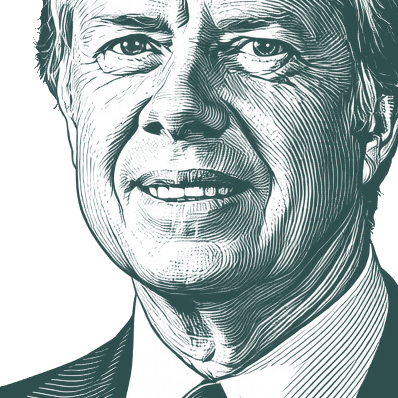
president of the United States from 1977 to 1981 (1924–2024)
James Earl Carter, Jr. (October 1, 1924 – December 29, 2024) was an American politician and member of the Democratic Party who served as the 39th president of the United States from 1977 to 1981. In 1982 he established the Carter Center, as a base for promoting human rights, democracy, finding peaceful solutions to international conflicts, and advancing economic and social development, for which he was awarded the Nobel Peace Prize in 2002. He was a key figure in the Habitat for Humanity project, and has been noted for his criticism of Israel's role in the Israeli–Palestinian conflict.
Bio from: Wikiquote (CC BY-SA 4.0) · Portrait adapted from: Wikimedia Commons, Department of Defense. Department of the Navy. Naval Photographic Center (Public domain / CC0)
Birth Name:
James Earl Carter Jr.
Alternative Names:
James E. Carter
•
James Carter
•
James Earl Carter
•
39th President of the United States
•
James E. Carter Jr.
•
James Earl Carter, Jr.
•
James E. Carter, Jr.
From Wikidata (CC0)
Well, as I spelled out in my last fireside chat to the American people, there 'are three basic elements that I would require: One is fairness in dealing with consumers; the second one is meeting the goals of both conservation and production in the energy area; and, third, an energy proposal that won't bankrupt this Nation nor seriously disturb the future budgets of our country. That's a fairly broad base, and I think it's an adequate parameter within which the conferees can work. But if any of those principles are violated, I would not sign the bill.
I've never had any conversation with Senator Long that would either encourage me or require me to change my position from what it was last April. We still maintain that the proposition we put to the House and Senate in the energy proposal is the best. The House-passed version of the comprehensive energy plan is very close to what we've proposed, and we support the House position in almost every instance when there is a disagreement. I don't have any inclination to modify that position anytime soon. We will be consulting very closely with the particular conferees who most nearly espouse the administration's position, and I would guess that the negotiations leading to some ultimate resolution of differences would be between the Senate conferees, headed by Senator Long and also, of course, Senator Jackson, on the one hand and the House conferee leaders on the other side. We will add our assistance when we can, but we will not betray the confidence of people who look to us for leadership. And I will not work out any private agreement with Senator Long that would betray the commitments that we've made previously, publicly, I might say, in all instances. So, I don't see any possibility of doing what you propose, or what you ask about. Obviously, both sides are very likely to compromise. They've already had compromises on literally dozens of issues. The three major issues remaining, as you know, are the electric rate reform--we have a good chance of having that resolved this week--the pricing structure on natural gas--and that conference committee will go back to work tomorrow; Senator Jackson is returning to Washington, D.C., then--and of course, the tax on crude oil. And these are to some degree interrelated. But I think that we've got a good chance, still, for making progress now, and I'm going to maintain the position that we described last April as long as possible, support in every instance the conferees that support our position.
Well, I think that we or the Soviets ought to play a constructive role. And I think both of us will. We have been the nation then and, I think, now that is uniquely trusted by all the parties involved to act fairly and consistently concerning the Middle East questions. I don't believe that the Soviets occupy that position. And I don't have any doubt that if the nations surrounding Israel can work out an individual peace settlement with Israel leading to peace treaties, that the Soviets will play a constructive role, certainly at that point. It would be contrary to their own interest to be identified as an obstacle to peace. I don't think they are trying to be an obstacle to peace. Their perspective is just different from ours.
The Soviets have been involved in the peace negotiations ever since 1973. The entire Geneva conference concept was established through the United Nations with the United States and with the Soviet Union as cochairmen. So, this has been established now for at least 4 years. And this is a concept that has been adopted and approved by all the parties involved, including the United Nations overwhelmingly, perhaps even unanimously. In the past, I think it's accurate to say that the Soviets have not played a constructive role in many instances because they had espoused almost completely the more adamant Arab position. My own feeling is that in recent months, the Soviets have moved toward a much more balanced position as a prelude to the Geneva conference. We have tried to spell out very clearly-certainly since I've been in office and, I think, my predecessors as well--the United States position. We disagree in some of those issues with the Soviet Union. We've not concealed those differences. We disagree in some instances because of the procedural items that are being discussed. But there is no division between us and the Soviet Union now that didn't exist before, and I would say that their positions have been much more compatible recently. I wish that the Soviets had decided to go to Cairo. They've decided not to. But we'll make as much progress as we can, following the leadership of Sadat and Begin, to make real progress in Cairo with the Soviets not present. And my belief is that the desire of the whole world is so great for peace in the Middle East that the Soviets will follow along and take advantage of any constructive step toward peace. The fact that we do have differences of opinion is well known and I don't think is an obstacle to eventual peace in the Middle East. But we did not bring the Soviets in. They have been in since the very initiation of a Geneva conference. Do you have a followup?
Well, we and Egypt and Israel have all taken the position, publicly, and the same position privately among ourselves, that a separate peace agreement between Egypt and Israel to the exclusion of the other parties is not desirable. This is predicated upon the very viable hope that a comprehensive settlement can be reached among all the parties involved. If at some later date it becomes obvious that Jordan does not want peace or that Syria does not want peace or that Lebanon does not want peace in a settlement with Israel, then an alternative might have to be pursued. But we've certainly not reached that point yet. I think that the other Arab leaders do want peace with Israel. And I am certainly not even considering, and neither is Sadat nor Begin, any assumption that the possibilities for peace have narrowed down to just two nations.
Well, I think that President Sadat, in his private communications with me and even in his public statements, has said that he is trying as best he can to represent the Arab position concerning Israeli withdrawal from occupied territories and also the resolution of the Palestinian question. Obviously, the leaders in Syria, even Jordan, certainly the PLO, have not recognized that Egypt is speaking for them adequately. I think, though, that in his speech to the Knesset, in his followup speech to the People's Assembly in Egypt, President Sadat has evoked very clearly the basic Arab position that I have understood in my private conversations with President Asad from Syria and with the King of Jordan, Hussein. So, I believe that this is an exploratory effort that does accurately represent the basic differences between Israel and all their neighbors. And the fact that Jordan and Syria have not been willing to participate, I don't think has dampened President Sadat's commitment or enthusiasm at all. It is constructive, and I think what he discovers in his already completed discussions with Prime Minister Begin and those that might be taking place in Egypt in the middle of next month will certainly be conducive to pursuing the Arab cause. I think it's constructive, because for the first time, the Arab position on those controversial issues has been spelled out very clearly for worldwide understanding. And I think the differences that have been faced by us and others for long years are now much more clearly understood by the public. The differences are still sharp; the resolution of those differences is going to be very difficult. I think that to the best of his ability, President Sadat is speaking for the Arab world.
The other comment I'd like to make is concerning the Middle East. In the last few days we have seen, I believe, an historic breakthrough in the search for a permanent, lasting peace in the Middle East because of the true leadership qualities that have been exhibited by the courage of President Sadat and the gracious reception of him in Israel by Prime Minister Begin. This has been, already, a tremendous accomplishment. I think the importance of it is that there has been an initiation of direct, person-to-person negotiations between Israel and the major power in the Mideast among the Arab nations who are Israel's neighbors. Lebanon, Syria, Jordan have a total population of about 12 million; Egypt has a population of 36 million and has by far the greatest military force. And the fact that this strongest Arab country and the nation of Israel are now conducting direct negotiations is a major accomplishment in itself. Two of Israel's most cherished desires have already been met. One is this face-to-face negotiation possibility, and the other one is a recognition by a major Arab leader that Israel has a right to exist. In fact, President Sadat said, "We welcome you in our midst." The United States has been very pleased to see this reduction in distrust and a reduction in fear and a reduction in suspicion between the Arabs and the Israelis. We have played a close consultative role with both of these leaders. We have, on several instances recently, acted as intermediaries at their request. Both Prime Minister Begin and President Sadat have publicly expressed their reconfirmation that these exploratory talks are designed to lead toward a comprehensive settlement including Israel and all her neighbors.Sunday, President Sadat called for a conference in Cairo. This is likely to be held around the 13th of December, about the middle of December. We will participate in that conference at a high level--Assistant Secretary Atherton will represent our Nation. We look on this as a very constructive step. The road toward peace has already led through Jerusalem, will now go to Cairo and ultimately, we believe, to a comprehensive consultation at Geneva. It's not an easy thing to bring about a comprehensive peace settlement. Immediate expectations have sometimes been exaggerated. The definition of real peace--I think we've made good progress on that already. The resolution of the Palestinian question still has not been decided. And the solution to the problem concerning borders and national security has also not been decided. We have played, I think, a proper role. I have tried to convince, in the past, Prime Minister Begin of the good intentions of President Sadat and vice versa. When there has been no progress being made, the United States has taken the initiative. Now that progress is being made, a proper role for the United States is to support that progress and to give the credit to the strong leadership that's already been exhibited by Prime Minister Begin and President Sadat and to let our Nation be used, as called upon, to expedite the peace process. I believe that this is a move that the whole world looks upon with great appreciation. And again, I want to express my congratulations and my appreciation to these two strong leaders for the tremendous progress already made and for their commitment to future progress.
Good morning. Thank you. I have two brief statements to make. One concerns Senator John McClellan from Arkansas, whose funeral is being held today. He served in the Congress for 39 years and exemplified a deep commitment to his own major committee assignments. He has recently been the chairman of the Appropriations Committee. He was always a strong fighter for an adequate national defense, and he was a man of supreme integrity. In a few minutes, the Vice President and my wife, the First Lady, will be going to the funeral along with a large delegation of Members of Congress. And I want publicly to express, on behalf of the American people, my admiration for what he has done, my public condolences, in addition to the private condolences I've already extended to his wife, and my appreciation for his tremendous contribution to our country.
I think now there's a new spirit in our Nation. I believe with our stand on human rights, our efforts to bring peace, to reduce the nuclear threat, to alleviate the hatreds in the Middle East, to bring majority rule and peace to southern Africa, that there is a sense of purpose again. And in my own way as a human being with limits that you and I both recognize, but occupying the most important office perhaps in the whole world, I want to be sure that the American flag is once more lifted high and when anyone on Earth sees it, they think about freedom, they think about the worth of an individual human being, they think about hope, they think about a sense of compassion and love, they think about high ideals, they think about openness of government, they think about democratic principles, they think about compassion and concern, and they think about the worth of our people who live in harmony from so many different places on Earth. These are the hopes that I have as President. I thank you for your involvement in the democratic processes, your support of our party, your friendship toward me. I thank you for the fine congressional delegation that you've sent to Washington who represent you and our Nation so well. And I know that I can speak for them as I repeat a phrase that I used thousands of times in my long campaign: All I want and all they want is a government as good as the people of our country. Thank you very much.
I wanted to mention tonight especially those two among many subjects that fall on my shoulders--agriculture and energy. The tests of political strength are severe; the responsibilities are great; the complexities are very difficult; the questions are hard to answer. But what gives me a sense of assurance and confidence is the degree with which I am close to you. When I base my opinion and my decision and my efforts on what I know you feel and what I know that you want, to that degree I feel that I represent you and our Nation well. I have a feeling that we are making good progress in correcting some of the deep concerns that we felt a year, 2 years, 3 years ago. The spirit of our country had been damaged severely by the Vietnam war. It had been damaged severely by the Watergate revelations, by the CIA investigations. There was a sense of concern about what our Nation stood for.
There are some myths that are exploited on your television set several times a day, sometimes several times an hour. The first myth is that the oil and gas industry is controlled by free market forces. All of us believe in the free enterprise system, but there is no free enterprise system in the oil and gas market. The prices are not established by competition. The prices are established arbitrarily when the OPEC nation leaders meet in secret and say, next year this is what we will charge for oil. And, as you well know, immediately that oil price prevails in new oil discoveries in our country. We have a need, at least for our Government, to play a stronger role, as is played in other countries. But we ought to get away from the proposition or the thought that free market forces control oil or natural gas prices. Another myth is that there's an inherent conflict between conservation and production. This is not true. We are making good progress in exploration for oil. There's about an 8-month waiting period right now for new oil drilling rigs. If we triple the price of oil and natural gas, there could be no substantial increase in the rate of exploration. It would be just an enormous windfall of profits. The cheapest oil is what we save, and the cheapest natural gas is what we save. Quite often it costs nothing to save the equivalent of one barrel of oil per day. When we add expensive conservation measures, it costs maybe from zero to $3,500 to provide the saving of one barrel of oil per day. The oil that we are now going to bring down from Alaska costs about $20,000 in capital investment for one barrel of oil per day, used at its final place to heat a home. For the production of electricity, the capital investment required is much greater, maybe $50,000 to $100,000 for the equivalent of one barrel of oil used in your home in electricity. For nuclear powerplants, the investment is $200,000 to $300,000 per barrel of oil per day, when it's actually delivered to your home for use. So, to conserve a barrel of oil is much better than producing that barrel of oil in investment alone. And at the same time it reserves for future use these extremely scarce supplies.
It's not easy to remove the hold on our government processes that have been in existence for a long time by the oil and gas companies, but I'm determined to do it with your help. In many ways, the acceptance by the American people and the acceptance by the American Congress of a comprehensive energy policy is a test of our strength and a test of our national will. The rest of the nations of the world watch us very closely to see if we can sacrifice in a time of international need. The proposal that we've put forward is bitter medicine, but it's not nearly so bitter as the catastrophe that might befall us if we don't take rapid action. We have put forward a well-balanced program that will induce our own selves to conserve energy of all kinds. It will induce us, without hurting us deeply, to shift to other forms of energy, away from oil and natural gas. I'm determined that the consumers of our Nation will not be hurt and that the oil suppliers, the companies that produce oil and gas, will not be enriched in an unwarranted fashion. We have built into our proposal adequate incentives to encourage oil and gas exploration and production. Under our own program new oil discovered by American companies in the future will have the highest price on Earth. But still the oil companies want more. And unless we stand firm, they may get it. And if they do, it will come out of the pockets of those who need it, who need the money and who need adequate energy supplies most. As a farmer, I know that we, just a small part of the American population, use $6 billion worth of oil and gas every year. About 75 percent of all the energy we use is oil and natural gas. This means that we have got to have a supply in the future, because it takes natural gas and propane to dry our crops. It takes oil to drive our tractors and our trucks and our other machinery. We can't very easily shift to coal. So, as we conserve and shift to other supplies of energy, in the production of electric power, for instance, it makes that much more available to farmers in the future when energy supplies become even more scarce.
There's another item I'd like to mention tonight, and that's the subject of energy. I presented to the Congress and to the American people last April, for the first time in the history of our Nation, a comprehensive energy policy. We had a severe blow in 1973 when the prices of oil were quadrupled almost overnight. And when an oil embargo was slapped on our country, that economically almost brought us to our knees. Other nations suffered the same challenge. They have reacted well. The consumption of oil in Germany, compared to 1973, is down. The consumption of oil in Sweden is down, France down, Italy down, Japan down. The consumption of oil in the United States since 1973 is up 87 percent. This year we are importing $45 billion worth of oil from overseas, half of the oil we use. And that's almost exactly the amount that we waste, that we don't have to waste. Notice that this is twice as much oil imported as all the agricultural products that we export. Something must be done.
One of the promises that I made to the farmers of this State and others during my campaign was there would be no more grain embargoes, and you can depend on that. There won't be as long as I'm in the White House. We're trying to establish, for instance, a noncommercial insurance program to make sure that farm product exporters are protected from losses that they can't anticipate. We're trying to expand Public Law 480 to increase the export of our farm products, food and fiber and feed, to nations that are destitute and hungry. We're trying to cut down artificial trade barriers in the multinational trade negotiations now going on in Europe. We're opening agricultural trade offices in places around the world where they haven't existed before. We're trying to make it possible for farmer-owned cooperatives to negotiate directly in the sale of feed grains and food grains. We're making sure that we bring together the different departments of our Federal Government in the common effort to sell agricultural products--the Labor Department, our Special Trade Representative, the Commerce Department, the State Department, as well as the Department of Agriculture. We're trying to establish a comprehensive world food policy to match the tremendous production that we have with the tremendous need among the hungry people of the world. And we're trying to explore new markets, not only in Western Europe and Japan but in Eastern Europe and other countries as well. So, in the export of food we're trying to increase the quality of service that the great farm areas of our Nation provide for the rest of the world. We've got a long way to go. We have to work out the problem with food reserves, and my promise to the farmers of this area was that when we did have high-yielding crops--and this is the greatest crop we have ever had in corn; it's the greatest crop we've ever had in soybeans that we would have reserves that would be not under the control of the Government, but supported and controlled by farmers so there can be no dumping on the market, artificially, to lower prices. And I promised you that we'd do the best I could to get the Government out of interference in the production, storage, and marketing of crops. These kinds of challenges are constantly on my mind. We have a long way to go in soil and water conservation efforts, and we've got a long way to go in providing a comprehensive disaster assistance program.