The Master of Elibank is quite right when he says that Socialism and Liberalism are antagonistic forces. Socialism represents the principles taught by Christ, the reign of love and fraternity; Liberalism represents fierce, unscrupulous strife and competition, the aggrandisement of the strong, the robbery of the weak. Between these there can be no truce. The struggle is between God and Mammon, and Liberalism has ever been a devotee of Mammon.
Scottish socialist and labour leader (1856–1915)
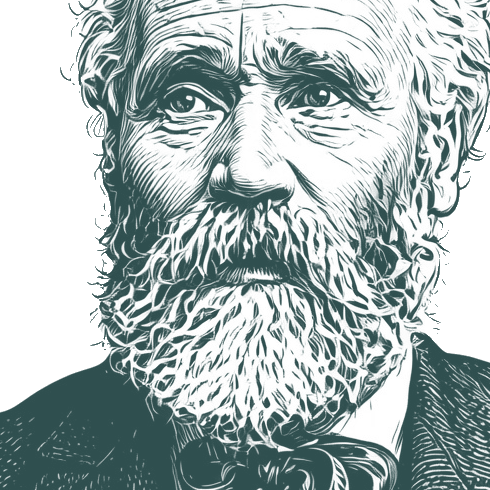
James Keir Hardie (15 August 1856 – 26 September 1915) was a Scottish trade unionist and politician. He was a founder of the Labour Party, and served as its first parliamentary leader from 1906 to 1908.
Bio from: Wikiquote (CC BY-SA 4.0) · Portrait adapted from: Wikimedia Commons, George Grantham Bain / Adam Cuerden (Public domain / CC0)
Alternative Names:
James Keir Hardie
From Wikidata (CC0)
Showing quotes in randomized order to avoid selection bias. Click Popular for most popular quotes.
If it could be shown that the great Trust magnate or the great Aristocratic landowner, apart from the advantages of his inherited wealth, was a more highly developed species of humanity than the poor struggling sempstress or the unemployed docker, then there might be some justification for allowing the docker and the sempstress as the representatives of a weaker class to die out in order to enable the more highly developed creature to survive; but one moment's reflection will show that the alleged superiority of the landowner or the Trust magnate rests on one fact alone, namely, that he owns certain material possessions, usually inherited, which enable him to dictate the terms upon which his less fortunate fellow creatures shall be permitted to live.
We are called upon at the beginning of the twentieth century to decide the question propounded in the Sermon on the Mount, as to whether we will worship God or Mammon. The present day is a Mammon-worshipping age. Socialism proposes to dethrone the brute-god Mammon and to lift humanity into its place. I beg to submit, in this very imperfect fashion, the resolution on the paper, merely promising that the last has not been heard of the Socialist movement either in the country or on the floor of this House, but that, just as sure as Radicalism democratised the system of government politically in the last century, so will socialism democratise the country industrially during the century upon which we just entered.
Women have no voice in making the laws which they are expected to obey. "What about Mrs. Pankhurst?" ejaculated one of the audience, to which Mr. Hardie retorted, "If women are not allowed a say in making the laws they are justified in breaking them." (Loud shouts of dissent and a voice, "What about burning houses?") Mr. Hardie continued:—When men were agitating for the franchise not only were houses burnt, but there was armed revolution and rioting. I will oppose every Franchise Bill, including what is called plural voting, until women have the franchise.
If...the Social Democrats make substantial gains at the polls every one here...will accept that as indisputable proof that the German people desire peace. ... A great Socialist triumph on that day would not only sweep the clouds of war from off this political horizon, but would also make it easy for an understanding to be reached between Germany and Great Britain concerning future naval policy, and thus relieve the taxpayers of both countries of the crushing burden which the present rivalry in Dreadnought building imposes.
They wanted to see in the House of Commons a strong Labour party, which would be able to compel the employer class and the landlord class to take their hands off the life of the nation and enable the working people to have a chance to live. They knew the terrible curse landlordism had been to Ireland; it had been the same in Scotland. It had been a curse all the time and always, and they wanted to get rid of it. They could only do so by having Labour members in Parliament to fight the cause of the common people.
Max Muller, on the strength of official documents and a missionary report concerning education in Bengal prior to the British occupation, asserts that there were 80,000 native schools in Bengal, or one for every 4000 of the population. Ludlow, in his History of British India, says that "in every Hindoo village which has retained its old form I am assured that the children generally are able to read, write, and cipher, but where we have swept away the village system, as in Bengal, there the village school has also disappeared."
The individualistic conception of the State as some external authority exercising a malign influence upon the life of the community is a travesty of fact. The State is that form of organised society which has evolved through the process of the ages, and represents the aptitude for freedom and self-government to which any people has attained. The policeman and the soldier, for example, who are at the call of the landlord or the employer when tenant or workman becomes turbulent, exist by the will and under the express authority of those same tenants and workmen, who constitute a preponderating majority in the State, and without whose consent neither soldier nor policeman could continue to exist.
Surely we had got beyond that stage of civilisation as represented by war and the age of barbarism. What was the deduction from Mr. Haldane's observations? That the mass of the people in the industrial army corresponded to the rank and file in the military Army were to have no opinions, no individuality, no will of their own, no right to think, and no power to act, that they were to be obedient and in subjection to those placed in power and authority over them. That kind of dogma might do for the military feudalism of Germany, but it was alien and contrary to the freedom-loving spirit of Scotland, which inspired the poems of Robert Burns.
They should remember that if wages were not so good as they should be, if the hours were long, and if the conditions of labour were becoming worse, the responsibility rested with those men who would not come inside the union and try to make things better. What was it that kept them apart? Some people said it was because...men held different religious opinions they would not work together in the union. Nothing, in his opinion, could be more stupid. What did it matter to a man whether his neighbour was a Protestant or a Catholic so long as they were working men and had one common interest, to work together for each other's good?
Limited Time Offer
Premium members can get their quote collection automatically imported into their Quotewise collections.