American venture capitalist
Samuel Harris Altman (born 1985) is an American entrepreneur, investor, and programmer. He is the CEO of OpenAI and was the co-founder of Loopt. He previously was the president of Y Combinator and was briefly the CEO of Reddit.
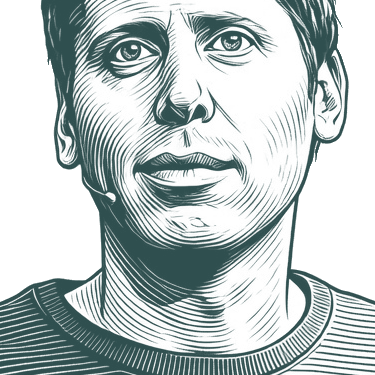
Bio from: Wikiquote (CC BY-SA 4.0) · Portrait adapted from: Wikimedia Commons, Steve Jurvetson (CC BY)
From Wikidata (CC0)

All companies that grow really big do so in only one way: people recommend the product or service to other people. What this means is that if you want to be a great company some day, you have to eventually build something so good that people will recommend it to their friends—in fact, so good that they want to be the first one to recommend it to their friends for the implied good taste. No growth hack, brilliant marketing idea, or sales team can save you long term if you don't have a sufficiently good product.
A big secret is that you can bend the world to your will a surprising percentage of the time—most people don't even try, and just accept that things are the way that they are. People have an enormous capacity to make things happen. A combination of self-doubt, giving up too early, and not pushing hard enough prevents most people from ever reaching anywhere near their potential.
"Ask for what you want. You usually won't get it, and often the rejection will be painful. But when this works, it works surprisingly well. Almost always, the people who say "I am going to keep going until this works, and no matter what the challenges are I'm going to figure them out", and mean it, go on to succeed. They are persistent long enough to give themselves a chance for luck to go their way."
Focus is a force multiplier on work. Almost everyone I've ever met would be well-served by spending more time thinking about what to focus on. It is much more important to work on the right thing than it is to work many hours. Most people waste most of their time on stuff that doesn't matter.
"Once you have figured out what to do, be unstoppable about getting your small handful of priorities accomplished quickly. I have yet to meet a slow-moving person who is very successful."
Life is not a dress rehearsal—this is probably it. Make it count.
Time is extremely limited and goes by fast. Do what makes you happy and fulfilled—few people get remembered hundreds of years after they die anyway. Don't do stuff that doesn't make you happy (this happens most often when other people want you to do something). Don't spend time trying to maintain relationships with people you don't like, and cut negative people out of your life…
The days are long but the decades are short.
We face serious risk. We face existential risk. The challenge that the world has is how we’re going to manage those risks and make sure we still get to enjoy those tremendous benefits. No one wants to destroy the world. Let's make sure we come together as a globe — and I hope this place can play a real role in this. We talk about the IAEA as a model where the world has said 'OK, very dangerous technology, let's all put some guard rails.' And I think we can do both. I think in this case, it's a nuanced message 'cause it's saying it's not that dangerous today but it can get dangerous fast. But we can thread that needle.
Is [AI] gonna be like the printing press that diffused knowledge, power, and learning widely across the landscape that empowered ordinary, everyday individuals that led to greater flourishing, that led above all two greater liberty? Or is it gonna be more like the atom bomb – huge technological breakthrough, but the consequences (severe, terrible) continue to haunt us to this day?
In a well functioning society, governments would be doing the AGI project and [nuclear] fusion and a whole bunch of things — and yet they’re not. So we either sit around and watch the gradual decline of state capacity and say ‘that’s a bummer’ and we’re just not going to have any more technical progress . . . or you do the next best thing and just build great companies.
I think what we believe in very strongly, is that keeping the rate of change in the world relatively constant, rather than, say, go build AGI in secret and then deploy it all at once when you’re done, is much better. This idea that people relatively gradually have time to get used to this incredible new thing that is going to transform so much of the world, get a feel for it, have time to update. You know, institutions and people do not update very well overnight. They need to be part of its evolution, to provide critical feedback, to tell us when we’re doing dumb mistakes, to find the areas of great benefit and potential harm, to make our mistakes and learn our lessons when the stakes are lower than they will be in the future. Although we still would like to avoid them as much as we can, of course. And I don’t just mean we, I mean the field as a whole, sort of understanding, as with any new technology, where the tricky parts are going to be..