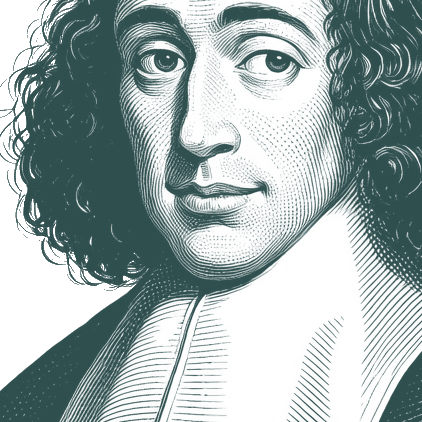
As is well known, a great flowering of Neo-Spinozism occurred in German philosophy and literature in the late eighteenth and early nineteenth centuri… - Benedictus de Spinoza
""
As is well known, a great flowering of Neo-Spinozism occurred in German philosophy and literature in the late eighteenth and early nineteenth centuries. Lessing, Herder, and Goethe; Hölderlin; the German Romantics Schleiermacher, Friedrich Schlegel, and Novalis; the German Idealists Schelling and Hegel — all of them subscribed to one or another version of Spinoza's monistic, deterministic metaphysics.
English
Collect this quote
About
Benedictus de Spinoza
Benedictus de Spinoza (24 November 1632 – 21 February 1677) was a social and metaphysical philosopher known for the elaborate development of his monist philosophy, which has become known as Spinozism. Controversy regarding his ideas led to his excommunication from the Jewish community of his native Amsterdam. He was named Baruch ("blessed" in Hebrew) Spinoza by his synagogue elders and known as Bento de Spinoza or Bento d'Espiñoza, but afterwards used the name Benedictus ("blessed" in Latin) de Spinoza.
Native Name:
בָּרוּךְ שְׂפִּינוֹזָה
•
Benedito de Espinosa
Alternative Names:
Benedict de Spinoza
•
Baruch de Espinosa
•
Barukh Shpinozah
•
Benoît de Spinoza
•
Sbīnūzā
•
Ispīnūzā
•
Barukh Spinoza
•
Bento de Espinosa
•
Baruch d' Espinoza
•
Shpinozah
•
Baruch de Spinoza
•
Spinoza
•
Benoit de Spinoza
•
Benedictus De Spinoza
•
Benedictus Spinoza
•
Baruch Spinoza
•
Baruch Benedictus de Spinoza
[T]hese instances are enough to show, that the body can by the sole laws of its nature do many things which the mind wonders at.
For Spinoza, by contrast, there is to be no criminalization of ideas in the well-ordered state. Libertas philosophandi, the freedom of philosophizing, must be upheld for the sake of a healthy, secure and peaceful commonwealth and material and intellectual progress.
Try QuoteGPT
Chat naturally about what you need. Each answer links back to real quotes with citations.
...Note that in saying this, Feuerbach stands close to Spinoza, whose philosophy he was already setting forth with great sympathy at the time his own breakaway from idealism was taking shape, that is, when he was writing his history of modern philosophy. In 1843 he made the subtle observation, in his Grundsätze, that pantheism is a theological materialism, a negation of theology but as yet on a theological standpoint. This confusion of materialism and theology constituted Spinoza's inconsistency, which, however, did not prevent him from providing a ‘correct – at least for his time – philosophical expression for the materialist trend of modern times’. That was why Feuerbach called Spinoza ‘the Moses of the modern free-thinkers and materialists’. In 1847 Feuerbach asked: ‘What then, under careful examination, is that which Spinoza calls Substance, in terms of logics or metaphysics, and God in terms of theology?’ To this question he replied categorically: ‘Nothing else but Nature.’ He saw Spinozism’s main shortcoming in the fact that ‘in it the sensible, anti-theological essence of Nature assumes the aspect of an abstract, metaphysical being’. Spinoza eliminated the dualism of God and Nature, since he declared that the acts of Nature were those of God. However, it was just because he regarded the acts of Nature to be those of God, that the latter remained, with Spinoza, a being distinct from Nature, but forming its foundation. He regarded God as the subject and Nature as the predicate. A philosophy that has completely liberated itself from theological traditions must remove this important shortcoming in Spinoza's philosophy, which in its essence is sound. ‘Away with this contradiction!’, Feuerbach exclaimed. ‘Not Deus sive Natura but aut Deus aut Natura is the watchword of Truth.’ Thus, Feuerbach's ‘humanism’ proved to be nothing else but Spinozism disencumbered of its theological pendant. And it was the standpoint of this kind of Spinozism, which Feuerbach had freed of its theological pendant, that Marx and Engels adopted when they broke with idealism. However, disencumbering Spinozism of its theological appendage meant revealing its true and materialist content. Consequently, the Spinozism of Marx and Engels was indeed materialism brought up to date.