...The teaching of Spinoza, the product of the Jewish genius and modern science [Wissenschaft], does not stand in contradiction with the Jewish teach… - Benedictus de Spinoza
""
...The teaching of Spinoza, the product of the Jewish genius and modern science [Wissenschaft], does not stand in contradiction with the Jewish teaching of unity - at most it may contradict its rationalistic and super-naturalistic approach.
English
Collect this quote
About
Benedictus de Spinoza
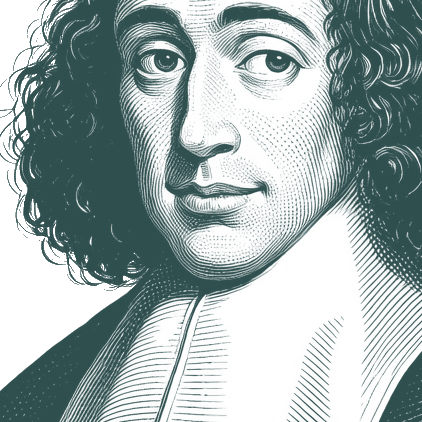
Benedictus de Spinoza (24 November 1632 – 21 February 1677) was a social and metaphysical philosopher known for the elaborate development of his monist philosophy, which has become known as Spinozism. Controversy regarding his ideas led to his excommunication from the Jewish community of his native Amsterdam. He was named Baruch ("blessed" in Hebrew) Spinoza by his synagogue elders and known as Bento de Spinoza or Bento d'Espiñoza, but afterwards used the name Benedictus ("blessed" in Latin) de Spinoza.
Native Name:
בָּרוּךְ שְׂפִּינוֹזָה
•
Benedito de Espinosa
Alternative Names:
Benedict de Spinoza
•
Baruch de Espinosa
•
Barukh Shpinozah
•
Benoît de Spinoza
•
Sbīnūzā
•
Ispīnūzā
•
Barukh Spinoza
•
Bento de Espinosa
•
Baruch d' Espinoza
•
Shpinozah
•
Baruch de Spinoza
•
Spinoza
•
Benoit de Spinoza
•
Benedictus De Spinoza
•
Benedictus Spinoza
•
Baruch Spinoza
•
Baruch Benedictus de Spinoza
...Humiliated beyond sufferance, Uriel went home, wrote a fierce denunciation of his persecutors, and shot himself. This was 1640. At that time Baruch Spinoza, "the greatest Jew of modern times," and the greatest of modern philosophers, was a child of eight, the favorite student of the synagogue. It was this Odyssey of the Jews that filled the background of Spinoza's mind, and made him irrevocably, however excommunicate, a Jew. Though his father was a successful merchant, the youth had no leaning to such a career, and preferred to spend his time in and around the synagogue, absorbing the religion and the history of his people. He was a brilliant scholar, and the elders looked upon him as a future light of their community and their faith.
Right from the beginning, Spinoza was a decisive philosopher for Schelling. This may now sound like yet another dusty little truth in the museums and archives of philosophy, but in Schelling's day, to embrace Spinoza was to dance with the devil and pantheism was the witches' brew served at this demonic party. [...] Now as bored college students sleep through class lectures and discussions on Continental Rationalism, it seems hard to imagine why Spinoza feared for his life were he to publish his Ethics, or why people were punished for reading it, or why records were kept of those who had read it in a way not altogether dissimilar to the way the FBI now keeps records on terrorists or even its own citizens.
For Spinoza, by contrast, there is to be no criminalization of ideas in the well-ordered state. Libertas philosophandi, the freedom of philosophizing, must be upheld for the sake of a healthy, secure and peaceful commonwealth and material and intellectual progress.