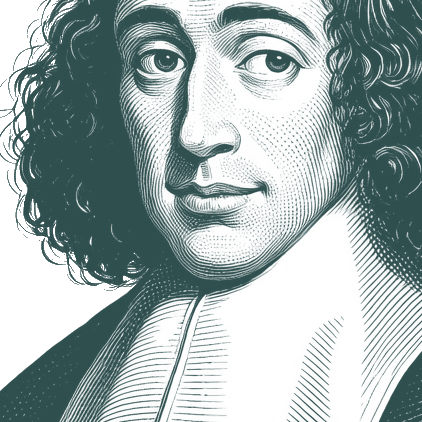
Benedictus de Spinoza (24 November 1632 – 21 February 1677) was a social and metaphysical philosopher known for the elaborate development of his monist philosophy, which has become known as Spinozism. Controversy regarding his ideas led to his excommunication from the Jewish community of his native Amsterdam. He was named Baruch ("blessed" in Hebrew) Spinoza by his synagogue elders and known as Bento de Spinoza or Bento d'Espiñoza, but afterwards used the name Benedictus ("blessed" in Latin) de Spinoza.
Native Name:
בָּרוּךְ שְׂפִּינוֹזָה
•
Benedito de Espinosa
Alternative Names:
Benedict de Spinoza
•
Baruch de Espinosa
•
Barukh Shpinozah
•
Benoît de Spinoza
•
Sbīnūzā
•
Ispīnūzā
•
Barukh Spinoza
•
Bento de Espinosa
•
Baruch d' Espinoza
•
Shpinozah
•
Baruch de Spinoza
•
Spinoza
•
Benoit de Spinoza
•
Benedictus De Spinoza
•
Benedictus Spinoza
•
Baruch Spinoza
•
Baruch Benedictus de Spinoza
The very starting-point of Spinoza, the search and discovery of the cause of causes, is hateful to Kant, who states that scientists err when they follow this path. He presumes and presupposes nothing, not even the possibility of the oneness of nature. Transcendental philosophy to him is only the theory of recognition of the possibility of nature itself. Spinoza, on the other hand, presumes and presupposes everything God, nature, its phenomena, and their different relationships. He begins with the supreme cause, without knowing whether it is and what it is. He sets out rationalistically and dogmatically while Kant begins critically. Kant is complicated, abstruse, and often dark, while Spinoza is simple, plain, and full of light. Kant's philosophy can be accepted either entirely or partly, but Spinoza's philosophy can be accepted only entirely. There can be no left or right Spinozists as there are left and right Kantians or Hegelians. In spite of its mathematical form, Spinozism is, in the last analysis, an experience of man's soul, while Kantianism is the product of man's critical mind. The soul is often disturbed and subject to varying moods, while man's mind is more rigid. Feeling is common to all people, but intellectual meditations are the heritage of the few. We can thus understand Spinoza's influence upon the entire fabric of modern culture with the exception of the plastic arts and music, and Kant's influence upon philosophy alone. Spinoza created a new world-picture, Kant only a new school of philosophy. Kant definitely established the frontiers of the human mind, but Spinoza reconstructed a new world out of an old one. Everyone is interested in Spinoza, but only philosophers are concerned with Kant.
...To substitute the society of ideas for that of things is simply to live in the mind; it is to survey the world of existences in its truth and beauty rather than in its personal perspectives, or with practical urgency. It is the sole path to happiness for the intellectual man, because the intellectual man cannot be satisfied with a world of perpetual change, defeat, and imperfection. It is the path trodden by ancient philosophers and modern saints or poets; not, of course, by modern writers on philosophy (except Spinoza), because these have not been philosophers in the vital sense; they have practised no spiritual discipline, suffered no change of heart, but lived on exactly like other professors, and exerted themselves to prove the existence of a God favourable to their own desires, instead of searching for the God that happens to exist.
Unlimited Quote Collections
Organize your favorite quotes without limits. Create themed collections for every occasion with Premium.
By posing the question of the ‘givenness’ of the object, Marx poses the question of the object itself, of its nature and limits, and therefore of the domain of its existence, since the modality according to which a theory thinks its object affects not only the nature of that object but also the situation and extent of its domain of existence. As an indication, let us adopt a famous thesis of Spinoza's: as a first approximation, we can suggest that Political Economy's existence is no more possible than the existence of any science of ‘conclusions’ as such: a science of ‘conclusions’ is not a science, since it would be the actual ignorance (‘ignorance en acte’) of its ‘premises’ – it is only the Imaginary in action (the ‘first kind’).