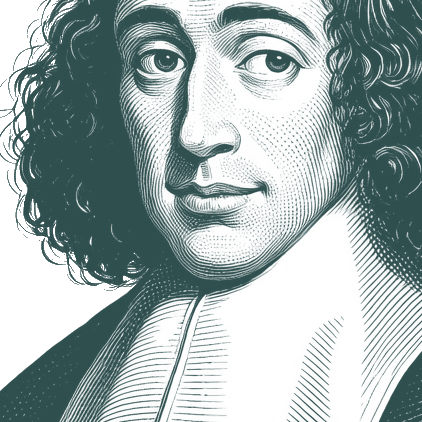
The brilliance of the solution of the problem of the relation of thinking to the world of bodies in space outside thought (i.e. outside the head of m… - Benedictus de Spinoza
""
The brilliance of the solution of the problem of the relation of thinking to the world of bodies in space outside thought (i.e. outside the head of man), which Spinoza formulated in the form of the thesis that thought and extension are not two substances, but only two attributes of one and the same substance, can hardly be exaggerated. This solution immediately rejected every possible kind of interpretation and investigation of thought by the logic of spiritualist and dualist constructions, so making it possible to find a real way out both from the blind alley of the dualism of mind and body and from the specific blind alley of Hegelianism. It is not fortuitous that Spinoza’s profound idea only first found true appreciation by the dialectical materialists Marx and Engels. Even Hegel found it a hard nut to crack. In fact, on the decisive point, he returned again to the position of Descartes, to the thesis that pure thought is the active cause of all the changes occurring in the ‘thinking body of man’, i.e. in the matter of the brain and sense organs, in language, in actions and their results, including in that the instruments of labour and historical events.
English
Collect this quote
About
Benedictus de Spinoza
Benedictus de Spinoza (24 November 1632 – 21 February 1677) was a social and metaphysical philosopher known for the elaborate development of his monist philosophy, which has become known as Spinozism. Controversy regarding his ideas led to his excommunication from the Jewish community of his native Amsterdam. He was named Baruch ("blessed" in Hebrew) Spinoza by his synagogue elders and known as Bento de Spinoza or Bento d'Espiñoza, but afterwards used the name Benedictus ("blessed" in Latin) de Spinoza.
Native Name:
בָּרוּךְ שְׂפִּינוֹזָה
•
Benedito de Espinosa
Alternative Names:
Benedict de Spinoza
•
Baruch de Espinosa
•
Barukh Shpinozah
•
Benoît de Spinoza
•
Sbīnūzā
•
Ispīnūzā
•
Barukh Spinoza
•
Bento de Espinosa
•
Baruch d' Espinoza
•
Shpinozah
•
Baruch de Spinoza
•
Spinoza
•
Benoit de Spinoza
•
Benedictus De Spinoza
•
Benedictus Spinoza
•
Baruch Spinoza
•
Baruch Benedictus de Spinoza
I shall not attempt to speculate as to what Spinoza might have been if he had lived in our time. For me, in any case, one thing is not open to doubt: Spinoza would never have been an agent of the League of Nations. The second point that I wish to emphasize is that we do not agree to yield Spinoza to our enemies in any case. There is no reason at all for this. Spinoza was a great materialistic thinker, and in this respect he should be considered a predecessor of dialectical materialism. The contemporary proletariat is Spinoza's only genuine heir.
Nature as conceived by many ecologists, and expressed philosophically by James Lovelock and others, is not the passive, dead, value-neutral nature of mechanistic science but is akin to the active, "naturing" nature of Spinoza. It is all-inclusive, creative (as natura naturans), infinitely diverse, and alive in the broad sense of Spinozistic so-called panpsychism.
...Yes, you must read Spinoza. Those who accuse him of atheism are asses. Goethe said, 'When I am upset or troubled I reread the Ethics.' Perhaps like Goethe you will find calm in the reading of this great book. Ten years ago I lost the friend I had loved more than any other, Alfred Le Poittevin. Fatally ill, he spent his last nights reading Spinoza. [Original in French: A propos de Spinoza (un fort grand homme, celui-là), tâchez de vous procurer sa biographie par Boulainvilliers. Elle est dans l'édition latine de Leipsick. Emile Saisset a traduit, je crois, l'Éthique. Il faut lire cela. L'article de Mme Coignet, dans la Revue de Paris était bien insuffisant. Oui, il faut lire Spinoza. Les gens qui l'accusent d'athéisme sont des ânes. Goethe disait: « Quand je me sens troublé, je relis l'Éthique ». Il vous arrivera peut-être, comme à Goethe, d'être calmée par cette grande lecture. J'ai perdu, il y a dix ans, l'homme que j'ai le plus aimé au monde, Alfred Le Poittevin. Dans sa maladie dernière, il passait ses nuits à lire Spinoza.]