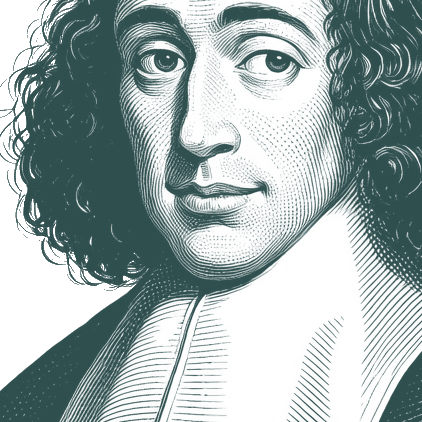
...Spinoza was the philosopher who knew full well that immanence was only immanent to itself and therefore that it was a plane traversed by movements… - Benedictus de Spinoza
""
...Spinoza was the philosopher who knew full well that immanence was only immanent to itself and therefore that it was a plane traversed by movements of the infinite, filled with intensive ordinates. He is therefore the prince of philosophers. Perhaps he is the only philosopher never to have compromised with transcendence and to have hunted it down everywhere. In the last book of the Ethics he produced the movement of the infinite and gave infinite speeds to thought in the third kind of knowledge. There he attains incredible speeds, with such lightning compressions that one can only speak of music, of tornadoes, of wind and strings. He discovered that freedom exists only within immanence. He fulfilled philosophy because he satisfied its prephilosophical presupposition. [...] Spinoza is the vertigo of immanence from which so many philosophers try in vain to escape. Will we ever be mature enough for a Spinozist inspiration?
Benedictus de Spinoza (24 November 1632 – 21 February 1677) was a social and metaphysical philosopher known for the elaborate development of his monist philosophy, which has become known as Spinozism. Controversy regarding his ideas led to his excommunication from the Jewish community of his native Amsterdam. He was named Baruch ("blessed" in Hebrew) Spinoza by his synagogue elders and known as Bento de Spinoza or Bento d'Espiñoza, but afterwards used the name Benedictus ("blessed" in Latin) de Spinoza.
Native Name:
בָּרוּךְ שְׂפִּינוֹזָה
•
Benedito de Espinosa
Alternative Names:
Benedict de Spinoza
•
Baruch de Espinosa
•
Barukh Shpinozah
•
Benoît de Spinoza
•
Sbīnūzā
•
Ispīnūzā
•
Barukh Spinoza
•
Bento de Espinosa
•
Baruch d' Espinoza
•
Shpinozah
•
Baruch de Spinoza
•
Spinoza
•
Benoit de Spinoza
•
Benedictus De Spinoza
•
Benedictus Spinoza
•
Baruch Spinoza
•
Baruch Benedictus de Spinoza
Let satirists then laugh their fill at human affairs, let theologians rail, and let misanthropes praise to their utmost the life of untutored rusticity, let them heap contempt on men and praises on beasts; when all is said, they will find that men can provide for their wants much more easily by mutual help.
However, his contemporary, Leibnitz, the father of the German enlightenment, who created an optimistic world-picture, always remained only a philosopher for philosophers. Even Immanuel Kant, although always famous, was never popular. In his own fatherland he was all but forgotten for most of the nineteenth century until revived by Hermann Cohen and his school. Spinoza, however, was never exhumed because he was never buried. Kant, because of his exclusive intellectuality, has influenced only his students, while Spinoza, because of his emotional appeal, has ruled even those who have never heard his name.
Enhance Your Quote Experience
Enjoy ad-free browsing, unlimited collections, and advanced search features with Premium.
One of Spinoza's more famous, influential and incendiary doctrines concerns the origin and status of Scripture. The Bible, Spinoza argues in the Theological-Political Treatise, was not literally authored by God. God or Nature is metaphysically incapable of proclaiming or dictating, much less writing, anything. Scripture is not ‘a message for mankind sent down by God from heaven’. Rather, it is a very mundane document. Texts from a number of authors of various socio-economic backgrounds, writing at different points over a long stretch of time and in differing historical and political circumstances, were passed down through generations in copies after copies after copies. [...] Spinoza supplements his theory of the human origins of Scripture with an equally deflationary account of its authors. The prophets were not especially learned individuals. They did not enjoy a high level of education or intellectual sophistication. They certainly were not philosophers or physicists or astronomers. There are no truths about nature or the cosmos to be found in their writings (Joshua believed that the Sun revolved around the Earth). Neither are they a source of metaphysical or even theological truths. The prophets often had naïve, even philosophically false beliefs about God.