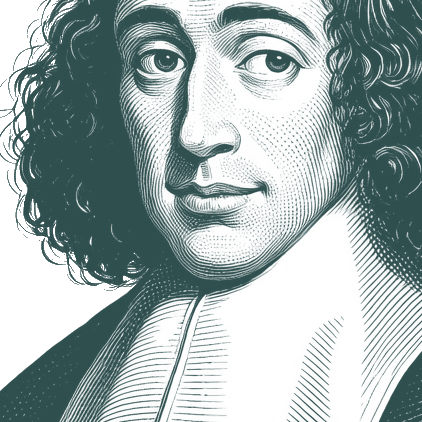
Philosophers conceive of the passions which harass us as vices into which men fall by their own fault, and, therefore, generally deride, bewail, or b… - Benedictus de Spinoza
""
Philosophers conceive of the passions which harass us as vices into which men fall by their own fault, and, therefore, generally deride, bewail, or blame them, or execrate them, if they wish to seem unusually pious. And so they think they are doing something wonderful, and reaching the pinnacle of learning, when they are clever enough to bestow manifold praise on such human nature, as is nowhere to be found, and to make verbal attacks on that which, in fact, exists. For they conceive of men, not as they are, but as they themselves would like them to be. Whence it has come to pass that, instead of ethics, they have generally written satire, and that they have never conceived a theory of politics, which could be turned to use, but such as might be taken for a chimera, or might have been formed in Utopia, or in that golden age of the poets when, to be sure, there was least need of it. Accordingly, as in all sciences, which have a useful application, so especially in that of politics, theory is supposed to be at variance with practice ; and no men are esteemed less fit to direct public affairs than theorists or philosophers.
English
Collect this quote
About
Benedictus de Spinoza
Benedictus de Spinoza (24 November 1632 – 21 February 1677) was a social and metaphysical philosopher known for the elaborate development of his monist philosophy, which has become known as Spinozism. Controversy regarding his ideas led to his excommunication from the Jewish community of his native Amsterdam. He was named Baruch ("blessed" in Hebrew) Spinoza by his synagogue elders and known as Bento de Spinoza or Bento d'Espiñoza, but afterwards used the name Benedictus ("blessed" in Latin) de Spinoza.
Native Name:
בָּרוּךְ שְׂפִּינוֹזָה
•
Benedito de Espinosa
Alternative Names:
Benedict de Spinoza
•
Baruch de Espinosa
•
Barukh Shpinozah
•
Benoît de Spinoza
•
Sbīnūzā
•
Ispīnūzā
•
Barukh Spinoza
•
Bento de Espinosa
•
Baruch d' Espinoza
•
Shpinozah
•
Baruch de Spinoza
•
Spinoza
•
Benoit de Spinoza
•
Benedictus De Spinoza
•
Benedictus Spinoza
•
Baruch Spinoza
•
Baruch Benedictus de Spinoza
The formation of society serves not only for defensive purposes, but is also very useful, and, indeed, absolutely necessary, as rendering possible the division of labor. If men did not render mutual assistance to each other, no one would have either the skill or the time to provide for his own sustenance and preservation: for all men are not equally apt for all work, and no one would be capable of preparing all that he individually stood in need of. Strength and time, I repeat, would fail, if every one had in person to plow, to sow, to reap, to grind corn, to cook, to weave, to stitch and perform the other numerous functions required to keep life going; to say nothing of the arts and sciences which are also entirely necessary to the perfection and blessedness of human nature.
As early as the 1670s, and continually, right through the eighteenth century, one finds numerous references in the contemporary controversial literature, theological, philosophical and historical, in all the Western European countries, to ‘Spinoza’ as supposedly the foremost and most dangerous of the ‘atheists’ threatening Christianity, society and the moral order generally, and the ‘sect of Spinozists’ specifically as the veritable hard-core of the libertine underground challenging all the structures of authority then in place.
Enhance Your Quote Experience
Enjoy ad-free browsing, unlimited collections, and advanced search features with Premium.
As the French philosopher Louis Althusser wrote in his 1976 Essays in Self-Criticism, much late 20th century Spinozism has proceeded by ‘attributing to the author of the Tractatus Theologico-Politicus and the Ethics a number of theses which he would surely never have acknowledged, though they did not actually contradict him. But to be a heretical Spinozist is almost orthodox Spinozism, if Spinozism can be said to be one of the greatest lessons in heresy that the world has seen!’. Though Spinozists have existed ever since the radical circles that rippled through Europe in the wake of Spinoza's death, I think it is fair to say that only in the past 50 years or so has there been a Spinozism to match in hermeneutic rigour and creative interventions the history of Kantianism or Hegelianism, that only now has the hereticism that Althusser referred to been complemented by the labour of the concept. Arguably, it is only now then that the scope of his thought and its relevance to our social and political existence can be truly appreciated, at a historical juncture when the communicative power of the multitude and of what Marx called the general intellect is so intensified that the physics, ethics, ontology and politics of Spinoza (what are ultimately indissociable facets of his philosophizing) can be thought simultaneously. Today more than ever, one might argue, is Spinoza, as Pierre Macherey puts it, ‘an irreplaceable reactor and developer’.