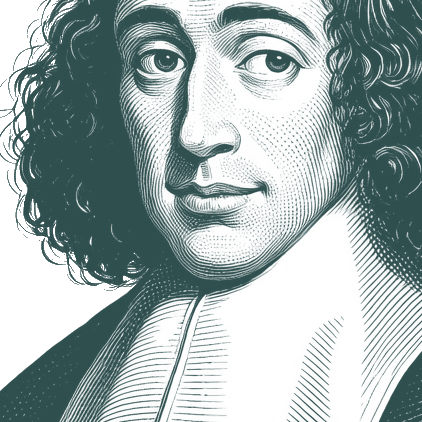
Benedictus de Spinoza (24 November 1632 – 21 February 1677) was a social and metaphysical philosopher known for the elaborate development of his monist philosophy, which has become known as Spinozism. Controversy regarding his ideas led to his excommunication from the Jewish community of his native Amsterdam. He was named Baruch ("blessed" in Hebrew) Spinoza by his synagogue elders and known as Bento de Spinoza or Bento d'Espiñoza, but afterwards used the name Benedictus ("blessed" in Latin) de Spinoza.
Native Name:
בָּרוּךְ שְׂפִּינוֹזָה
•
Benedito de Espinosa
Alternative Names:
Benedict de Spinoza
•
Baruch de Espinosa
•
Barukh Shpinozah
•
Benoît de Spinoza
•
Sbīnūzā
•
Ispīnūzā
•
Barukh Spinoza
•
Bento de Espinosa
•
Baruch d' Espinoza
•
Shpinozah
•
Baruch de Spinoza
•
Spinoza
•
Benoit de Spinoza
•
Benedictus De Spinoza
•
Benedictus Spinoza
•
Baruch Spinoza
•
Baruch Benedictus de Spinoza
dulce, que la libertad, he creído hacer una buena obra, y de alguna utilidad, tal vez, enseñando que la libertad de pensar, no tan sólo puede conciliarse con la paz y salvación del estado, sino que no puede destruirse sin destruir al mismo tiempo esa paz del estado y la piedad misma. He aquí lo principal que yo he deseado establecer en este tratado. (TTP Praef.)
No philosopher was ever more worthy, but neither was any philosopher more maligned and hated. To grasp the reason for this it is not enough to recall the great theoretical thesis of Spinozism: a single substance having an infinity of attributes, Deus sive Natura, all "creatures" being only modes of these attributes or modifications of this substance. It is not enough to show how pantheism and atheism are combined in this thesis, which denies the existence of a moral, transcendent, creator God. We must start rather from the practical theses that made Spinozism an object of scandal. These theses imply a triple denunciation: of "consciousness," of "values," and of "sad passions." These are the three major resemblances with Nietzsche. And already in Spinoza's lifetime, they are the reasons for his being accused of materialism, immoralism, and atheism.
Go Premium
Support Quotewise while enjoying an ad-free experience and premium features.
...Spinoza hit the nail on the head with his paradoxical proposition: God is an extended, that is, material being. He found, at least for his time, the true philosophical expression for the materialistic tendency of the modern era; he legitimated and sanctioned it: God himself is a materialist. Spinoza's philosophy was religion; he himself was an amazing man. Unlike so many others, Spinoza's materialism did not stand in contradiction to the notion of a non-material and anti-materialistic God who also quite consistently imposes on man the duty to give himself up only to anti-materialistic, heavenly tendencies and concerns, for God is nothing other than the archetypal and ideal image of man; what God is and how he is, is what man ought to be or wants to be, or at least hopes to be in the future. But only where theory does not belie practice, and practice theory, is there character, truth, and religion. Spinoza is the Moses of modern free-thinkers and materialists.