You cannot choose between party government and Parliamentary government. I say, you can have no Parliamentary government if you have no party government; and, therefore, when Gentlemen denounce party government, they strike at that scheme of government which, in my opinion, has made this country great, and which I hope will keep it great.
British statesman (1804–1881)
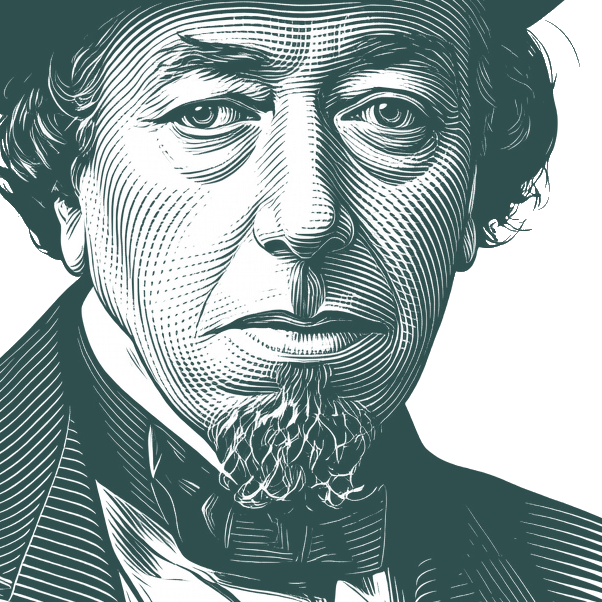
Benjamin Disraeli, 1st Earl of Beaconsfield (21 December 1804 – 19 April 1881) was a British politician, novelist, and essayist, serving twice as Prime Minister of the United Kingdom. The anniversary of his death on 19 April is known as Primrose Day.
Bio from: Wikiquote (CC BY-SA 4.0) · Portrait adapted from: Wikimedia Commons, Cornelius Jabez Hughes (Public domain / CC0)
Birth Name:
Benjamin D'Israeli
Alternative Names:
1st Earl of Beaconsfield Benjamin Disraeli
•
Benjamin, Earl of Beaconsfield Disraeli
•
Benjamin Disraeli, Earl of Beaconsfield
•
Benjamin, Earl of Beaconsfield, Viscount Hughenden of Hughenden Disraeli
•
Dizzy
•
Lord Beaconsfield
From Wikidata (CC0)

Showing quotes in randomized order to avoid selection bias. Click Popular for most popular quotes.
I have always been of opinion that the Tory party has three great objects. The first is to maintain the institutions of the country—not from any sentiment of political superstition, but because we believe that they embody the principles upon which a community like England can alone safely rest. The principles of liberty, of order, of law, and of religion ought not to be entrusted to individual opinion or to the caprice and passion of multitudes, but should be embodied in a form of permanence and power. We associate with the Monarchy the ideas which it represents—the majesty of law, the administration of justice, the fountain of mercy and of honour. We know that in the Estates of the Realm and the privileges they enjoy, is the best security for public liberty and good government. We believe that a national profession of faith can only be maintained by an Established Church, and that no society is safe unless there is a public recognition of the Providential government of the world, and of the future responsibility of man.
Against that rapacious, tyrannical, and incapable faction, who, having knavishly obtained power by false pretences, sillily suppose that they will be permitted to retain it by half measures, and who, in the course of their brief but disastrous career, have contrived to shake every great interest of the Empire to its centre. Ireland in rebellion, the colonies in convulsion, our foreign relations in a state of such inextricable confusion, that we are told that war alone can sever the Gordian knot of complicated blunders; the farmer in doubt, the shipowner in despair, our merchants without trade, and our manufacturers without markets, the revenue declining, and the army increased, the wealthy hoarding their useless capital, and pauperism prostrate in our once-contented cottages. Englishmen, behold the unparalleled Empire raised by the heroic energies of your fathers; rouse yourselves in this hour of doubt and danger; rid yourselves of all that political jargon and factious slang of Whig and Tory—two names with one meaning, used only to delude you—and unite in forming a great national party which can alone save the country from impending destruction.
The life of this people greatly accords with my taste, which is naturally somewhat indolent and melancholy... To repose on voluptuous ottomans and smoke superb pipes, daily to indulge in the luxuries of a bath which requires half a dozen attendants for its perfection; to court the air in a carved caïque, by shores which are a perpetual scene; and to find no exertion greater than a canter on a barb; this is, I think, a far more sensible life than all the bustle of clubs, all the boring of drawing-rooms, and all the coarse vulgarity of our political controversies.
In great cities men are brought together by the desire of gain. They are not in a state of cooperation, but of isolation, as to the making of fortunes;; and for all the rest they are careless of neighbors. Christianity teaches us to love our neighbour as ourself; modern society acknowledges no neighbour.
[A] danger, in its ultimate results scarcely less disastrous than pestilence and famine...distracts that country [Ireland]. A portion of its population is attempting to sever the constitutional tie which unites it to Great Britain in that bond which has favoured the power and prosperity of both. It is to be hoped that all men of light and leading will resist this destructive doctrine. The strength of this nation depends on the unity of feeling which should pervade the United Kingdom and its widespread dependencies.
It has been said that the people of this country are deeply interested in the humanitarian and philanthropic considerations involved in [the Eastern Question]. All must appreciate such feelings. But I am mistaken if there be not a yet deeper sentiment on the part of the people of this country, one with which I cannot doubt your lordships will ever sympathise, and that is—the determination to maintain the Empire of England.
In great cities men are brought together by the desire of gain. They are not in a state of cooperation, but of isolation, as to the making of fortunes; and for all the rest they are careless of neighbors. Christianity teaches us to love our neighbour as ourself; modern society acknowledges no neighbour.