American fiction writer and essayist (1962–2008)
David Foster Wallace (21 February 1962 – 12 September 2008) was an American novelist, essayist, and short story writer. His works include The Broom of the System (novel), Infinite Jest (novel), The Girl With Curious Hair (short story collection), Brief Interviews with Hideous Men (short story collection), A Supposedly Fun Thing I'll Never Do Again (essay collection), and the posthumously-published The Pale King (novel) and Both Flesh and Not (essay collection).
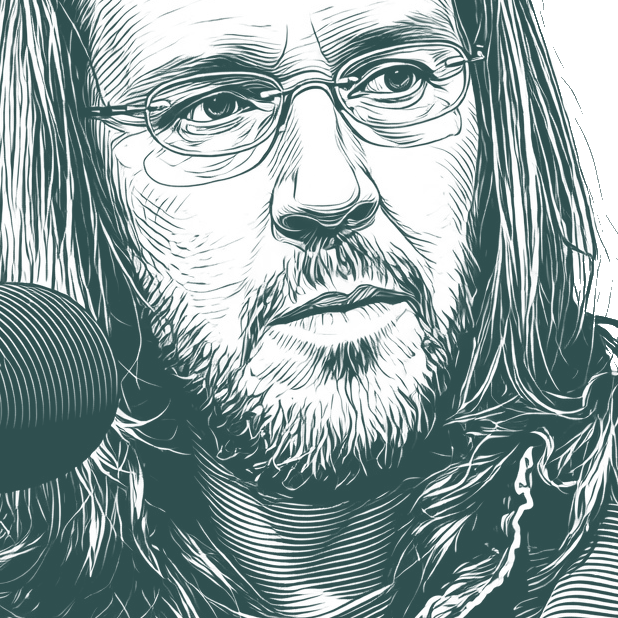
Bio from: Wikiquote (CC BY-SA 4.0) · Portrait adapted from: Wikimedia Commons, Steve Rhodes (CC BY)
From Wikidata (CC0)

I learned that the world of men as it exists today is a bureaucracy. This is an obvious truth, of course, though it is also one the ignorance of which causes great suffering.
“But moreover, I discovered, in the only way that a man ever really learns anything important, the real skill that is required to succeed in a bureaucracy. I mean really succeed: do good, make a difference, serve. I discovered the key. This key is not efficiency, or probity, or insight, or wisdom. It is not political cunning, interpersonal skills, raw IQ, loyalty, vision, or any of the qualities that the bureaucratic world calls virtues, and tests for. The key is a certain capacity that underlies all these qualities, rather the way that an ability to breathe and pump blood underlies all thought and action.
“The underlying bureaucratic key is the ability to deal with boredom. To function effectively in an environment that precludes everything vital and human. To breathe, so to speak, without air.
“The key is the ability, whether innate or conditioned, to find the other side of the rote, the picayune, the meaningless, the repetitive, the pointlessly complex. To be, in a word, unborable.
“It is the key to modern life. If you are immune to boredom, there is literally nothing you cannot accomplish.
More than any other mass medium, radio enjoys a captive audience—if only because so many of the listeners are driving—but in a major market there are dozens of AM stations to listen to, plus of course FM and satellite radio, and even a very seductive and successful station rarely gets more than a five or six percent audience share.
Unlimited Quote Collections
Organize your favorite quotes without limits. Create themed collections for every occasion with Premium.
It took years after I’d graduated from Amherst to realize that people were actually far more complicated and interesting than books, that almost everyone else suffered the same secret fears and inadequacies as I, and that feeling alone and inferior was actually the great valent bond between us all. I wish I’d been smart enough to understand that when I was an adolescent.
When they were introduced, he made a witticism, hoping to be liked. She laughed extremely hard, hoping to be liked. Then each drove home alone, staring straight ahead, with the very same twist to their faces.
The man who'd introduced them didn't much like either of them, though he acted as if he did, anxious as he was to preserve good relations at all times. One never knew, after all, now did one now did one now did one.
"The really important kind of freedom involves attention, and awareness, and discipline, and effort, and being able truly to care about other people and to sacrifice for them, over and over, in myriad petty little unsexy ways, every day.
That is real freedom.
That is being taught how to think.
The alternative is unconsciousness, the default setting, the "rat race" — the constant, gnawing sense of having had and lost some infinite thing."
"Learning how to think" really means learning how to exercise some control over how and what you think.
It means being conscious and aware enough to choose what you pay attention to and to choose how you construct meaning from experience.
Because if you cannot or will not exercise this kind of choice in adult life, you will be totally hosed.
"This story ["The Depressed Person"] was the most painful thing I ever wrote. It's about narcissism, which is a part of depression. The character has traits of myself. I really lost friends while writing on that story, I became ugly and unhappy and just yelled at people. The cruel thing with depression is that it's such a self-centered illness - Dostoevsky shows that pretty good in his "Notes from Underground". The depression is painful, you're sapped/consumed by yourself; the worse the depression, the more you just think about yourself and the stranger and repellent you appear to others."
What teachers and the administration in that era never seemed to see was that the mental work of what they called daydreaming often required more effort and concentration than it would have taken simply to listen in class. Laziness is not the issue. It is just not the work dictated by the administration.
The really important kind of freedom involves attention and awareness and discipline, and being able truly to care about other people and to sacrifice for them over and over in myriad petty, unsexy ways every day. That is real freedom. That is being educated, and understanding how to think. The alternative is unconsciousness, the default setting, the rat race, the constant gnawing sense of having had, and lost, some infinite thing.