American fiction writer and essayist (1962–2008)
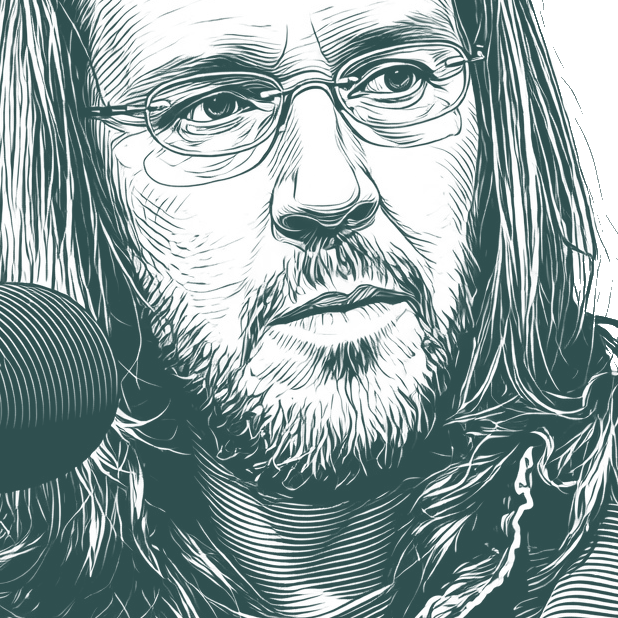
David Foster Wallace (21 February 1962 – 12 September 2008) was an American novelist, essayist, and short story writer. His works include The Broom of the System (novel), Infinite Jest (novel), The Girl With Curious Hair (short story collection), Brief Interviews with Hideous Men (short story collection), A Supposedly Fun Thing I'll Never Do Again (essay collection), and the posthumously-published The Pale King (novel) and Both Flesh and Not (essay collection).
Bio from: Wikiquote (CC BY-SA 4.0) · Portrait adapted from: Wikimedia Commons, Steve Rhodes (CC BY)
From Wikidata (CC0)

"In a way, what Tarantino has done with the French New Wave and with David Lynch is what Pat Boone did with rhythm and blues: He's found (ingeniously) a way to take what is ragged and distinctive and menacing about their work and homogenize it, churn it until it's smooth and cool and hygienic enough for mass consumption. Reservoir Dogs, for example, with its comically banal lunch chatter, creepily otiose code names, and intrusive soundtrack of campy pop from decades past, is a Lynch movie made commercial, i.e., fast, linear, and with what was idiosyncratically surreal now made fashionably (i.e., "hiply") surreal [...] D. Lynch is an exponentially better filmmaker than Q. Tarantino. For, unlike Tarantino, D. Lynch knows that an act of violence in an American film has, through repetition and desensitization, lost the ability to refer to anything but itself. A better way to put what I just tried to say: Quentin Tarantino is interested in watching somebody's ear getting cut off; David Lynch is interested in the ear."
It’s all over everywhere. I don’t know what I could call it. It’s like I can’t get enough outside it to call it anything. It’s like horror more than sadness. It’s more like horror. It’s like something horrible is about to happen, the most horrible thing you can imagine — no, worse than you can imagine because there’s the feeling that there’s something you have to do right away to stop it but you don’t know what it is you have to do, and then it’s happening, too, the whole horrible time, it’s about to happen and also it’s happening, all at the same time.’
I fear this feeling more than I fear anything, man. More than pain, or my mom dying, or environmental toxicity. Anything.
When people call it [depression] I always get pissed off because I always think depression sounds like you just get like really sad, you get quiet and melancholy and just like sit quietly by the window sighing or just lying around. A state of not caring about anything. A kind of blue kind of peaceful state … Well this - isn’t a state. This is a feeling. I feel it all over. In my arms and legs … All over. My head, throat, butt. In my stomach. It’s all over everywhere. I don’t know what to call it. It’s like I can’t get enough outside it to call it anything. It’s like horror more than sadness. It’s more like horror. It’s like something horrible is about to happen, the most horrible thing you imagine – no, worse than you can imagine because there’s the feeling that there’s something you have to do right away to stop it but you don’t know what it is you have to do, and then it’s happening, too, the whole horrible time, it’s about to happen and also it’s happening, all at the same time. … Everything gets horrible. Everything you see gets ugly. Lurid is the word. … That’s the right word for it. And everything sounds harsh, spiny and harsh-sounding, like every sound you hear all of a sudden has teeth. And smelling like I smell bad even after I just got out of the shower. It’s like what’s the point of washing if everything smells like I need another shower.
Advanced Search Filters
Filter search results by source, date, and more with our premium search tools.
But when you talk about Nabokov and Coover, you’re talking about real geniuses, the writers who weathered real shock and invented this stuff in contemporary fiction. But after the pioneers always come the crank turners, the little gray people who take the machines others have built and just turn the crank, and little pellets of metafiction come out the other end. The crank-turners capitalize for a while on sheer fashion, and they get their plaudits and grants and buy their IRAs and retire to the Hamptons well out of range of the eventual blast radius. There are some interesting parallels between postmodern crank-turners and what’s happened since post-structural theory took off here in the U.S., why there’s such a big backlash against post-structuralism going on now. It’s the crank-turners fault. I think the crank-turners replaced the critic as the real angel of death as far as literary movements are concerned, now. You get some bona fide artists who come along and really divide by zero and weather some serious shit-storms of shock and ridicule in order to promulgate some really important ideas. Once they triumph, though, and their ideas become legitimate and accepted, the crank-turners and wannabes come running to the machine, and out pour the gray pellets and now the whole thing’s become a hollow form, just another institution of fashion. Take a look at some of the critical-theory Ph.D. dissertations being written now. They’re like de Man and Foucault in the mouth of a dull child. Academia and commercial culture have somehow become these gigantic mechanisms of commodification that drain the weight and color out of even the most radical new advances. It’s a surreal inversion of the death-by-neglect that used to kill off prescient art. Now prescient art suffers death-by acceptance. We love things to death, now. Then we retire to the Hamptons.
When people call it that I always get pissed off because I always think depression sounds like you just get like really sad, you get quiet and melancholy and just like sit quietly by the window sighing or just lying around. A state of not caring about anything. A kind of blue kind of peaceful state.