It’s one of those unpleasant opioid feverish half-sleep states, more a fugue-state than a sleep-state, less a floating than like being cast adrift on rough seas, tossed mightily in and out of this half-sleep where your mind’s
still working and you can ask yourself whether you’re asleep even as you dream. And any dreams you do have seem ragged at the edges, gnawed on, incomplete.
American fiction writer and essayist (1962–2008)
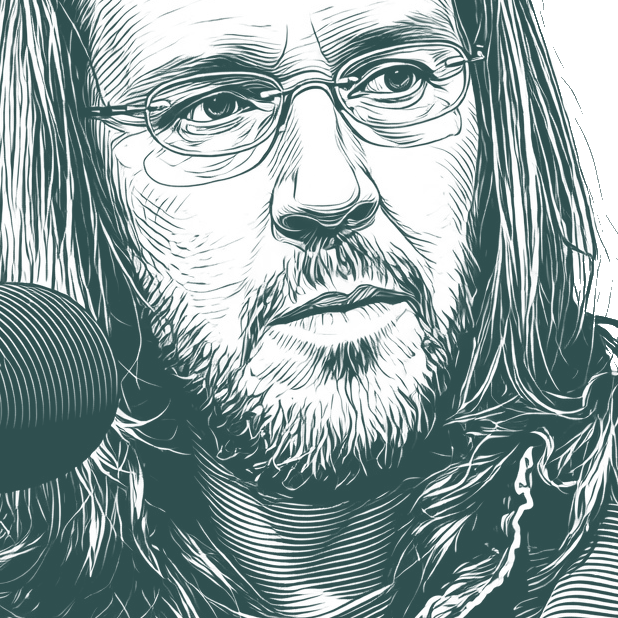
David Foster Wallace (21 February 1962 – 12 September 2008) was an American novelist, essayist, and short story writer. His works include The Broom of the System (novel), Infinite Jest (novel), The Girl With Curious Hair (short story collection), Brief Interviews with Hideous Men (short story collection), A Supposedly Fun Thing I'll Never Do Again (essay collection), and the posthumously-published The Pale King (novel) and Both Flesh and Not (essay collection).
Bio from: Wikiquote (CC BY-SA 4.0) · Portrait adapted from: Wikimedia Commons, Steve Rhodes (CC BY)
Alternative Names:
David Wallace
From Wikidata (CC0)

Showing quotes in randomized order to avoid selection bias. Click Popular for most popular quotes.
But the young educated adults of the 90s — who were, of course, the children of the same impassioned infidelities and divorces Mr. Updike wrote about so
beautifully — got to watch all this brave new individualism and self-expression and sexual freedom deteriorate into the joyless and anomic self-indulgence of the Me Generation. Today's sub-40s have different horrors, prominent among which are anomie and solipsism and a peculiarly American loneliness: the prospect of dying without once having loved something more than yourself.
Then he looked up, despite all best prior intentions. In four minutes, it would be another hour; a half hour after that was the ten-minute break. Lane Dean imagined himself running around on the break, waving his arms and shouting gibberish and holding ten cigarettes at once in his mouth, like a panpipe. Year after year, a face the same color as your desk. Lord Jesus. Coffee wasn't allowed because of spills on the files, but on the break he'd have a big cup of coffee in each hand while he pictured himself running around the outside grounds, shouting. He knew what he'd really do on the break was sit facing the wall clock in the lounge and, despite prayers and effort, count the seconds tick off until he had to come back and do this again. And again and again and again.
Unlimited Quote Collections
Organize your favorite quotes without limits. Create themed collections for every occasion with Premium.
The depressed person was in terrible and
unceasing emotional pain, and the impossibility of sharing or articulating this pain was itself a component of the pain and a contributing factor in its essential horror. Despairing, then, of describing the emotional pain itself, the depressed person hoped at least to be able to express something of its context, its shape and texture, as it were-by recounting circumstances related to its etiology.
Because here's something else that's weird but true: in the day-to day trenches of adult life, there is actually no such thing as atheism. There is no such thing as not worshipping. Everybody worships. The only choice we get is what to worship. And the compelling reason for maybe choosing some sort of god or spiritual-type thing to worship — be it JC or Allah, be it YHWH or the Wiccan Mother Goddess, or the Four Noble Truths, or some inviolable set of ethical principles — is that pretty much anything else you worship will eat you alive. If you worship money and things, if they are where you tap real meaning in life, then you will never have enough, never feel you have enough. It's the truth. Worship your body and beauty and sexual allure and you will always feel ugly. And when time and age start showing, you will die a million deaths before they finally grieve you. On one level, we all know this stuff already. It's been codified as myths, proverbs, clichés, epigrams, parables; the skeleton of every great story. The whole trick is keeping the truth up front in daily consciousness.
But most days, if you're aware enough to give yourself a choice, you can choose to look differently at this fat, dead-eyed, over-made-up lady who just screamed at her kid in the checkout line. Maybe she's not usually like this. Maybe she's been up three straight nights holding the hand of a husband who is dying of bone cancer. Or maybe this very lady is the low-wage clerk at the motor vehicle department, who just yesterday helped your spouse resolve a horrific, infuriating, red-tape problem through some small act of bureaucratic kindness. Of course, none of this is likely, but it's also not impossible. It just depends what you want to consider. If you're automatically sure that you know what reality is, and you are operating on your default setting, then you, like me, probably won't consider possibilities that aren't annoying and miserable. But if you really learn how to pay attention, then you will know there are other options. It will actually be within your power to experience a crowded, hot, slow, consumer-hell type situation as not only meaningful, but sacred, on fire with the same force that made the stars: love, fellowship, the mystical oneness of all things deep down.
Not that that mystical stuff is necessarily true. The only thing that's capital-T True is that you get to decide how you're gonna try to see it.
This, I submit, is the freedom of a real education, of learning how to be well-adjusted. You get to consciously decide what has meaning and what doesn't. You get to decide what to worship.
Limited Time Offer
Premium members can get their quote collection automatically imported into their Quotewise collections.
The thrust here is that Dostoevsky wrote fiction about the stuff that's really important. He wrote fiction about identity, moral value, death, will, sexual vs. spiritual love, greed, freedom, obsession, reason, faith, suicide. And he did it without ever reducing his characters to mouthpieces or his books to tracts. His concern was always what it is to be a human being-that is, how to be an actual person, someone whose life is informed by values and principles, instead of just an especially shrewd kind of self-preserving animal.
Even as I wrote my note to Fern, for instance, expressing sentiments and regrets that were real, a part of me was noticing what a fine and sincere note it was, and anticipating the effect on Fern of this or that heartfelt phrase, while yet another part was observing the whole scene of a man in a dress shirt and no tie sitting at his breakfast nook writing a heartfelt note on his last afternoon alive, the blondwood table's surface trembling with sunlight and the man's hand steady and face both haunted by regret and ennobled by resolve, this part of me sort of hovering above and just to the left of myself, evaluating the scene, and thinking what a fine and genuine-seeming performance in a drama it would make if only we all had not already been subject to countless scenes just like it in dramas ever since we first saw a movie or read a book, which somehow entailed that real scenes like the one of my suicide note were now compelling and genuine only to their participants, and to anyone else would come off as banal and even somewhat cheesy or maudlin, which is somewhat paradoxical when you consider – as I did, setting there at the breakfast nook – that the reason scenes like this will seem stale or manipulative to an audience is that we’ve already seen so many of them in dramas, and yet the reason we’ve seen so many of them in dramas is that the scenes really are dramatic and compelling and let people communicate very deep, complicated emotional realities that are almost impossible to articulate in any other way, and at the same time still another facet or part of me realizing that from this perspective my own basic problem was that at an early age I’d somehow chosen to cast my lot with my life’s drama’s supposed audience instead of with the drama itself, and that I even now was watching and gauging my supposed performance’s quality and probable effects, and thus was in the final analysis the very same manipulative fraud writing the note to Fern that I had been throughou