British writer and journalist (1903–1950)
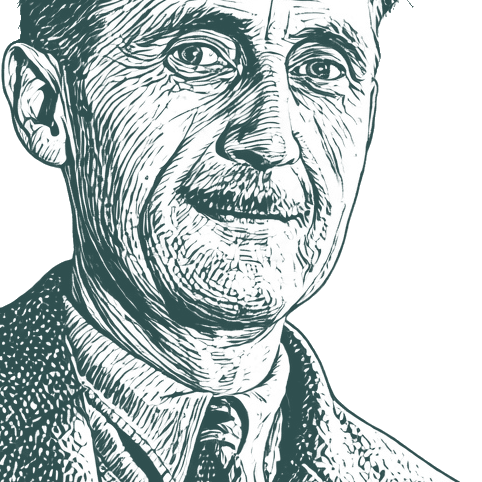
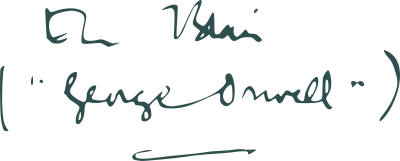
George Orwell (25 June 1903 – 21 January 1950) was the pen name of British novelist, essayist, and journalist Eric Arthur Blair, whose work is characterised by lucid prose, awareness of social injustice, opposition to totalitarianism, and strong support of democratic socialism.
Bio from: Wikiquote (CC BY-SA 4.0) · Portrait adapted from: Wikimedia Commons, Cassowary Colorizations (CC BY)
From Wikidata (CC0)
I have little direct evidence about the atrocities in the Spanish civil war. I know that some were committed by the Republicans, and far more (they are still continuing) by the Fascists. But what impressed me then, and has impressed me ever since, is that atrocities are believed in or disbelieved in solely on grounds of political predilection. Everyone believes in the atrocities of the enemy and disbelieves in those of his own side, without ever bothering to examine the evidence.
At any given moment there is an orthodoxy, a body of ideas of which it is assumed that all right-thinking people will accept without question. It is not exactly forbidden to say this, that or the other, but it is “not done” to say it… Anyone who challenges the prevailing orthodoxy finds himself silenced with surprising effectiveness. A genuinely unfashionable opinion is almost never given a fair hearing, either in the popular press or in the high-brow periodicals.
In past ages, a war, almost by definition, was something that sooner or later came to an end, usually in unmistakable victory or defeat. In the past, also, war was one of the main instruments by which human societies were kept in touch with physical reality. All rulers in all ages have tried to impose a false view of the world upon their followers, but they could not afford to encourage any illusion that tended to impair military efficiency. So long as defeat meant the loss of independence, or some other result generally held to be undesirable, the precautions against defeat had to be serious. Physical facts could not be ignored. In philosophy, or religion, or ethics, or politics, two and two might make five, but when one was designing a gun or an aeroplane they had to make four. Inefficient nations were always conquered sooner or later, and the struggle for efficiency was inimical to illusions. Moreover, to be efficient it was necessary to be able to learn from the past, which meant having a fairly accurate idea of what had happened in the past. Newspapers and history books were, of course, always coloured and biased, but falsification of the kind that is practiced today would have been impossible. War was a sure safeguard of sanity, and so far as the ruling classes were concerned it was probably the most important of all safeguards. While wars could be won or lost, no ruling class could be completely irresponsible.
How does one man assert his power over another, Winston?“
Winston thought. “By making him suffer”, he said.
“Exactly. By making him suffer. Obedience is not enough. Unless he is suffering, how can you be sure that he is obeying your will and not his own? Power is in inflicting pain and humiliation. Power is in tearing human minds to pieces and putting them together again in new shapes of your own choosing. Do you begin to see, then, what kind of world we are creating? It is the exact opposite of the stupid hedonistic Utopias that the old reformers imagined. A world of fear and treachery is torment, a world of trampling and being trampled upon, a world which will grow not less but MORE merciless as it refines itself. Progress in our world will be progress towards more pain. The old civilizations claimed that they were founded on love or justice. Ours is founded upon hatred. In our world there will be no emotions except fear, rage, triumph, and self-abasement. Everything else we shall destroy – everything. Already we are breaking down the habits of thought which have survived from before the Revolution. We have cut the links between child and parent, and between man and man, and between man and woman. No one dares trust a wife or a child or a friend any longer. But in the future there will be no wives and no friends. Children will be taken from their mothers at birth, as one takes eggs from a hen. The sex instinct will be eradicated. Procreation will be an annual formality like the renewal of a ration card. We shall abolish the orgasm. Our neurologists are at work upon it now. There will be no loyalty, except loyalty towards the Party. There will be no love, except the love of Big Brother. There will be no laughter, except the laugh of triumph over a defeated enemy. There will be no art, no literature, no science. When we are omnipotent we shall have no more need of science. There will be no distinction between beauty and ugliness. There will be no curiosity, no enj
He gazed up at the enormous face. Forty years it had taken him to learn what kind of smile was hidden beneath the dark moustache. O cruel, needless misunderstanding! O stubborn, self-willed exile from the loving breast! Two gin-scented tears trickled down the sides of his nose. But it was all right, everything was all right, the struggle was finished. He had won the victory over himself. He loved Big Brother.
Of all types of human being, only the artist takes it upon himself to say that he 'cannot' work. But it is quite true; there ARE times when one cannot work. Money again, always money! Lack of money means discomfort, means squalid worries, means shortage of tobacco, means ever-present consciousness of failure - above all, it means loneliness. How can you be anything but lonely on two quid a week? And in loneliness no decent book was ever written.
I only realized during my last week that I was being cheated, and, as I could prove nothing, only twenty-five francs were refunded. The doorkeeper played similar tricks on any employee who was fool enough to be taken in. He called himself a Greek, but in reality he was an Armenian. After knowing him I saw the force of the proverb "Trust a snake before a Jew and a Jew before a Greek, but don't trust an Armenian."
England is perhaps the only great country whose intellectuals are ashamed of their own nationality. In left-wing circles it is always felt that there is something slightly disgraceful in being an Englishman and that it is a duty to snigger at every English institution, from horse racing to suet puddings. It is a strange fact, but it is unquestionably true that almost any English intellectual would feel more ashamed of standing to attention during God save the King than of stealing from a poor box.