How healing it was to be back at Gombe again, and by myself with the chimpanzees and their forest. I had left the busy, materialistic world so full of greed and selfishness and, for a little while, could feel myself, as in the early days, a part of nature. I felt very much in tune with the chimpanzees, for I was spending time with them not to observe, but simple because I needed their company, undemanding and free of pity.
English primatologist and anthropologist (1934–2025)
Dame Jane Morris Goodall DBE (born Valerie Jane Morris-Goodall; 3 April 1934), formerly Baroness Jane van Lawick-Goodall, is an English primatologist, ethologist, and anthropologist. She is best-known for her study of chimpanzee social and family life in the Gombe Stream National Park in Tanzania and she did that for 45 years. She also founded the Jane Goodall Institute. In April 2002, she was named a UN Messenger of Peace,
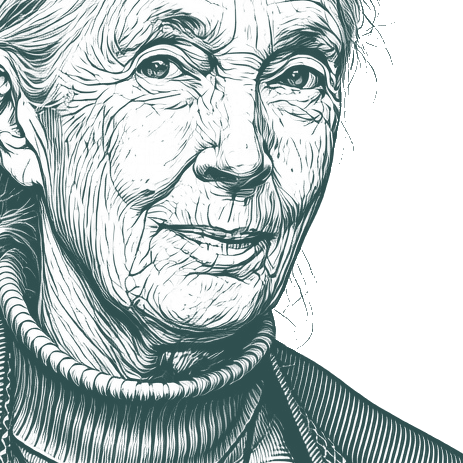
Bio from: Wikiquote (CC BY-SA 4.0) · Portrait adapted from: Wikimedia Commons, U.S. Department of State from United States (Public domain / CC0)
Birth Name:
Valerie Jane Morris-Goodall
Alternative Names:
Baroness Jane van Lawick-Goodall
•
Dame Jane Morris Goodall
•
Dame Jane Goodall
•
Jane Morris Goodall
From Wikidata (CC0)

Showing quotes in randomized order to avoid selection bias. Click Popular for most popular quotes.
Is it not possible that the chimpanzees are responding to some feeling like awe? A feeling generated by the mystery of water; water that seems alive, always rushing past yet never going, always the same yet ever different. Was it perhaps similar feelings of awe that gave rise to the first animistic religions, the worship of the elements and the mysteries of nature over which there was no control? Only when our prehistoric ancestors developed language would it have been possible to discuss such internal feelings and create a shared religion.
Well, in some ways we’re not successful at all. We’re destroying our home. That’s not a bit successful. Chimpanzees, gorillas, orangutans have been living for hundreds of thousands of years in their forest, living fantastic lives, never overpopulating, never destroying the forest. I would say that they have been in a way more successful than us as far as being in harmony with the environment.
How would I have turned out, I sometimes wonder, had I grown up in a house that stifled enterprise by imposing harsh and senseless discipline? Or in an atmosphere of overindulgence, in a household where there were no rules, no boundaries drawn? My mother certainly understood the importance of discipline, but she always explained why some things were not allowed. Above all, she tried to be fair and to be consistent.