French novelist, critic and essayist (1871–1922)
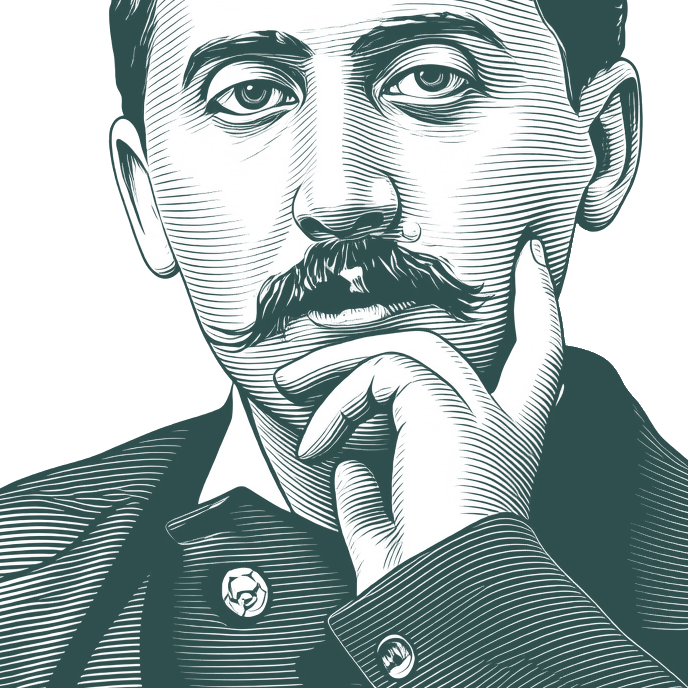
Valentin Louis Georges Eugène Marcel Proust (10 July 1871 – 18 November 1922) was a French novelist, essayist and critic.
Bio from: Wikiquote (CC BY-SA 4.0) · Portrait adapted from: Wikimedia Commons, Otto Wegener (Public domain / CC0)
From Wikidata (CC0)

But genius, and even great talent, springs less from seeds of intellect and social refinement superior to those of other people than from the faculty of transforming and transposing them. To heat a liquid with an electric lamp requires not the strongest lamp possible, but one of which the current can cease to illuminate, can be diverted so as to give heat instead of light. To mount the skies it is not necessary to have the most powerful of motors, one must have a motor which, instead of continuing to run along the earth's surface, intersecting with a vertical line the horizontal line which it began by following, is capable of converting its speed into lifting power. Similarly, the men who produce works of genius are not those who live in the most delicate atmosphere, whose conversation is the most brilliant or their culture the most extensive, but those who have had the power, ceasing suddenly to live only for themselves, to transform their personality into a sort of mirror, in such a way that their life, however mediocre it may be socially and even, in a sense, intellectually, is reflected by it, genius consisting in reflecting power and not int he intrinsic quality of the scene reflected.
These dreams reminded me that, since I wished some day to become a writer, it was high time to decide what sort of books I was going to write. But as soon as I asked myself the question, and tried to discover some subject to which I could impart a philosophical significance of infinite value, my mind would stop like a clock, my consciousness would be faced with a blank, I would feel either that I was wholly devoid of talent or perhaps that some malady of the brain was hindering its development.
A little tap at the window, as though some missile had struck it, followed by a plentiful, falling sound, as light, though, as if a shower of sand were being sprinkled from a window overhead; then the fall spread, took on an order, a rhythm, became liquid, loud, drumming, musical, innumerable, universal. It was the rain
Even the simple act which we describe as 'seeing someone we know' is, to some extent, an intellectual process. We pack the physical outline of the creature we see with all the ideas we already formed about him, and in the complete picture of him which we compose in our minds those ideas have certainly the principal place. In the end they come to fill out so completely the curve of his cheeks, to follow so exactly the line of his nose, they blend so harmoniously in the sound of his voice that these seem to be no more than a transparent envelope, so that each time we see the face or hear the voice it is our own ideas of him which we recognize and to which we listen.
Limited Time Offer
Premium members can get their quote collection automatically imported into their Quotewise collections.
Enhance Your Quote Experience
Enjoy ad-free browsing, unlimited collections, and advanced search features with Premium.
Forgetting that beauty and happiness are only ever incarnated in an individual person, we replace them in our minds by a conventional pattern, a sort of average of all the different faces we have ever admired, all the different pleasures we have ever enjoyed, and thus carry about with us abstract images, which are lifeless and uninspiring because they lack the very quality that something new, something different from what is familiar, always possesses, and which is the quality inseparable from real beauty and happiness. So we make our pessimistic pronouncements on life, which we think are valid, in the belief that we have taken account of beauty and happiness, whereas we have actually omitted them from consideration, substituting for them synthetic compounds that contain nothing of them.