These sprays, dusts, and aerosols are now applied almost universally to farms, gardens, forests, and homes — nonselective chemicals that have the power to kill every insect, the "good" and the "bad," to still the song of birds and the leaping of fish in the streams, to coat the leaves with a deadly film, and to linger on in soil — all this though the intended target may be only a few weeds or insects. Can anyone believe it is possible to lay down such a barrage of poisons on the surface of the earth without making it unfit for all life? They should not be called "insecticides," but "biocides."
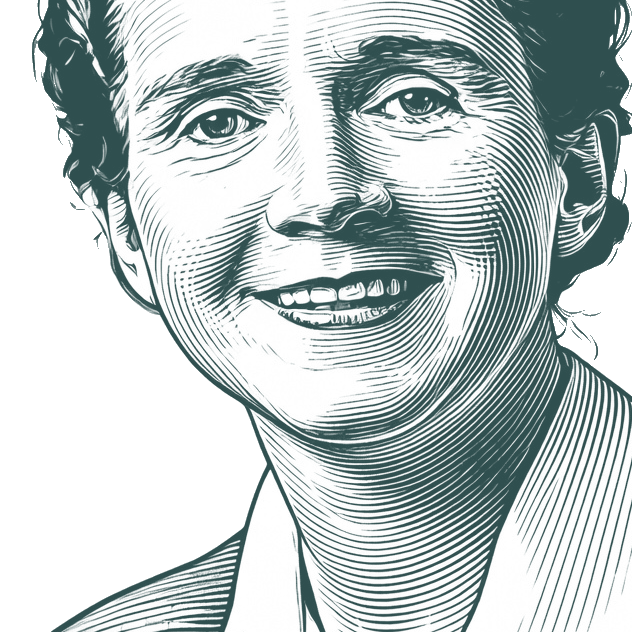
American marine biologist and conservationist (1907–1964)
Rachel Louise Carson (27 May 1907 – 14 April 1964) was an American marine biologist, writer, and conservationist whose influential book Silent Spring (1962) and other writings are credited with advancing the global environmental movement. The impact of Carson's works are still felt today as our awareness of environmental contaminants continues to grow.
Bio from: Wikiquote (CC BY-SA 4.0) · Portrait adapted from: Wikimedia Commons, U.S. Fish and Wildlife Service (Public domain / CC0)
Native Name:
Rachel Louise Carson
Alternative Names:
Rachel L. Carson
From Wikidata (CC0)
It is an era dominated by industry, in which the right to make a dollar at whatever cost is seldom challenged. When the public protests, confronted with some obvious evidence of damaging results of pesticide applications, it is fed little tranquilizing pills of half truth. We urgently need an end to these false assurances, to the sugar coating of unpalatable facts. It is the public that is being asked to assume the risks that the insect controllers calculate. The public must decide whether it wishes to continue on the present road, and it can do so only when in full possession of the facts.
It is not my contention that chemical insecticides must never be used. I do contend that we have put poisonous and biologically potent chemicals indiscriminately into the hands of persons largely or wholly ignorant of their potential for harm. We have subjected enormous numbers of people to contact with these poisons, without their consent and often without their knowledge. If the Bill of Rights contains no guarantee that a citizen shall be secure against lethal poisons distributed either by private individuals or by public officials, it is surely only because our forefathers, despite their considerable wisdom and foresight, could conceive of no such problem.
Much of the necessary knowledge is now available but we do not use it. We train ecologists in our universities and even employ them in our governmental agencies but we seldom take their advice. We allow the chemical death rain to fall as though there were no alternative, whereas in fact there are many, and our ingenuity could soon discover many more if given opportunity.
Limited Time Offer
Premium members can get their quote collection automatically imported into their Quotewise collections.
It is ironic to think that man might determine his own future by something so seemingly trivial as the choice of an insect spray. All this has been risked-for what? Future historians may well be amazed by our distorted sense of proportion. How could intelligent beings seek to control a few unwanted species by a method that contaminated the entire environment and brought the threat of disease and death even to their own kind? Yet this is precisely what we have done. We have done it, moreover, for reasons that collapse the moment we examine them. We are told that the enormous and expanding use of pesticides is necessary to maintain farm production. Yet is our real problem not one of overproduction?
The most alarming of all man's assaults upon the environment is the contamination of air, earth, rivers, and sea with dangerous and even lethal materials. This pollution is for the most part irrecoverable; the chain of evil it initiates not only in the world that must support life but in living tissues is for the most part irreversible.
The history of life on earth has been a history of interaction between living things and their surroundings. To a large extent, the physical form and the habits of the earth's vegetation and its animal life have been molded by the environment. Considering the whole span of earthly time, the opposite effect, in which life actually modifies its surroundings, has been relatively slight. Only within the moment of time represented by the present century has one species-man-acquired significant power to alter the nature of his world.
Mankind has gone very far into an artificial world of his own creation. He has sought to insulate himself, with steel and concrete, from the realities of earth and water. Perhaps he is intoxicated with his own power, as he goes farther and farther into experiments for the destruction of himself and his world. For this unhappy trend there is no single remedy-no panacea. But I believe that the more clearly we can focus our attention on the wonders and realities of the universe about us, the less taste we shall have for destruction.